
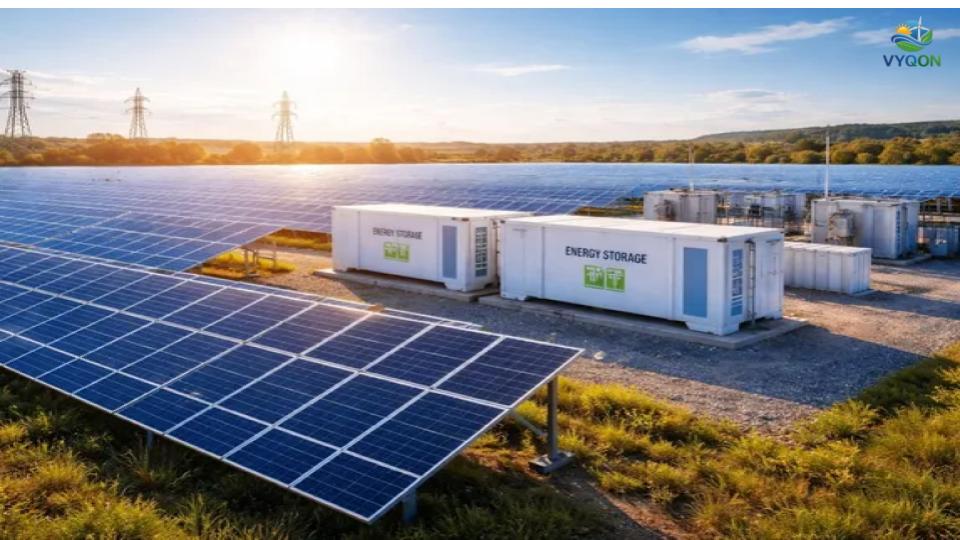
Commercial and industrial (C&I) electricity consumers in Maharashtra are increasingly evaluating battery energy storage systems (BESS) to manage peak demand and protect the value of their renewable energy investments. The shift follows a package of draft regulations released by the Maharashtra Electricity Regulatory Commission (MERC) in September 2026. These propose time-slot-based banking of renewable energy and storage requirements for new renewable installations above 100 kW.
Combined with Time-of-Day (ToD) tariffs that make evening power costlier and daytime power cheaper, these measures are reshaping the economics of captive, rooftop and open access solar for factories, commercial buildings and MSMEs across the state.
A Tariff Structure Built Around Solar Hours
The Ministry of Power’s Electricity (Rights of Consumers) Amendment Rules, 2023, notified on 14 June 2023, made ToD tariffs mandatory for C&I consumers with maximum demand above 10 kW. Peak-period tariffs for these consumers must be at least 1.20 times the normal tariff, while solar-hour tariffs must be at least 20% lower than normal.
MERC has applied this principle in its Multi-Year Tariff (MYT) framework for FY 2025-26 to FY 2029-30. Solar hours run from 09:00 to 17:00 and attract a rebate on energy charges. The evening peak runs from 17:00 to 24:00 and carries a surcharge on energy charges for industrial and commercial consumers.
MERC’s June 2025 review order also restricted the use of banked solar energy largely to the same solar-hour block. Earlier, consumers could draw banked energy across most non-peak hours of the day.
What MERC’s Draft Regulations Propose
In late September 2026, MERC released seven draft regulations and amendments to align its framework with the state’s new renewable energy and storage policy. They cover intra-state transmission connectivity, distribution open access, grid-interactive rooftop renewable energy, battery storage, forecasting and scheduling, renewable purchase obligations and the state grid code.
The draft MERC (Distribution Open Access) Regulations, 2026 and the draft MERC (Grid Interactive Rooftop Renewable Energy Generating Systems) Regulations, 2026 propose to replace in-kind banking with monetary charges. These comprise a fixed banking and standby charge in ₹/kW/month and a variable banking charge in ₹/kWh on set-off energy.
The drafts propose dividing daily banking into time slots that increase with contracted renewable capacity: four slots for 10-100 kW systems, eight for 0.1-1 MW, and up to 24 for the largest consumers. For consumers above 5 MW of contracted renewable capacity, the drafts propose capping banked energy credited in a slot at 10% of consumption in that slot. These consumers would also move to 15-minute scheduling, with banking withdrawn after three years. For ToD consumers, banked energy would first be adjusted against the slots carrying the highest energy charges.
Existing open access consumers already availing banking would get a one-time option to continue under the current rules until their agreements expire. Consumers augmenting their renewable capacity, however, would have to migrate to the new framework. The draft open access regulations retain the existing 100 kW green open access threshold, which can be met by aggregating connections in the same electricity circle.
Storage Is Now a Policy Requirement
The Government of Maharashtra notified the Maharashtra Renewable Energy and Energy Storage Policy 2025-26 to 2035-36 through a Government Resolution dated 18 March 2026. It targets renewable energy meeting 50% of electricity consumption by FY 2029-30 and 65% by FY 2035-36. The state estimates this will need around 100 GW of renewable capacity and about 100 GWh of daily storage.
The Energy Department’s FAQ on the policy states that all new renewable energy projects above 100 kW must include energy storage, applied on the basis of each connectivity. For rooftop systems above 100 kW, the MERC draft specifies a minimum of 50% of installed renewable capacity for two hours, or 25% for four hours.
Why Batteries Fit the C&I Load Profile
Many factories and commercial establishments draw significant power in the evening, when the peak surcharge applies and solar generation is unavailable. Under slot-restricted banking, surplus daytime solar that cannot be adjusted within the same slot risks lapsing or being settled at a lower value.
A battery charged from rooftop or open access solar between 09:00 and 17:00 can discharge during the 17:00-24:00 peak, offsetting the costliest grid units directly without depending on banking.
The same asset can also lower the maximum demand recorded on the meter, reducing demand charges, and provide backup that cuts diesel generator use. Combining peak shaving, tariff arbitrage, renewable self-consumption and resilience in one system, called value stacking, is central to the investment case. Battery sizing and dispatch strategy therefore matter as much as hardware cost in determining returns.
Utilities Are Building Storage Too
Through an order dated 31 December 2025, MERC approved MSEDCL’s plan to procure 2,000 MW/4,000 MWh of standalone BESS, within an estimated storage requirement of 2,750 MW by FY 2030-31. In Mumbai, Tata Power received MERC approval in April 2025 to install a 100 MW BESS for peak load management and grid resilience.
Outlook
The MERC drafts are open for public comments until 12 October 2026, with counter-submissions due by 15 October 2026, and may change before final notification. C&I consumers planning new rooftop or open access capacity should model their consumption against the proposed banking slots. Storage is best sized to evening load requirements rather than only to compliance minimums.
With ToD price signals, slot-based banking and a statewide storage mandate converging, battery storage is moving from optional backup to a core element of C&I energy strategy in Maharashtra.
Official References
- Maharashtra Electricity Regulatory Commission – Draft Regulations
- Maharashtra Electricity Regulatory Commission – Official Website (Orders and Tariff Orders)
- Energy Department, Government of Maharashtra – FAQ on Maharashtra RE & ESS Policy 2025-26 to 2035-36
- Ministry of Power – Lok Sabha Reply on Time of Day Tariff, 20 July 2023
- Tata Power – Stock Exchange Disclosure on 100 MW BESS in Mumbai, 7 April 2025
Leave a Comment