
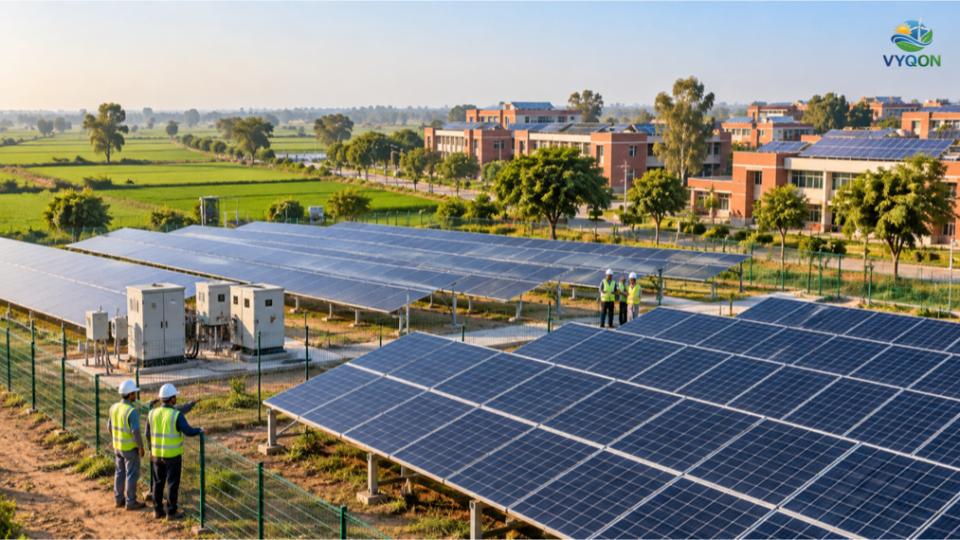
The Punjab Energy Development Agency’s latest tender targets 50 MWp of grid-connected solar installations across the state, with developer-financed deployment, net-metering or net-billing arrangements and a bid submission deadline of 29 October 2026.
The Punjab Energy Development Agency (PEDA) has invited bids for the development of approximately 50 MWp of grid-connected solar photovoltaic systems at multiple locations across Punjab under the Renewable Energy Service Company (RESCO) model.
The tender, published on 7 October 2026, includes a Payment Security Mechanism (PSM) intended to support the commercial arrangements associated with solar electricity supply.
Issued under tender reference PEDA/2026-27/18, with tender ID 2026_PEDA_176894_1, the procurement targets a tentative cumulative capacity of 50 MWp.
The official tender title refers to grid-connected rooftop solar installations, while detailed sector reporting also identifies ground-mounted systems within the proposed scope, with net-metering or net-billing facilities.
The initiative aims to encourage private-sector participation in distributed solar generation while reducing the requirement for upfront installation investment by participating host organisations.
The proposed capacity represents a procurement target rather than solar generation already installed or commissioned.
PEDA Announces 50 MWp Solar Tender Across Punjab
According to Punjab’s official e-procurement portal, the tender seeks developers to implement a cumulative 50 MWp solar portfolio at various locations across the state.
The procurement will follow the RESCO model, allowing selected developers to finance, install and operate solar power systems under applicable contractual arrangements.
The reported tender details are summarised below.
| Parameter | Details |
|---|---|
| Tendering agency | Punjab Energy Development Agency |
| Proposed capacity | 50 MWp |
| Location | Various sites across Punjab |
| Implementation model | RESCO |
| Installation type | Rooftop; ground-mounted options reported |
| Metering arrangement | Net metering / Net billing |
| Tender reference | PEDA/2026-27/18 |
| Tender ID | 2026_PEDA_176894_1 |
| Tender publication | 7 October 2026 |
| Pre-bid meeting | 15 October 2026 |
| Bid submission deadline | 29 October 2026, 5:00 PM |
| Scheduled bid opening | 3 November 2026, 10:30 AM |
The pre-bid meeting is scheduled for 15 October at 11:30 AM, with participation through online and physical arrangements at PEDA’s Chandigarh office.
Bidders should check the official portal for corrigenda, revised deadlines and final eligibility conditions.
RESCO Model Enables Developer-Financed Solar Installations
Under the Renewable Energy Service Company (RESCO) model, a solar power developer generally finances, designs, installs, owns and maintains the solar power system during the agreed contractual period.
The participating consumer or host organisation purchases electricity generated by the installation according to the applicable agreement.
Unlike a conventional capital expenditure (CAPEX) model, where the consumer directly funds the system, RESCO allows solar deployment without requiring the host to bear the full initial installation cost. The developer recovers its investment through electricity supply payments or other agreed commercial arrangements. This structure can support wider adoption of solar energy at public buildings, institutions and other eligible locations.
However, the commercial success of RESCO projects depends on electricity tariffs, generation performance, financing costs, payment reliability and long-term equipment maintenance.
Contracts must clearly define the responsibilities of developers and host organisations, including system access, operation, insurance, payment arrangements and equipment ownership.
Payment Security Mechanism Supports Commercial Viability
An important feature of PEDA’s procurement is the inclusion of a Payment Security Mechanism (PSM).
Payment security provisions are particularly relevant for developer-financed renewable energy projects because investors must recover capital expenditure over an extended operating period.
A payment security mechanism can help reduce uncertainty regarding electricity supply payments, depending on its specific contractual structure.
For developers and lenders, payment reliability directly influences project financing and risk assessment.
However, the presence of a PSM does not eliminate all commercial risks.
The actual protection available will depend on the financial instrument, payment obligations, beneficiaries and procedures specified in the final tender documents.
The detailed payment security arrangements should therefore be examined alongside the proposed power purchase agreements and other contractual provisions.
Tender Includes Financial and Eligibility Requirements
Published procurement reports describe several financial requirements for developers participating in the tender.
The minimum capacity that a bidder may apply for is reportedly 1 MWp (1,000 kWp), while the maximum is 50 MWp.
Other reported requirements include:
| Tender requirement | Reported provision |
|---|---|
| Minimum bid capacity | 1 MWp |
| Maximum bid capacity | 50 MWp |
| Tender document fee | ₹1,180 including GST |
| Earnest Money Deposit | ₹10 lakh per MW |
| Performance Bank Guarantee | ₹10 lakh per MW |
| PEDA service charge | ₹1,350/kWp plus 18% GST |
The reported non-refundable service charge covers activities such as site visits, inspections, monitoring and coordination.
These amounts may influence the financial calculations prepared by participating developers.
However, the complete official tender package should be consulted to confirm the applicable fee calculations, exemptions, guarantee conditions and payment schedules.
Rooftop and Ground-Mounted Solar Require Different Engineering Approaches
PEDA’s procurement primarily identifies rooftop solar installations, while published reports also describe ground-mounted project options.
Both configurations use photovoltaic modules to generate electricity, but their engineering requirements differ.
Rooftop solar systems are installed on existing structures and can generate electricity close to consumer loads. Before installation, engineers must assess roof strength, waterproofing, shading, module orientation, wind resistance and safe maintenance access. Ground-mounted solar systems offer greater flexibility in module positioning and layout but require suitable land, access roads, foundations and electrical infrastructure.
Ground-mounted systems may also involve additional land-use and development approvals.
Across both configurations, technical planning must consider inverter selection, cable sizing, earthing, electrical protection and distribution-network connectivity.
Site-specific studies are important because solar generation varies with weather conditions, temperature, module orientation and shading.
Net Metering and Net Billing Influence Project Economics
The tender’s reported inclusion of net-metering and net-billing arrangements makes electricity accounting an important element of project planning.
Under net metering, electricity imported from and exported to the grid is adjusted according to the applicable regulatory framework.
Under net billing, imported and exported electricity may be valued separately using the relevant retail and export tariffs.
These arrangements can produce different financial results even when solar installations have similar generating capacity.
For example, a building with substantial daytime consumption may directly use a larger proportion of its solar generation, reducing electricity purchases from the grid.
A building with lower daytime consumption may export more electricity, making the applicable export compensation particularly important.
Developers should therefore examine electricity consumption patterns, sanctioned loads, tariff categories and distribution utility requirements before finalising system capacities.
Implementation and Long-Term Performance
Developing a distributed solar portfolio across multiple locations requires coordination between developers, participating organisations and electricity distribution utilities.
Individual sites may have different structural conditions, electricity demand patterns and interconnection requirements.
Project execution generally involves site surveys, engineering, equipment procurement, construction, grid approvals, testing and commissioning.
Phased implementation can allow completed installations to begin operating while remaining sites progress through development. Long-term operation and maintenance will also influence project performance.
Solar modules, inverters and electrical systems require periodic inspection, cleaning and monitoring to maintain efficient electricity generation. Centralised monitoring platforms can help developers track energy production, identify faults and coordinate maintenance across different locations.
Important performance indicators include specific energy yield, performance ratio, inverter availability and electricity exported to the grid.
Reliable operation will be essential for meeting contractual obligations and ensuring the financial viability of RESCO installations.
Importance for Punjab’s Renewable Energy Development
The proposed 50 MWp solar portfolio represents another opportunity to expand distributed renewable electricity generation in Punjab.
Solar installations on existing buildings can support electricity consumption near the point of generation while reducing the need for additional land.
Where suitable ground-mounted locations are included, developers may also benefit from greater flexibility in system layout and equipment placement. The initiative could create opportunities for solar EPC contractors, equipment suppliers, electrical engineers and maintenance service providers.
However, actual project benefits will depend on successful tender awards, available sites, electricity supply agreements, regulatory approvals and system performance.
The next milestones will include bid evaluation, developer selection, contractual arrangements and individual project commissioning.
Conclusion
PEDA’s tender for approximately 50 MWp of grid-connected solar capacity marks a further step in Punjab’s efforts to encourage distributed renewable energy deployment. The RESCO model, supported by a proposed Payment Security Mechanism, aims to facilitate developer-financed solar installations while addressing long-term commercial considerations. With bids scheduled to close on 29 October 2026, the programme presents an opportunity for solar developers to participate in a statewide renewable energy portfolio. However, the 50 MWp figure remains a tentative procurement target rather than commissioned generation capacity. Successful implementation will depend on appropriate site selection, competitive financing, compliant grid connectivity and dependable long-term solar electricity generation. The initiative highlights the potential of structured RESCO procurement to expand renewable energy adoption across Punjab.
Reference:
Government of Punjab – Official e-Procurement Tender Listing
Tender ID: 2026_PEDA_176894_1
Reference Number: PEDA/2026-27/18
Leave a Comment