
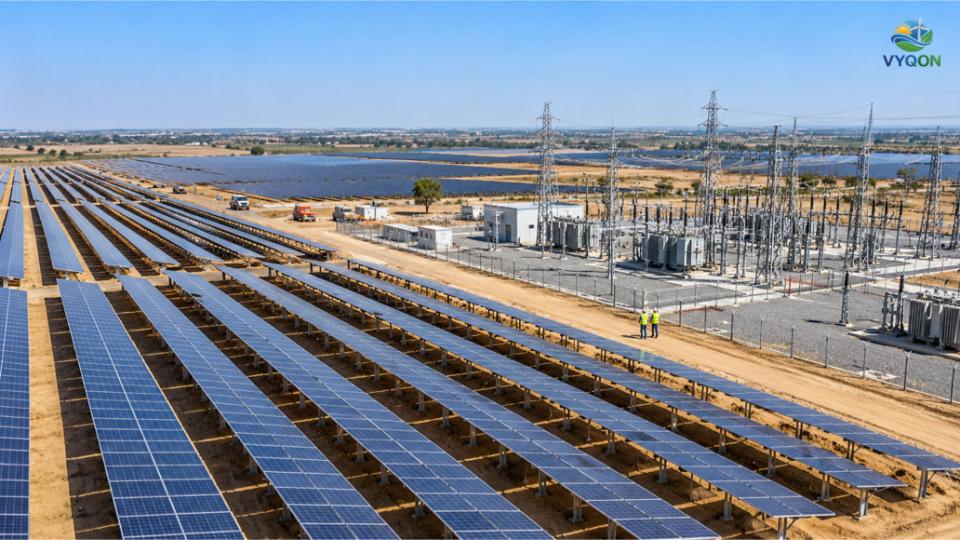
The C&I-1 tender aims to develop 700 MW of solar capacity in qualifying Special Economic Zones and Export Oriented Unit areas, supported by a 25-year power purchase arrangement for an industrial consumer in Odisha.
The Solar Energy Corporation of India Limited (SECI) has invited bids for the development of 700 MW of Inter-State Transmission System (ISTS)-connected solar photovoltaic projects under its Commercial and Industrial (C&I-1) procurement initiative.
The tender, originally issued on 3 September 2026, seeks solar power developers to establish projects in Special Economic Zones (SEZs) or areas designated as Export Oriented Units (EOUs). Electricity generated from these projects will be procured by SECI and supplied to an industrial consumer located in Odisha through long-term contractual arrangements.
SECI issued a stakeholder meeting notification on 6 October 2026, scheduling discussions for 8 October ahead of the bidding deadlines. Online bid submission is scheduled to close on 15 October 2026 at 6:00 PM, followed by offline document submission on 19 October and bid opening on 21 October.
The initiative represents an important development in India’s commercial and industrial renewable energy market, linking utility-scale solar generation with long-term industrial electricity requirements.
SECI’s 700 MW Solar Procurement Under C&I-1
The procurement will follow a tariff-based competitive bidding process, including an electronic reverse auction to determine competitive electricity tariffs.
Under the Build-Own-Operate (BOO) model, selected developers will be responsible for financing, constructing, owning and operating their solar power projects.
SECI will act as an intermediary procurer, purchasing electricity from successful developers under Power Purchase Agreements (PPAs) and selling it to the designated industrial consumer through corresponding Power Sale Agreements (PSAs).
The proposed PPA duration is 25 years, providing a long-term commercial framework for electricity supply and project investment.
The Request for Selection does not publicly identify the final industrial buying entity, although it confirms that the intended consumer is located in Odisha. Importantly, the solar generating projects themselves are not required to be physically located in Odisha.
Developers may establish their projects at qualifying locations elsewhere in India, provided they satisfy SECI’s site eligibility, grid connectivity and regulatory requirements.
The tender permits individual bids ranging from 50 MW to 700 MW, in multiples of 10 MW. It also specifies an earnest money deposit of ₹8 lakh per MW and a performance bank guarantee of ₹20 lakh per MW.
These financial requirements form part of SECI’s framework for selecting developers capable of implementing large-scale renewable energy projects.
SEZ and EOU Framework Offers Potential ALMM Exemption
One of the most distinctive features of the tender is its requirement for solar projects to be established within qualifying SEZs or EOU-designated areas.
According to the official Request for Selection, this project structure is intended to enable developers to avail applicable exemptions from the Approved List of Models and Manufacturers (ALMM) requirements.
The provision refers to MNRE Circular No. 1/74/2023-NT, dated 27 May 2024, as subsequently amended.
ALMM regulations establish eligibility requirements for solar photovoltaic modules and cells used in specified categories of Indian solar projects. By using a qualifying SEZ or EOU structure, developers may be able to access the exemptions available under the applicable regulatory framework.
However, eligibility for these exemptions is not automatic. Developers must comply with the relevant requirements and obtain the necessary permissions and registrations.
The provision may influence equipment procurement and project economics, particularly where developers are evaluating photovoltaic module suppliers, solar cell technologies and overall construction costs.
At the same time, project developers must consider site availability, land rights, environmental permissions and electricity evacuation arrangements before selecting locations.
Long-Term Power Supply and Commercial Arrangements
The proposed 25-year power purchase structure is intended to create a stable commercial arrangement between developers, SECI and the industrial electricity buyer.
Long-term electricity supply agreements can support project financing by establishing a contracted source of revenue over an extended operating period.
However, the financial viability of the selected projects will depend on several factors, including the discovered tariff, financing costs, solar generation performance, payment security and transmission-related expenses.
The intermediary procurement model introduces separate contractual responsibilities for developers and the industrial buyer.
Developers must satisfy generation, scheduling and delivery requirements under their PPAs, while the buying entity must fulfil its obligations under the corresponding PSA.
SECI’s participation provides a structured procurement mechanism but does not mean the corporation will directly finance or own the generating assets.
The tender specifies that the scheduled commencement of electricity supply is 24 months from the effective date of the PPA, subject to the detailed contractual provisions.
Developers must complete construction, grid connectivity, testing and commissioning within the applicable implementation schedule.
Grid Connectivity and Engineering Requirements
The projects will connect to India’s Inter-State Transmission System, allowing solar electricity to be transferred through the national transmission network.
SECI’s tender requires connectivity at a minimum voltage level of 220 kV, reflecting the utility-scale nature of the proposed installations.
Project implementation will involve photovoltaic modules, inverters, transformers, electrical collection systems, protection equipment and power evacuation infrastructure.
Developers must also secure suitable land and obtain relevant technical and regulatory approvals.
Grid-interconnection studies are particularly important because solar plants must comply with requirements relating to voltage regulation, reactive power, metering, electrical protection and system stability.
Successful commissioning depends on the readiness of both generation equipment and transmission infrastructure. Even a completed solar plant may be unable to export electricity if the required grid connection is unavailable.
The projects will also require accurate generation forecasting and scheduling, as solar electricity output varies with irradiation, temperature and seasonal weather conditions.
The proposed 700 MW represents procurement capacity, not electricity already being generated or a guarantee of annual energy production.
Supporting Industrial Renewable Energy Procurement
India’s commercial and industrial electricity market is increasingly exploring renewable energy procurement to manage energy costs and support corporate sustainability objectives.
Long-term solar PPAs can provide industrial consumers with a structured electricity supply arrangement while reducing exposure to certain conventional electricity procurement costs.
For export-oriented manufacturers, renewable electricity procurement may also support efforts to address electricity-related emissions within their production operations.
However, environmental claims must be supported by appropriate electricity accounting, contractual attributes and applicable reporting standards.
SECI’s C&I-1 tender demonstrates how utility-scale renewable energy development can be connected with specialised industrial demand through a competitive procurement framework.
Its SEZ/EOU requirements and proposed ALMM exemption arrangements distinguish it from conventional solar tenders serving distribution utilities.
The effectiveness of this structure will depend on competitive tariffs, commercially viable project locations, regulatory compliance and reliable electricity delivery.
Outlook and Conclusion
With bid submission scheduled for October 2026, the next important milestones will include developer selection, tariff discovery, execution of power purchase agreements and financial closure.
Successful developers will then proceed with land arrangements, grid-connectivity approvals, equipment procurement, construction and commissioning.
SECI’s 700 MW C&I-1 solar tender represents an initiative to expand renewable electricity procurement for industrial consumers through long-term commercial arrangements.
By combining ISTS-connected solar generation, SEZ/EOU eligibility and a 25-year PPA structure, the procurement creates opportunities for renewable energy developers while supporting India’s industrial energy transition.
However, the proposed 700 MW remains a tendered capacity rather than an operational solar portfolio. Its eventual contribution will depend on successful project execution, commercially sustainable agreements and dependable electricity supply to the intended industrial consumer.
Reference:
SECI – Official Tender Notice — Tender details, deadlines and associated documents.
SECI – Official Request for Selection (PDF) — Complete 128-page tender document covering eligibility, project requirements, ALMM provisions and commercial conditions.
Tender Reference: SECI/C&P/IPP/15/0009/26-27
Tender ID: SECI000278
Leave a Comment