
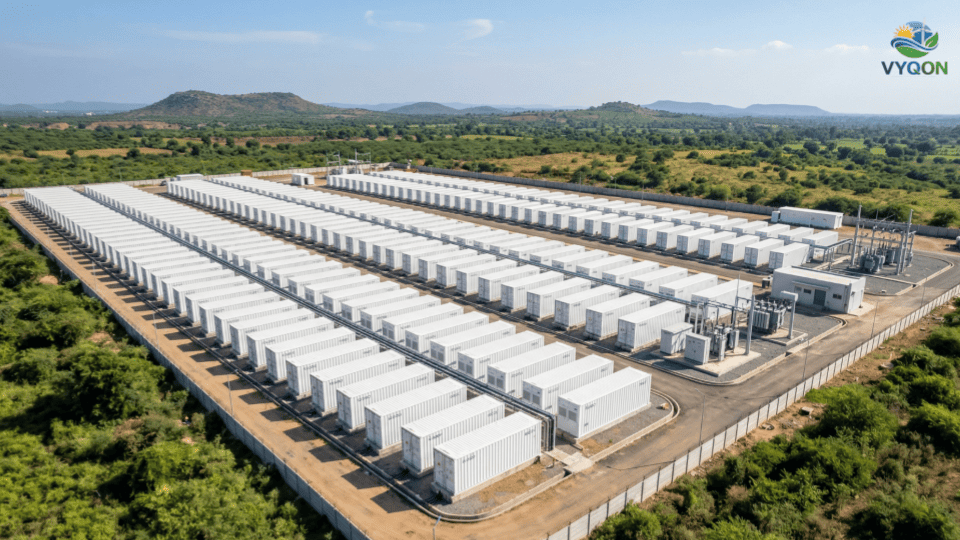
The Telangana Power Generation Corporation Limited (TGGENCO) has officially invited proposals for the selection of Battery Energy Storage System Developers (BESSDs) to establish a 250 MW / 500 MWh standalone pilot project in the state. Issued under a tariff-based global competitive bidding framework, this initiative is supported by Viability Gap Funding (VGF) and follows the “Build, Own, and Operate” (BOO) model. The project is designed to provide “On-Demand” storage capacity to State DISCOMs, enabling them to manage peak-load requirements and integrate a higher share of variable renewable energy into the grid.
Proposed Project Locations and Connectivity Requirements
Developers selected through this tender will be responsible for setting up projects in the vicinity of designated State Transmission Utility (STU) substations. Land for these installations will be provided by TGGENCO on a sub-lease or right-to-use basis with zero lease charges.
Proposed Project Locations and Connectivity Requirements
| Infrastructure Category | Requirement Details |
| Primary Substations | Locations as identified in Annexure-E, including the 400 kV Shankarpally Substation. |
| Grid Connectivity | Minimum interconnection voltage of 400 kV at the STU network. |
Note: While land is provided at zero cost, BESSDs are responsible for the cost of additional bay construction (e.g., at Shankarpally) and all transmission infrastructure up to the interconnection point.
Financial Structure and VGF Support Mechanism
The economic framework of the tender focuses on a capacity-based bidding process where the primary parameter is the monthly capacity charge (INR/MW/Month). Key financial components include:
- Viability Gap Funding (VGF): Eligible projects will receive central financial assistance capped at ₹27 lakh per MWh or 30% of the total capital cost, whichever is lower.
- Success Charges: Selected bidders must pay ₹1 lakh per MW (plus GST) to TGGENCO for administrative and monitoring overheads.
- VGF Disbursement Schedule: Funding will be released in five tranches: 10% upon Financial Closure; 45% at the Commercial Operation Date (COD); and three annual installments of 15% each during years 1-3 post-COD.
- Payment Security: BESSDs are required to furnish a non-refundable Payment Security Deposit of ₹5 lakh per MWh prior to the commissioning of the first part capacity.
Technical Specifications and Implementation Timeline
TGGENCO has mandated a technology-agnostic approach, allowing for various battery chemistries (such as Lithium-ion, Flow, or Solid-state) provided they meet rigorous safety and performance standards.
- Discharge Duration: The system must be capable of a minimum 2-hour discharge duration (250 MW x 2 hours).
- Agreement Term: The Battery Energy Storage Purchase Agreement (BESPA) remains valid for 12 years from the date of full commissioning.
- Commissioning Window: The Scheduled Commissioning Date (SCD) is set at 18 months from the Effective Date of the BESPA.
- Operational Cycle: The system must support two complete charge-discharge cycles per day.
Stringent Operational and Performance Mandates
To ensure grid reliability, developers must adhere to strict annual availability and efficiency benchmarks.
Performance Standards: BESSDs are required to guarantee a minimum annual system availability of 95%. Furthermore, the system must maintain a minimum AC-to-AC Round-Trip Efficiency (RtE) of 85% on a monthly basis. To account for technical aging, the project must adhere to a strict capacity degradation schedule, starting at 97.5% of nameplate capacity at the end of Year 1 and maintaining at least 70% by the end of the 12-year contract term.
Project Objectives and Grid Integration
The primary objective of the 250 MW / 500 MWh pilot project is to enhance the resource adequacy of Telangana’s energy grid. By utilizing these systems on an “on-demand” basis, State DISCOMs can effectively bridge the gap between supply and demand during peak hours.
All projects must be designed for interconnection with the State Transmission Network at the 400 kV level. While the BESSD is responsible for the transmission system up to the delivery point, TGDISCOMs will be responsible for providing the power required for charging the systems, factoring in the guaranteed Round-Trip Efficiency. Under the BOO model, developers maintain ownership of the assets throughout the 12-year term, contributing to the state’s broader target of integrating large-scale non-fossil energy by 2030.
Leave a Comment