
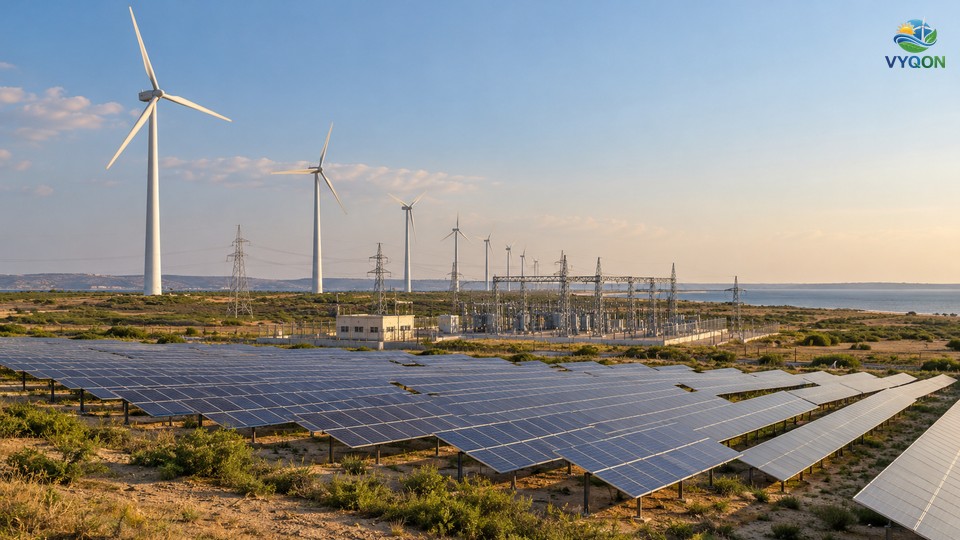
The Central Electricity Regulatory Commission (CERC) has allowed a waiver of inter-state transmission system (ISTS) charges for only 174.9 MW of Mounting Renewable Power Limited’s 250 MW wind-solar hybrid project at Jamnagar, Gujarat, because that was the capacity that reached commercial operation by 30 June 2026. In an order dated 26 October 2026 in Petition No. 779/MP/2025, along with applications 103/IA/2025 and 108/IA/2026, the Commission extended the project’s scheduled commercial operation date (SCOD) to 30 June 2026 and limited the waiver to the capacity that met that date.
The petitioners are Mounting Renewable Power Limited (MRPL), Welspun Living Limited and Welspun Corp Limited. The respondents are the Central Transmission Utility of India Limited (CTUIL) and Power Grid Corporation of India Limited.
The project
MRPL is setting up a 250 MW (AC) project at Jamnagar, which the Committee report cited in the order describes as 161.7 MW of wind and 88.3 MW of solar capacity. Power is to be evacuated at the Jam Khambhaliya pooling station at 220 kV through a single-circuit line. CTUIL issued the intimation for final grant of 250 MW connectivity on 6 November 2024.
What the petitioners asked for
Under Regulation 13(2)(h) read with Regulation 13(2)(a) of the CERC (Sharing of Inter-State Transmission Charges and Losses) Regulations, 2020, the petitioners sought a 12-month extension on account of force majeure and a 100 per cent waiver of ISTS charges, provided the project was commissioned by 30 June 2026. They also asked the Commission to adopt the Committee report dated 19 June 2026.
The petitioners cited right-of-way litigation over the dedicated transmission line at Gowana and Dharampur villages, delays in state permissions and government land allotment for the solar project, floods, cyclone Biparjoy, and policy changes that unsettled the solar equipment market.
The Committee, set up by the Commission to recommend extensions, recommended on 19 June 2026 that the SCOD be extended from 30 June 2025 to 30 June 2026. The Commission noted that this was the second and maximum six-month extension the regulation allows. The petition was admitted on 7 July 2026.
What the rule says
Regulation 13(2)(h) covers wind, solar and hybrid stations, and battery storage, that are eligible for the waiver and have a SCOD on or before 30 June 2025. If they are delayed by force majeure, including non-availability of the transmission system or reasons not attributable to the generator, they can be given extra time. A project that achieves commercial operation by the extended date is treated as if it had done so on 30 June 2025. Extensions cannot exceed six months at a time or be granted more than twice.
What was commissioned
In an affidavit dated 17 July 2026, MRPL said it had completed trial runs and achieved commercial operation for a cumulative 174.9 MW as on 30 June 2026, made up of 115.5 MW of wind and 59.4 MW of solar:
- 125.4 MW (92.4 MW wind from 28 turbines of 3.3 MW each, plus 33 MW solar), trial runs completed on 15 and 16 June 2026
- 33 MW (6.6 MW wind from two turbines, plus 26.4 MW solar), completed on 29 June 2026
- 16.5 MW wind from five turbines, completed on 30 June 2026
The remaining 75 MW is at an advanced stage and is expected in phases from the last week of July 2026 to the end of August 2026.
CTUIL’s affidavit
Citing the 52nd Joint Coordination Committee meeting for generation projects in the Western Region, held on 18 and 19 June 2026, CTUIL told the Commission that two transmission works must be completed for the GNA to become effective. Part A, a network expansion scheme in Gujarat for drawing about 3.6 GW of load under Phase-I in the Jamnagar area, is being built by AESL through tariff-based competitive bidding and is scheduled for 30 September 2027. Part B, augmentation of transformation capacity at Jam Khambhaliya, is being built by POWERGRID through the same route and is scheduled for 30 April 2027. CTUIL put the likely GNA operationalisation date for the project at 30 September 2027.
The Commission’s decision
The Commission accepted the Committee’s finding that the delay was not attributable to the petitioners. It allowed the extension of the SCOD to 30 June 2026 and the waiver of ISTS charges, as if the capacity had achieved commercial operation on 30 June 2025, strictly under Regulation 13(2)(h) and only for the capacity that actually did so by 30 June 2026. It directed the National Load Despatch Centre (NLDC) to verify the commercial operation certificates for that capacity. The petition and both applications were disposed of.
What it means for India’s clean-energy sector
The order shows how strictly the ISTS waiver cut-off is applied. The relief was real, but tied to megawatts proven operational on the final date, not to the project as a whole. The remaining 75 MW, expected after the deadline, is not covered by this order.
It also shows how transmission readiness shapes renewable economics around Jamnagar. Even with 174.9 MW declared commissioned, the likely GNA operationalisation date for the project is 30 September 2027, because the downstream network expansion is still under construction. Developers and bulk consumers need to line up generation, dedicated lines and the central grid on the same timeline.
Official references
- CERC order dated 26 October 2026 in Petition No. 779/MP/2025 along with 103/IA/2025 and 108/IA/2026: https://cercind.gov.in/2026/Orders/779-MP-2025-Ors.pdf
Leave a Comment