
Tata Power Company Limited reported its highest-ever quarterly profit for the July-September quarter of FY27. The Tata Power Q2 FY27 profit after tax (PAT) was Rs 1,652 crore, up 33% from the same quarter last year, on consolidated revenue of Rs 19,886 crore, up 26%. The company shared the numbers in a press release filed with BSE and NSE on 11 November 2026, covering the quarter and half year ended 30 September 2026.
Tata Power Q2 FY27 profit and revenue: the numbers
The release gives consolidated figures for the quarter (Q2) and the first half (H1) of FY27, with last year’s comparison:
- Q2 FY27 revenue: Rs 19,886 crore, against Rs 15,769 crore a year earlier (up 26%).
- Q2 FY27 EBITDA: Rs 4,245 crore, against Rs 4,032 crore (up 5%).
- Q2 FY27 reported PAT: Rs 1,652 crore, against Rs 1,245 crore (up 33%).
- H1 FY27 revenue: Rs 38,784 crore, against Rs 33,233 crore (up 17%).
- H1 FY27 EBITDA: Rs 8,494 crore, against Rs 7,961 crore (up 7%).
- H1 FY27 reported PAT: Rs 3,053 crore, against Rs 2,508 crore (up 22%).
PAT before exceptional items was Rs 1,521 crore in Q2, up 22%, and Rs 2,922 crore in H1, up 17%. The company said the profit came from all business clusters, and that regulated and long-term contracted businesses account for a growing share of EBITDA, which gives more predictable cash flows.
Tata Power’s CEO and Managing Director, Dr Praveer Sinha, said the company delivered its highest-ever quarterly profit with contributions from all businesses. He added that regulated and contracted businesses provide resilient cash flows, while renewables, rooftop solar, storage and customer-facing solutions add growth momentum.
Capital spending of about Rs 10,000 crore in H1
Tata Power invested about Rs 10,000 crore in H1 FY27, which it describes as its highest half-yearly capital deployment. Renewables took about Rs 6,000 crore of this. The company says the spending covers renewable energy, transmission, pumped storage and distribution networks, and that it is on track to meet its annual capex guidance.
Renewables: capacity, manufacturing and rooftop solar
The company installed 765 MW of clean and green generation capacity in H1 FY27, taking total installed clean and green capacity to 8.6 GW. It added 1.4 GW of renewable capacity over the last twelve months.
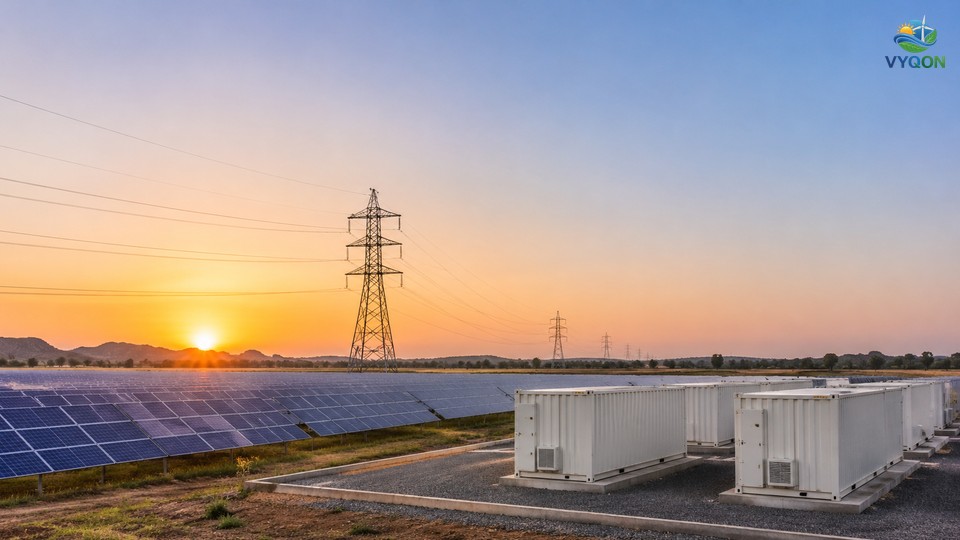
Utility-scale renewable capacity, including solar and wind, rose to 7.2 GW. In H1 the company installed 645 MW of utility-scale projects and 101.2 MWh of storage. Projects under construction and in the pipeline stand at 4.9 GW, along with 696 MWh of battery energy storage (BESS).
In solar manufacturing, the plant produced 0.9 GW of solar cells and 1 GW of solar modules in Q2, which brings the H1 totals to 1.8 GW of cells and 2.0 GW of modules. The company reports a module yield of 97%, which it calls industry-leading, and says a better sales mix helped profitability.
In rooftop solar, Tata Power installed 426 MWp in the quarter. Cumulative rooftop installations stand at 5.12 GWp (over 5.1 GWp). Tata Power also reported that it has executed a 60 MWh BESS project in Mumbai; VYQON has separately covered the Tata Power Mumbai BESS.
Pumped storage and thermal generation
Construction of the 600 MW Khorlochhu hydropower project, in which Tata Power holds a 40% stake, and the 1,000 MW Bhivpuri pumped storage project is on track. The company received a Letter of Award from SECI for 324 MW of power supply from Bhivpuri. The release also notes that the Board has approved the capital commitment for the Shirwata pumped storage project; VYQON’s report on the Shirwata pumped storage approval has the details of that decision.
In conventional generation, plant availability was about 90%. The Mundra plant operated at 89% availability in Q2 under the extended Section 11 directive and continues to run at full capacity under it until the end of December.
Transmission and distribution
The transmission portfolio under operation reached 7,894 circuit kilometres. The 164 ckt km Khurja-Jalpura 400 kV line and its GIS substation are fully commissioned.
In distribution, smart meter installations across its discoms passed 60 lakh. In Odisha, AT&C losses fell to 21.0%, an improvement of 5.7% over Q1 FY27.
What it means for India’s clean-energy sector
Tata Power’s numbers show how an integrated utility is spreading its growth across generation, renewables, grid and consumer businesses. The company points to rising electricity demand in H1, linked to industrial activity, agriculture, household use, EV adoption and data centres, with heatwaves and a delayed monsoon adding to cooling demand.
For clean energy, three trends stand out. Solar manufacturing is now producing cells and modules at scale in India. Storage is moving from pilots into projects, from the 60 MWh Mumbai system to pumped hydro. Rooftop solar continues to grow through channel partners and consumer financing.
The release carries a forward-looking statement disclaimer, so plans on capacity, capex and project timelines depend on execution, regulation and market conditions.
Official references
1. The Tata Power Company Limited, Press Release on results for the quarter and half year ended 30 September 2026, filed with BSE (scrip code 500400) and NSE, 11 November 2026: https://www.bseindia.com/xml-data/corpfiling/AttachLive/7a4ac249-057f-4abc-b701-cabc9e2370c8.pdf
Leave a Comment