
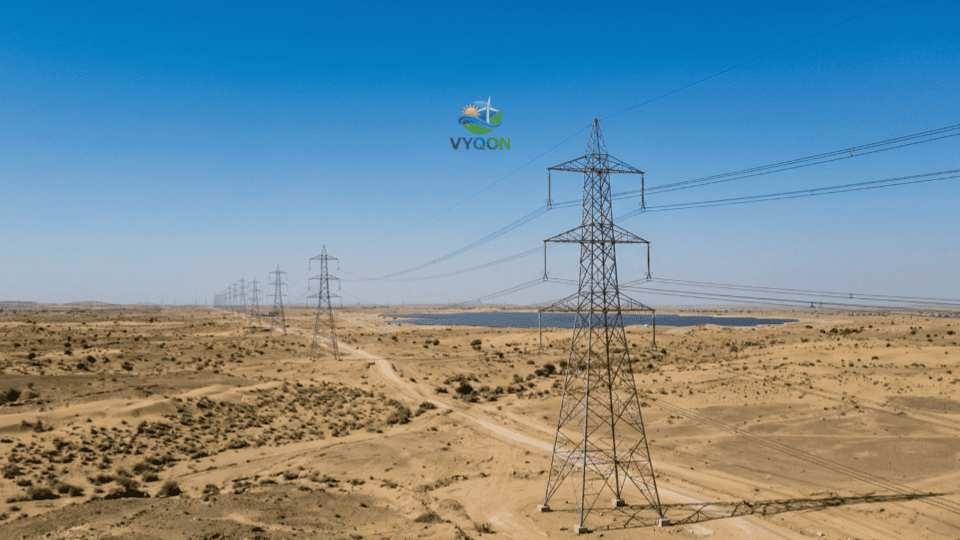
REC Power Development and Consultancy Limited (RECPDCL) has formally launched the bidding process to select a Transmission Service Provider (TSP) for one of the most significant links in India’s evolving green energy corridor. The Ministry of Power’s August 29, 2025, notification (No. 3860 [F No. 15/03/2018-Trans-Part(4)]) set the stage for this massive procurement effort, which aims to establish an Inter-State Transmission System (ISTS) for the evacuation of 6 GW of solar power from the Rajasthan Renewable Energy Zone (REZ) Phase-IV (Part-5) Barmer Complex.
The project is a critical component of the government’s strategy to integrate 75 GW of renewable capacity from Rajasthan. The scheme reached this tender stage following rigorous technical deliberations, having been cleared during the 36th CMETS-NR and 35th CMETS-WR meetings in early 2025, with final endorsement from the 30th National Committee on Transmission (NCT) in May 2025.
Project Scope and Engineering Sophistication
The project will be developed under the Build, Own, Operate, and Transfer (BOOT) model. At its core, the infrastructure centers on a ±800 kV High Voltage Direct Current (HVDC) Bipole link connecting the Barmer-II terminal in Rajasthan to the South Kalamb terminal in Maharashtra.
Departing from the more common Voltage Source Converter (VSC) technology, this project specifically mandates a Line Commutated Converter (LCC) configuration for the 6,000 MW capacity terminals. The transmission line itself will utilize high-performance “Hexa lapwing” conductors featuring a parallel Dedicated Metallic Return (DMR) and 100% reverse power capability.
To ensure grid stability during the injection of massive solar loads, the technical scope includes several sophisticated dynamic support systems:
- Synchronous Condensers (Syncons): Two units at the 400 kV level of the Barmer-II station. Each unit is required to provide a minimum dynamic support of +300 MVAr/-200 MVAr and a critical short circuit contribution at the Point of Common Coupling (PCC) of at least 1200 MVA.
- Terminal Infrastructure: The establishment of two 3,000 MW Bipole terminal stations at both the Barmer and South Kalamb ends.
- Barmer-II Pooling Station: A 400/220 kV Air Insulated Substation (AIS) featuring 6×500 MVA Interconnecting Transformers (ICTs).
- South Kalamb Augmentation: A complex expansion involving 4×1500 MVA, 765/400 kV ICTs. Critically, these are distributed to align with the station’s sectionalization: 1 No. on Section-I and 3 Nos. on Section-II. The HVDC Bipole-I will terminate on Section-I, while Bipole-II terminates on Section-II. Operational logic dictates that the 765 kV bus sectionalizer remains normally closed, while the 400 kV bus sectionalizer is kept normally open.
- Auxiliary Power: To maintain terminal reliability, the TSP must install dedicated 400/33 kV, 2×50 MVA transformers exclusively for HVDC auxiliary power.
Bidding Ecosystem and Framework
The procurement is governed by the Tariff-Based Competitive Bidding (TBCB) framework under Section 63 of The Electricity Act, 2003. RECPDCL, acting as the Bid Process Coordinator (BPC), is utilizing the MSTC Limited electronic platform for a single-stage, two-envelope process.
Key administrative milestones and financial requirements include:
- RFP Document Fee: Rs. 5,00,000 or US$ 7,000 (plus 18% GST).
- RFP Purchase Window: January 28, 2026, to March 30, 2026.
- Acquisition Price Disclosure: The BPC will intimate the finalized acquisition price for the project SPV twenty (20) days prior to the Bid Deadline.
- Bid Deadline: April 1, 2026, at 1600 hours (IST).
- Technical Bid Opening: April 1, 2026, at 1630 hours (IST).
Following technical qualification, eligible bidders will enter an electronic reverse auction. The objective is to discover the lowest “Final Offer” for Quoted Transmission Charges, which will be adopted by the Central Electricity Regulatory Commission (CERC).
Eligibility and Financial Security
Prospective bidders must demonstrate robust financial and technical capacity to handle a project of this scale. A mandatory Bid Bond of Rupees Two Hundred Eighty-Six Crore Forty Lakhs (Rs. 286.40 Crore) must be submitted. This security can be provided via Bank Guarantee, Insurance Surety Bond, or a Payment on Order Instrument from IREDA, REC, or PFC.
Development Timeline and Asset Transfer
The successful bidder will acquire 100% equity in the Special Purpose Vehicle, “Barmer HVDC Power Transmission Limited.” The project follows a phased implementation timeline from the effective date:
- Bipole-1: 48 months to completion.
- Bipole-2 / Project SCOD: 54 months to completion.
Under the BOOT framework, the TSP will operate the assets for a period of 35 years from the Commercial Operation Date (COD). A critical legal requirement for bidders is the terminal asset transfer: the TSP must transfer all project assets—including land, rights of way, and clearances—to the Central Transmission Utility (CTU) at zero cost. This transfer must be completed within a strict 90-day window following the expiry of the 35-year term. Failure to comply allows the CTU to take over the assets suo moto.
Leave a Comment