
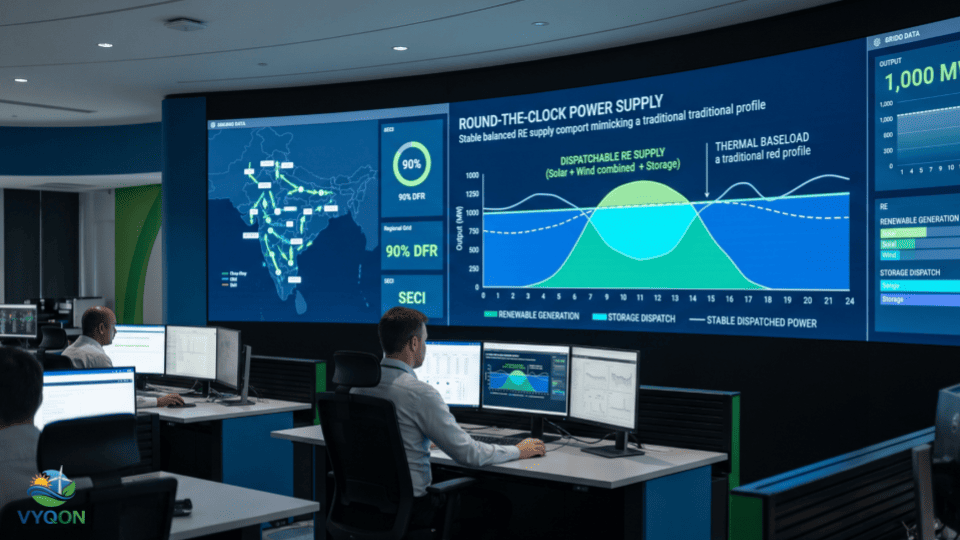
On March 10, 2026, the Solar Energy Corporation of India (SECI) officially issued a Request for Selection (RfS) for the SECI-RTC-TM-V tender. This initiative seeks to procure 1,000 MW of renewable power on a Round-the-Clock (RTC) basis, with a primary mandate to provide firm and dispatchable electricity to distribution companies (DISCOMs). Developers interested in participating in this procurement must adhere to a bid submission deadline of May 6, 2026.
The ‘Thermal Mimic’ Concept
The “Thermal Mimic” (RTC-TM) procurement model represents a strategic evolution from “plain vanilla” renewable energy (RE) tenders toward a demand-centric supply framework. This model addresses the inherent intermittency of solar and wind by utilizing “reverse bundling”—a principle that integrates cheaper renewable sources with either existing idle thermal capacity or Energy Storage Systems (ESS).
By allowing developers to act as firm power suppliers, the RTC-TM model replicates the steady, reliable output typically associated with base-load thermal plants. This approach is particularly critical as DISCOMs shift away from high-cost, non-sustainable new thermal capacity, which currently faces rising commodity prices and stranded asset risks, in favor of firming-up RE-integrated power to ensure grid stability.
Technical Requirements and the Role of ESS
To ensure that renewable projects can match the reliability of conventional generation, SECI has established stringent performance metrics and technology-agnostic requirements:
- Demand Fulfillment Ratio (DFR): Developers are mandated to maintain a fulfillment ratio of 90% during peak demand hours and 80% during off-peak hours. On an annual basis, the project must maintain an average fulfillment ratio of at least 90%. Per the RfS guidelines, some seasonal flexibility may be applied to these ratios to account for resource variability.
- Energy Storage Systems (ESS): The inclusion of ESS is mandatory to ensure dispatchability. While the tender allows any storage technology (battery, mechanical, or pumped hydro), the guidelines provide a unique flexibility: developers are permitted to resize the ESS capacity for up to three years after the project’s commissioning date.
- Grid Connectivity: Projects must connect to the Inter-State Transmission System (ISTS) at a minimum voltage level of 220 kV. To optimize infrastructure, different project components—including solar, wind, and storage—may be connected at multiple injection points on the ISTS network.
Bidding and Project Specifications
The tender utilizes a Build-Own-Operate (BOO) structure, where successful bidders are responsible for land acquisition, grid connectivity, and the development of all necessary transmission infrastructure to the delivery point. The procurement process follows a single-stage, two-envelope system, which is then followed by an electronic reverse auction to discover the final tariffs.
- Capacity Limits: Bidders must propose a minimum capacity of 100 MW and a maximum of 500 MW.
- PPA Structure: SECI will sign long-term Power Purchase Agreements (PPAs) with developers for a 25-year term, selling the power to buying entities on a back-to-back basis.
- Commissioning Timeline: Projects must reach financial closure no later than six months before the scheduled commencement of supply. The full commissioning timeline is set at 18 months from the effective date of the PPA.
Financial Criteria for Developers
The tender outlines specific financial obligations for participating developers, including a Success Charge of Rs. 1,00,000 per MW plus GST, which is applied to the total installed project capacity.
| Fee Category | Specification |
| Document Fee | Rs. 50,000 + GST |
| Bid Processing Fee | Rs. 20,000 per MW (Capped at Rs. 20,00,000 + GST) |
Security Deposit Formulas
The Earnest Money Deposit (EMD) and Performance Bank Guarantee (PBG) are calculated using formulas that account for the specific technology mix of the project. In these formulas, S represents the rated cumulative installed capacity of the Solar component (MW), W represents the Wind or other RE component (MW), and E represents the rated cumulative capacity of the ESS component (MWh):
- EMD Formula: Rs. [9,54,000 * S + 13,32,000 * W + 2,35,450 * E]
- PBG Formula: Rs. [23,85,000 * S + 33,30,000 * W + 5,88,625 * E]
Leave a Comment