
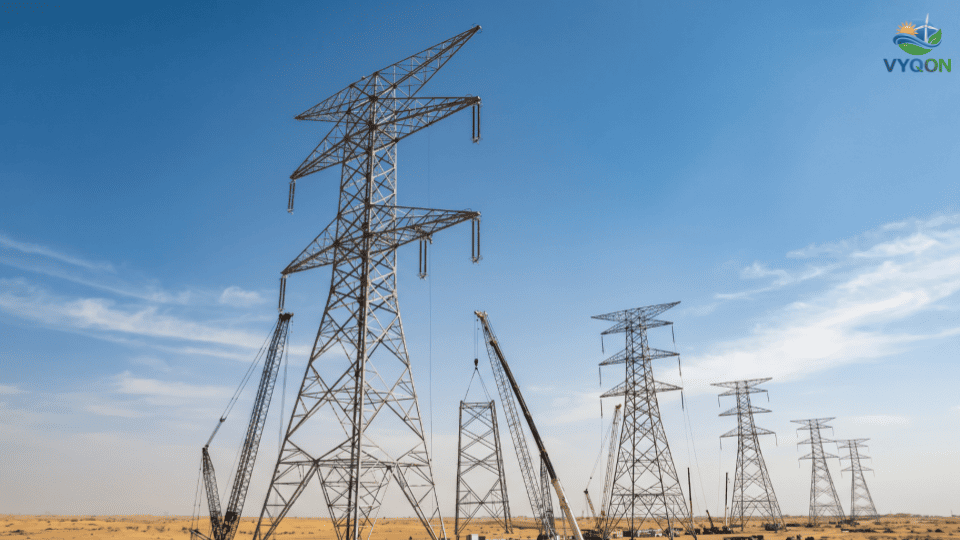
Executive Lead: 6 GW Evacuation Infrastructure Tenders
Power Grid Corporation of India Ltd (POWERGRID) has officially invited bids for the establishment of a massive transmission system to evacuate 6 GW of solar power from the Rajasthan Renewable Energy Zone (REZ) Phase IV (Part 5), specifically targeting the Barmer Complex. This high-capacity link will anchor the Barmer Solar Complex, bridging the Barmer-II HVDC terminal in Rajasthan to the South Kalamb HVDC terminal in Maharashtra. Although the terminal points are located in Rajasthan and Maharashtra, the actual construction work will transit extensively through Gujarat to complete the interstate connection. The project is being executed under the Tariff-Based Competitive Bidding (TBCB) modality.
Project Context: PGCIL Dominance in Rajasthan REZ Phase-IV
PGCIL continues to solidify its dominance in the transmission landscape for the Rajasthan REZ Phase-IV (Part 2: 5.5 GW) scheme. This specific phase was originally segmented into seven TBCB components, with PGCIL securing the lion’s share of the infrastructure:
- PGCIL Portfolio: The utility has officially won four components (Part B, Part C, Part D, and Part E). Additionally, PGCIL has been declared the successful bidder for Part H1. Insightfully, Part H1 is geographically located in Madhya Pradesh following a project scope revision that integrated Western Region development schemes into this project.
- Active Bids: PGCIL remains in the fray for Part F (a single component formed by clubbing the originally separate F1 and F2 packages).
- Other Developers: Apraava Energy secured Part A, while India Grid Trust (IndiGrid) was allotted Part H2, a minor project under the Regulated Tariff Mechanism (RTM).
- Environmental Hold: Part G is currently suspended due to critical environmental concerns regarding Great Indian Bustard (GIB) habitats in the Fatehgarh and Bhadla areas.
Industry observers should note that while Phase-IV Part 2 components have a 24-month window, these new Barmer (Part 5) tenders carry a significantly longer implementation timeframe of 38 months due to the technical complexity of the HVDC bipole line.
Technical Specifications of the Transmission System
The infrastructure is designed to facilitate high-capacity, long-distance renewable energy transport with advanced grid-stabilizing features. Key parameters include:
- ±800 kV HVDC Bipole Line: This primary link will utilize Hexa Lapwing conductors. Crucially, the system is designed with 100% reverse power capability to enhance grid stability and flexible load management.
- Terminal Infrastructure: The project establishes 6000 MW ± 800 kV terminal stations at both Barmer-II and South Kalamb. Both terminals will utilize Line Commutated Converter (LCC) configuration.
- Barmer-II Augmentation: The 400/220 kV Barmer-II station will feature 4×1500 MVA Inter-Connecting Transformers (ICTs). To maintain voltage stability, two Syncon units will be installed at the 400 kV level.
- South Kalamb Infrastructure: This station’s expansion includes 4×1500 MVA, 765/400 kV ICTs, along with specific reactor requirements: 2×330 MVAR 765 kV bus reactors and 2×125 MVAR 420 kV bus reactors on Section-II.
Analysis of Tender Packages
The infrastructure requirements are split into specific technical packages. Of note is the Pre-Bid Tie-Up for Package-I, which allows for the formation of consortiums before the final Request for Proposal (RfP) submission by POWERGRID to the Barmer Project Company (BPC).
- Package TL01: Covers the Loop-In Loop-Out (LILO) of both circuits of the 400 kV Fatehgarh-IV to Barmer-I line at Barmer-II. This includes a new 400 kV double-circuit quad transmission line between Barmer-II and Barmer-I, alongside Part-I of the ±800 kV HVDC bipole line.
- Pre-Bid Tie-Up Package: Focuses on Part II of the ±800 kV HVDC bipole line and the development of the associated dedicated metallic return system.
Bidder Eligibility: Technical and Financial Requirements
POWERGRID has established stringent eligibility criteria to ensure the delivery of this high-voltage infrastructure. Average annual turnover is calculated based on the best three years of the last five financial years.
- Technical Experience: Bidders must have completed at least 100 km of 345 kV D/C or higher-voltage transmission line projects within the last seven years, including tower foundation, erection, and stringing.
- Financial Turnover: Requirements range between ₹2.17 billion (~23.47 million)** and **₹2.68 billion (~29 million) depending on the specific package.
- Net Worth & Liquidity: Positive net worth is required over the last three financial years. Liquid asset access or credit facilities must range from approximately ₹362.4 million (~3.92 million)** to **₹447.6 million (~5 million).
- MSE & Startup Incentives: Startups and Micro and Small Enterprises (MSEs) are eligible for an 80% relaxation threshold on turnover and liquidity requirements, provided the positive net worth condition is met.
Tender Deadlines and Bidding Schedule
The procurement process is managed through the PRANIT e-tendering portal.
| Event | Date / Requirement |
| Reference Number | CC/T/W-TW/DOM/A04/26/04607 |
| Document Sale End Date | April 15, 2026 |
| Bid Submission Deadline | April 17, 2026 (11:00 AM) |
| Technical Bid Opening | April 17, 2026 (11:30 AM) |
| Tender Fee | ₹25,000 (~$268.91) – Non-refundable |
| Earnest Money Deposit (EMD) | Zero |
Strategic Grid Impact
This project effectively bridges the 6 GW Barmer Solar Complex with the high-demand industrial centers of Maharashtra, acting as a vital artery for India’s “Green Energy Corridor.” By integrating large-scale solar potential from western India into the national grid via high-efficiency HVDC technology, the project significantly reduces fossil fuel dependency while enhancing overall grid reliability. This expansion represents a decisive step in India’s energy transition, supporting the integration of massive renewable loads into the Western Grid.
Leave a Comment