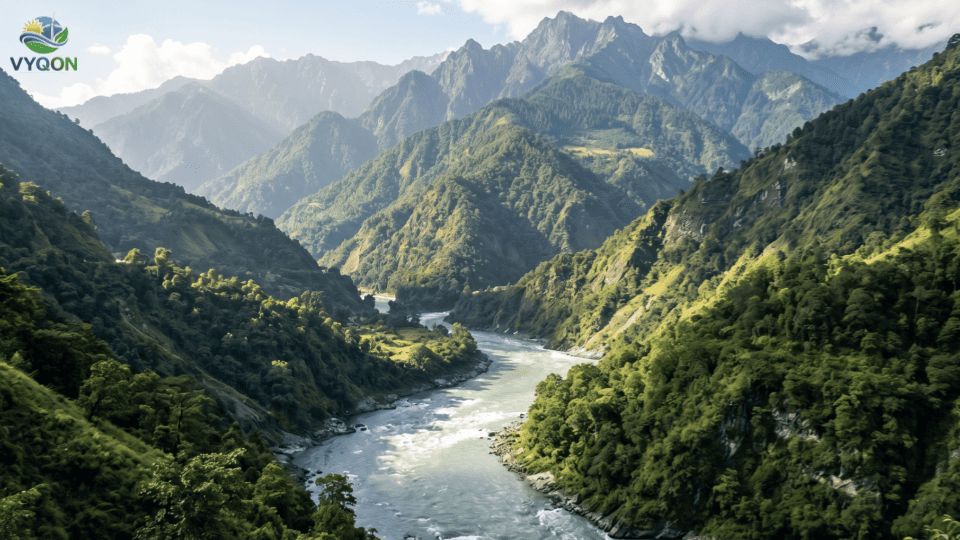
On April 8, 2026, the Cabinet Committee on Economic Affairs (CCEA), chaired by Prime Minister Narendra Modi, approved the investment for the Kalai-II Hydro Electric Project (HEP). The project is situated at Hawai village in the Anjaw District of Arunachal Pradesh, utilizing the waters of the Lohit River. The official investment outlay for the project has been sanctioned at ₹14,105.83 crore.
Technical Specifications and Capacity
The Kalai-II HEP is designed as a run-of-the-river facility with pondage, intended to harness the high hydropower potential and steep gradients of the Lohit River. The engineering design focuses on peak demand management and long-term grid stability.
| Parameter | Detail |
| Installed Capacity | 1,200 MW |
| Unit Configuration | 6 units of 190 MW and 1 unit of 60 MW |
| Annual Generation | 4,852.95 Million Units (MU) |
| Project Type | Run-of-the-river with pondage |
| Engineering Features | Concrete gravity dam; circular diversion tunnels (14.4 m finished diameter); gross head of 125 m |
| Diversion Infrastructure | 5 circular diversion tunnels (16.5 m excavated diameter) |
| Coffer Dam Specifications | Upstream: 32.7 m height; Downstream: 21 m height |
| Reservoir Capacity | 318.8 Million Cubic Meters (MCM) |
Financial Framework and Central Assistance
The financial structure for the project integrates direct investment with targeted central support to facilitate state-level participation and infrastructure readiness. The allocation of the ₹14,105.83 crore outlay is categorized as follows:
- Total Investment Outlay: ₹14,105.83 crore.
- Budgetary Support for Infrastructure: ₹599.88 crore is specifically earmarked for “enabling infrastructure,” including the construction of project-specific roads, bridges, and associated transmission lines.
- Central Financial Assistance: ₹750 crore has been provided to the State of Arunachal Pradesh as “state equity assistance” to fund its equity share in the joint venture.
Execution Timeline and Governance Structure
The project will be executed through a Joint Venture (JV) between THDC India Limited and the Government of Arunachal Pradesh. The total construction timeline is projected at 78 months.
Implementation has commenced with procurement activities for preliminary civil works. THDC has invited electronic bids for Package II, which carries an estimated cost of ₹15.887 billion and a specific execution duration of 31.5 months. The scope of Package II includes:
- Construction of five circular diversion tunnels and coffer dams.
- Construction of an 8 m-diameter road tunnel with a length of 1,837 m on the right bank.
- Installation of ten vertical lift, fixed wheel diversion tunnel gates.
Infrastructure and State-Level Benefits
The development of the Kalai-II project includes statutory power allocations and regional infrastructure enhancements intended to provide long-term socio-economic benefits:
- Roads and Bridges: Construction of approximately 29 km of roads and bridges in the Namsai and Anjaw districts, which will be accessible for local public use.
- Free Power Allocation: The State of Arunachal Pradesh is entitled to 12% free power from the project’s total generation.
- Local Area Development Fund (LADF): An additional 1% of power/funds is earmarked for local development initiatives.
- Socio-Economic Provisions: The framework includes mandatory provisions for land compensation, local employment opportunities, and Corporate Social Responsibility (CSR) activities.
Strategic Context and Environmental Status
As the first major hydroelectric installation in the Lohit Basin, Kalai-II serves a critical strategic role in peak demand management and national grid balancing. Furthermore, the project is a significant component of frontier infrastructure, reinforcing logistical connectivity and territorial integration in a sensitive region near the international border and the Line of Actual Control (LAC).
The environmental status of the project progressed in early 2026 when the Expert Appraisal Committee (EAC) of the Union Environment Ministry recommended environmental clearance (EC). However, the project remains a subject of objective environmental debate regarding its Environmental Impact Assessment (EIA). Critics have noted the EIA’s omission of the white-bellied heron (Ardea insignis), a critically endangered species documented within the Lohit basin and protected under Schedule-I of the Wildlife (Protection) Act, 1972.
Local engagement was recorded during a public hearing in August 2025 involving representatives from 33 affected villages. The primary concerns raised by the local populace centered on the transparency of land compensation and the formalization of employment assurances for residents.
Leave a Comment