
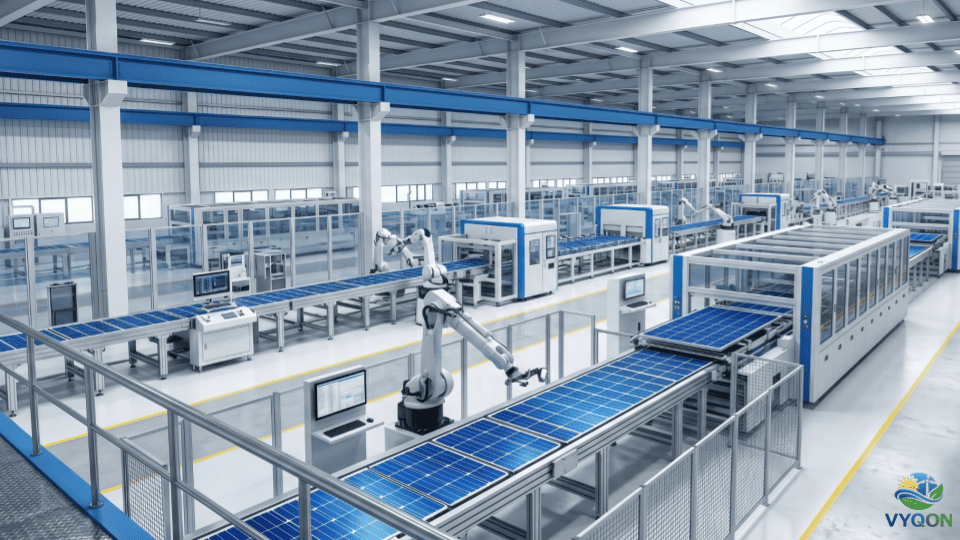
Executive Summary of Commissioning
AMPIN Solar One Private Limited, a joint venture between independent power producer AMPIN Energy Transition and solar solutions provider Jupiter International, has commissioned an integrated solar manufacturing facility in Bhubaneswar, Odisha. Inaugurated by Odisha Chief Minister Mohan Charan Majhi, the plant is designed to manufacture both solar cells and modules on a single platform. The project was established under Tranche-II of the Government of India’s Production-Linked Incentive (PLI) scheme, a national initiative aimed at building Giga-watt scale manufacturing capacity to reduce reliance on imported solar components and strengthen the domestic supply chain.
Technical Specifications and Integrated Capacity
The facility utilizes high-efficiency N-Type TOPCon (Tunnel Oxide Passivated Contact) technology, which targets efficiency levels of approximately 25.2%. By housing both cell and module production under one platform, the facility achieves significant backward integration. Key production details include:
- Annual Production Capacity: 1.3 GW of integrated solar cells and modules.
- Technological Focus: N-Type TOPCon technology, prioritizing superior low-light performance and higher efficiency compared to older cell architectures.
- Operational Distinctions: This 1.3 GW joint venture capacity is distinct from Jupiter International’s independent manufacturing roadmap, which includes a separate 4.2 GW solar cell and 3.6 GW module facility planned for the Khurda district.
- Existing Infrastructure: The Bhubaneswar site expands Jupiter International’s footprint beyond its established 2 GW Mono PERC (Passivated Emitter Rear-Cell) production lines located in Baddi, Himachal Pradesh.
Strategic Context: PLI Scheme and Domestic Content Requirements
The commissioning of the Bhubaneswar facility aligns with national industrial policy objectives defined under Tranche-II of the Production Linked Incentive (PLI) scheme for High Efficiency Solar PV Modules. By focusing on cell manufacturing—an upstream segment historically dominated by imports—the facility addresses critical gaps in the Indian solar ecosystem.
Strategically, the plant enables developers to meet Domestic Content Requirement (DCR) mandates for government-linked projects. Furthermore, the availability of domestic N-Type TOPCon cells is significant given the upcoming Approved List of Cell Manufacturers (ALCM) requirements, slated to take effect in June 2026. This move toward backward integration is designed to insulate the joint venture from global price volatility and supply disruptions.
Official Statements and Leadership Perspectives
The facility’s inauguration highlights a collaborative effort between private industry and state policy to achieve technological self-sufficiency.
“The inauguration of the manufacturing facility of AMPIN Solar One Private Limited is a significant step toward building a stronger domestic manufacturing backbone for India’s energy transition. This platform brings together scale, manufacturing depth, and quality-focused execution to enable the reliable supply of high-performance cells and modules from within the country.” — Alok Garodia, Chairman and Managing Director, Jupiter International
“Partnering with Jupiter International… resonates with the Indian government’s vision of a self-sufficient nation. This move will help us achieve backward integration and enhance our control over the supply chain for crucial components, which would help us optimize our operations for quality, efficiency and cost-effectiveness.” — Pinaki Bhattacharyya, MD and CEO, AmpIn Energy Transition
Supply Chain Integration and Market Impact
The facility’s output is structured to serve both internal project requirements and the broader merchant market. This dual-supply strategy is intended to stabilize the domestic supply of high-performance components.
| Output Recipient | Purpose/Application |
| Internal (AMPIN Energy Transition) | Captive supply for in-house Utility-scale and Commercial & Industrial (C&I) renewable energy projects. |
| External (Third-party Developers) | Merchant sale of modules and cells to the Indian market to meet DCR and ALMM mandates. |
Regional Industrial Context: The Odisha Advantage
Odisha was selected as the project site due to specific fiscal incentives and logistical infrastructure provided under the state’s Industrial Policy Resolution (IPR) 2022. The policy designates “green equipment manufacturing” as a “thrust sector,” granting it prioritized administrative and financial support.
Key regional factors cited for the facility’s establishment include:
- Logistical Connectivity: Proximity to Paradip, Vizag, and Gopalpur ports provides essential links to Southeast Asian supply chains for raw material imports (such as polysilicon and wafers) while facilitating export routes to markets in the Middle East and Africa.
- Infrastructure Support: Access to the state’s Land Bank Facility and “plug-and-play” infrastructure, which streamlines single-window clearances and land acquisition.
- Fiscal Incentives: Under IPR 2022, the facility benefits from a 30% capital subsidy on plant and machinery, a 100% reimbursement of state GST (SGST), and a power tariff reimbursement of Rs 2 per unit.
- Employment Incentives: The state provides 100% reimbursement of the employer’s contribution toward ESI and EPF for a seven-year period, encouraging local job creation within the renewable sector.
Leave a Comment