
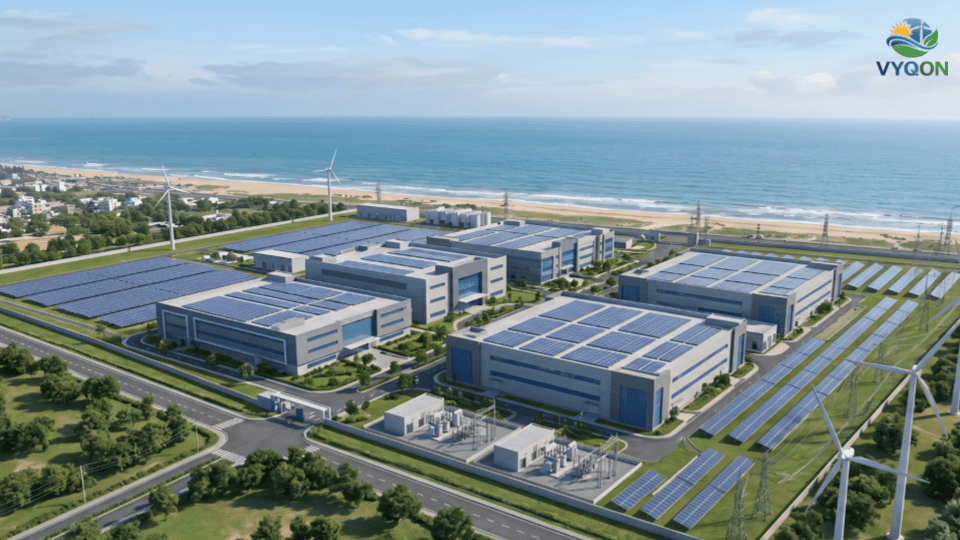
Google and the Adani Group have announced a $15 billion investment over five years to establish a 1-gigawatt (GW) artificial intelligence (AI) data center hub in Visakhapatnam, Andhra Pradesh. This facility, slated to be Google’s largest AI-focused infrastructure project outside the United States, will integrate hyperscale compute capacity with an international subsea cable landing station. Developed in partnership with Adani Infra Limited and Bharti Airtel, the project represents the largest single foreign direct investment in India and will be executed across three specialized park campuses totaling 601 acres.
Technical and Financial Specifications
- Investment Amount: $15 billion (USD) over five years (2026–2030).
- Scale: India’s first gigawatt-scale (1 GW) hyperscale data centre campus.
- Total Land Area: 601 acres across three distinct campuses.
- Legal Structure: Project executed by Raiden Infotech India Private Limited (Google subsidiary) via three Special Purpose Vehicles (SPVs) fully owned by Adani Infra Limited.
- Campus Distribution and Land Allocation:
- Vizag Hyperscale Data Centre Park Limited: 160 acres at Adavivaram and Mudasarlova (Visakhapatnam district).
- Vizag Mega Data Centre Park Limited: 266.6 acres at Tarluvada (Visakhapatnam district).
- Vizag Rambilli Data Centre Park Limited: 174.8 acres at Rambilli (Anakapalli district).
- Strategic Partners: Adani Infra Limited (physical development and green energy services) and Bharti Airtel (international subsea cable landing station).
- Primary Subsidiary: Raiden Infotech India Private Limited.
Direct Power Procurement and Grid Control
A critical regulatory milestone for the project is the 1 GW power distribution license granted by the Andhra Pradesh cabinet to Google’s subsidiary, Raiden Infotech India Private Limited. This authorization marks the first time a private technology company in Andhra Pradesh has been granted a distribution company (DISCOM) license.
The license allows Google to bypass the standard utility supply chain and procure electricity directly from generators or its own renewable sources. Because electricity accounts for approximately 40–60% of data center operating costs, this direct distribution model provides tighter control over reliability, load balancing, and long-term expenditure. This vertical integration of power infrastructure is intended to reduce exposure to grid disruptions and ensure the continuous uptime required for hyperscale AI operations.
Sustainability and Energy Requirements
The project is governed by sustainability objectives to align the facility with clean energy transition goals. Adani Infra Limited is tasked with providing green energy services, which includes the development of new transmission lines and innovative energy storage systems to enhance the resilience of the local grid. While the facility will optimize its initial energy mix for higher renewable integration, the project is architected with the ultimate objective of being run entirely on clean energy to meet Google’s global sustainability targets.
AI Infrastructure and Global Connectivity
The Visakhapatnam hub is technically designed to support advanced AI workloads and global cloud services. The facility will house Google’s custom tensor processing units (TPUs), specialized hardware used to power services including Gemini, Search, and Google Cloud.
The coastal location of Visakhapatnam offers two primary technical advantages. First, the proximity to the coast provides access to the large volumes of water required for data center cooling operations. Second, it serves as a landing point for an international subsea gateway. Developed in partnership with Bharti Airtel, this infrastructure will connect the hub to Google’s network of more than two million miles of terrestrial and subsea cables, linking the facility directly to a dozen countries to ensure low-latency global data transfer.
Economic Impact and Employment Projections
The project’s scale is expected to generate significant fiscal and developmental impact:
- Revenue Generation: Estimated to generate approximately ₹10,000 crore for the state of Andhra Pradesh.
- Job Creation: Projected to create 5,000–6,000 direct jobs and 20,000–30,000 total jobs.
- Regional Impact: Infrastructure growth is anticipated to drive a 30–50% appreciation in land values within the Bhogapuram and Bheemili corridors.
Project Timeline
- Groundbreaking Ceremony: Scheduled for April 28, 2026.
- Construction Commencement: Late April 2026.
- Phase-wise Commissioning: Targeted to begin by July 2028.
Leave a Comment