
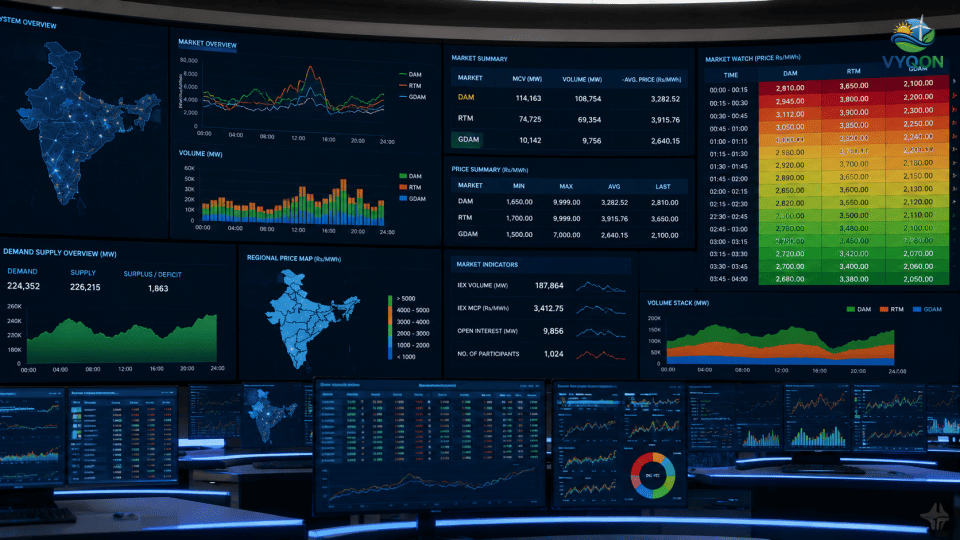
The Indian Energy Exchange (IEX) reported a consolidated net profit of ₹134.8 crore for the first quarter ended June 30, 2026, marking an 11.7% increase over the same period last year. The performance was supported by a 15.9% year-on-year (YoY) expansion in total electricity trading volumes, which reached 37.5 billion units (BU). Consolidated revenue for the quarter stood at ₹202.8 crore, a 10.1% increase compared to Q1 FY 2026.
Key Financial Highlights
During the quarter, IEX demonstrated healthy operating leverage as revenue from operations rose 11.37% to ₹157.87 crore. On a standalone basis, the exchange reported a 12.1% growth in Profit After Tax (PAT) to ₹126.7 crore, while revenue exceeded analyst consensus estimates by approximately 3%.
| Metric | Q1 FY27 (₹ Cr) | Q1 FY26 (₹ Cr) | YoY Growth (%) |
| Revenue from Operations | 157.87 | 141.75 | 11.37% |
| Total Revenue | 202.80 | 184.17 | 10.12% |
| EBITDA (Excl. Other Income) | 130.92 | 115.30 | 13.55% |
| Consolidated PAT | 134.75 | 120.69 | 11.65% |
The company’s EBITDA margin (excluding Other Income) expanded by 159 basis points to 82.93%. When accounting for total income, the EBITDA margin stood at 87.82%, reflecting a 176-basis-point expansion YoY due to cost discipline and higher treasury income, which normalized to ₹450 million during the period.
Volume and Market Segment Analysis
Trading activity was largely concentrated in the electricity segments, where distribution companies utilized the exchange to manage high demand volatility.
- Real-Time Market (RTM): This segment emerged as the primary growth driver, expanding 23.5% to 16,019 million units (MU). The average price rose 13.8% to ₹4.5 per unit. RTM outperformed routine procurement markets as distribution companies (Discoms) were forced to manage unpredictable demand spikes during a prolonged heatwave.
- Day-Ahead Market (DAM): Volumes grew 7.6% to 13,345 MU, while the average market price increased 15.7% to ₹5.1 per unit.
- Term-Ahead Market (TAM): The segment registered a 25% volume increase, totaling 5,344 MU.
- Green Market (GDAM+GTAM): Combined volumes for renewable segments reached 2,828 MU, reflecting a 6% YoY growth.
- Renewable Energy Certificate (REC) Market: In contrast to electricity segments, REC volumes fell 81.4% to 9.77 lakh certificates. Sell-side participation declined 86.1%, a sharp contraction attributed to current market structure and policy shifts.
Subsidiary Performance and Strategic Developments
The Indian Gas Exchange (IGX) reported a PAT of ₹16.3 crore, up 15.5% YoY, on traded volumes of 27.5 million MMBtu (an 11.9% increase). On July 14, 2026, IEX filed a Draft Red Herring Prospectus (DRHP) for an initial public offering of IGX. The 22.3% offer for sale (OFS) is intended to reduce IEX’s stake to the 25% regulatory ceiling mandated by the Petroleum and Natural Gas Regulatory Board (PNGRB).
Furthermore, the Ministry of Coal notified Coal Exchange Rules on June 4, 2026, with the licensing portal opening on July 15. These rules mandate that all coal trading, including Coal India’s e-auctions, must route through an exchange within six months of the first license going live. This transition opens a market currently estimated at 120 million tonnes (MT).
The International Carbon Exchange (ICX) reported revenue growth of 16.1% to ₹2.1 crore. This occurred despite a slight dip in International Renewable Energy Certificate (I-REC) issuances, which totaled 4.24 million for the quarter.
Operational Context and Power Demand
Financial results were influenced by a record-heat summer that pushed India’s peak electricity demand to an all-time high of 270.8 GW in May 2026. National electricity consumption rose 8.8% to 485.4 BUs during the quarter.
Fuel supply remained stable to meet this requirement; domestic coal production reached approximately 233 million tonnes. Thermal power plants maintained an average coal inventory of 17 days as of June 30, 2026, providing the necessary buffer for peak summer demand.
Regulatory Landscape: Market Coupling Update
The proposed implementation of “Market Coupling” continues to present a structural challenge to IEX’s current 85% market share. While the Supreme Court of India recently admitted IEX’s appeal against the Central Electricity Regulatory Commission’s (CERC) directions, it declined to grant an interim stay. CERC has indicated that market coupling norms are expected shortly, with an implementation window of four to six weeks following notification.
Regulatory directions suggest the coupling of the Day-Ahead Market (DAM) may utilize a “round-robin” mode, where power exchanges rotate as the Market Coupling Operator (MCO). Grid India would serve as a fourth MCO for audit and backup purposes. Grid India’s submissions have also suggested a fallback mechanism allowing exchanges to perform price discovery if the central MCO fails.
According to Monte Carlo model projections grounded in current segment mixes, the implementation of DAM coupling could see IEX’s overall power-exchange market share migrate toward a 50–60% range. This scenario assumes RTM remains uncoupled in the initial phase, acting as a stabilizer for the exchange’s dominant volume position.
Official Regulatory & Legal Sources
- CERC Petition 8/SM/2025 (Directions on Power Market Coupling – July 2025): The foundational directive initiating the phased approach for market coupling in India.
- CERC Power Market Regulations, 2021: The regulatory framework (specifically Regulations 37–39) that enables market coupling implementation.
- CERC Market Monitoring Cell (September 2025 Monthly Report): Primary source for verified baseline market shares across Indian power exchanges.
- APTEL Judgment on IEX Market Coupling Appeal (13 February 2026): The tribunal ruling that disposed of IEX’s initial challenge while preserving future rights to contest upcoming regulations.
- CERC Corrigendum to July 2025 Order (8 January 2026): Official clarification changing the legal designation of the coupling document from “Order” to “Directions.”
- CERC Order on Transaction Fees (April 2023): Regulatory ruling regarding the 2 paise/kWh transaction fee ceiling for exchanges.
Official Corporate & Exchange Disclosures
- IEX Regulatory News Verification Clarification to NSE (January 2026): Official exchange filing regarding the status of the APTEL hearings.
- IEX Investor Presentation via BSE Filings (January 2025): Historical context for market share and exchange performance metrics.
International Regulatory Benchmarks
- EU Commission Regulation 2015/1222 (CACM): The primary legislation for the European Single Day-Ahead and Intraday Coupling.
Leave a Comment