
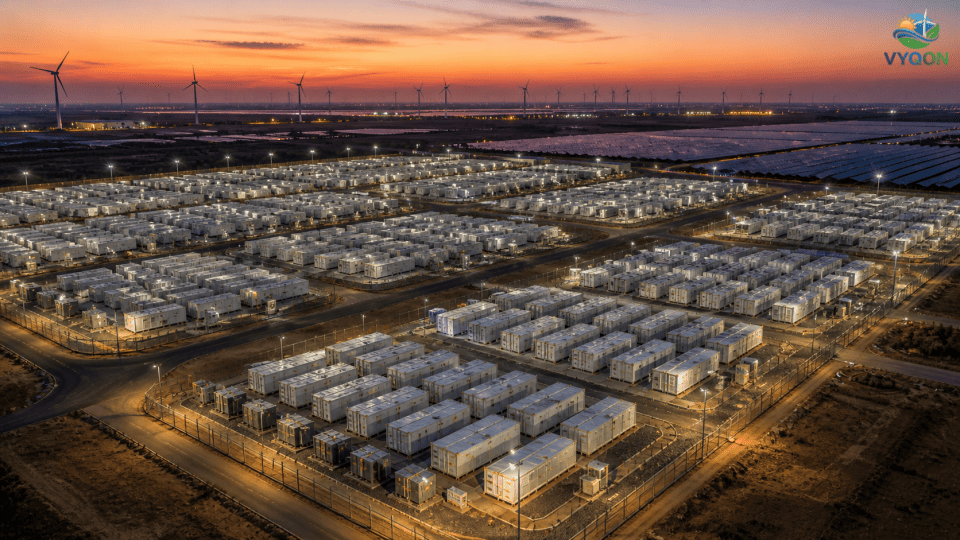
As of April 1, 2026, Adani Green Energy Ltd (AGEL) has commercially operationalized a 1,376 MWh Battery Energy Storage System (BESS) tranche at the Khavda Renewable Energy Park in Gujarat. The project, which provides capacity on a dispatchable basis, was commissioned through two step-down subsidiaries: Adani Renewable Energy Forty Three Limited (953 MWh) and Adani Renewable Energy Thirty Seven Limited (423 MWh). This deployment represents the first operational phase of a total planned project scale of 1,126 MW / 3,530 MWh.
System Architecture and Infrastructure Details
With the commissioning of this tranche, AGEL’s total operational BESS capacity has reached 1,376 MWh. This makes the Khavda installation the largest operational BESS project in India and the third-largest single-location battery storage cluster globally.
The system architecture consists of more than 700 BESS containers utilizing Lithium-Iron-Phosphate (LFP) battery chemistry. These units are integrated with advanced Energy Management Systems (EMS) for real-time monitoring and dispatch logic. Project execution was managed by Adani Infra India Ltd (AIIL), while long-term operations and maintenance (O&M) are handled by Adani Infra Management Services Pvt Ltd (AIMSL).
Technical Function and Grid Integration
The deployment of grid-scale storage at Khavda is a strategic response to regional infrastructure challenges, specifically delays in grid augmentation and power evacuation constraints near the India-Pakistan border. The BESS serves the following functional objectives:
- Grid Stability: Mitigating peak load pressures and reducing transmission congestion within the regional grid.
- Resource Optimization: Reducing solar curtailment by absorbing excess generation during periods when transmission infrastructure is not fully aligned with production.
- Energy Shifting: Storing solar and wind power for dispatch during peak demand hours, optimized for an approximately three-hour discharge cycle.
- Price Arbitrage: Capturing energy during high-generation periods to capitalize on peak power pricing, thereby improving revenue realization for co-located renewable assets.
Khavda RE Park: Infrastructure Profile
The Khavda Renewable Energy Park is located in the Kutch district of Gujarat, spanning 538 square kilometers of barren land. This area is roughly five times the size of Paris and was selected due to its high concentration of solar and wind resources.
Khavda RE Park Technical Specifications
| Feature | Specification |
| Total Area | 538 sq. km / 72,600 hectares |
| Total Operational Capacity (as of April 2026) | 9.4 GW |
| Planned Total Capacity (by 2029) | 30 GW |
| Natural Resources | Solar irradiance (~2,060 kWh/m2) and wind speeds (8 m/s) |
| Location | Kutch district, Gujarat (near India-Pakistan border) |
Operational Portfolio and Future Roadmap
Following this commissioning, AGEL’s total operational renewable portfolio stands at 19.3 GW. To support continued expansion, the company has projected a capital expenditure range of ₹25,000–₹40,000 crore for the next financial year.
The company’s storage roadmap includes the following capacity targets:
- FY27 Target: Deployment of an additional 15 GWh of BESS capacity by March 2027, with total operational capacity expected to exceed 10,000 MWh.
- 2030 Target: Achieving a long-term cumulative energy storage capacity of 50 GWh.
These milestones are designed to support AGEL’s broader objective of reaching 50 GW of total renewable energy capacity by 2030, utilizing the Khavda site as a central hub for large-scale grid integration.
Leave a Comment