
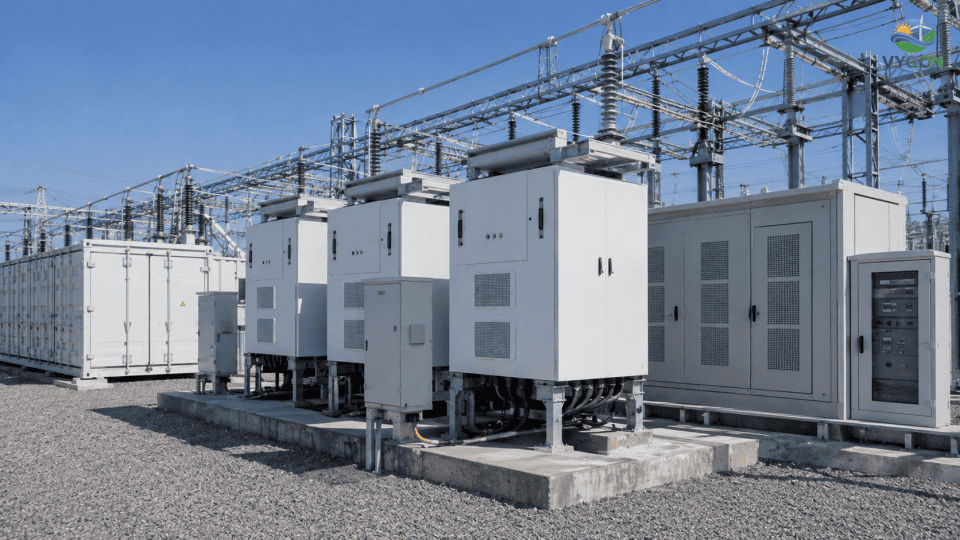
On July 10, 2026, India’s Central Electricity Authority (CEA) issued a landmark advisory mandating 100% Grid-Forming (GFM) inverter technology for all upcoming large-scale Battery Energy Storage Systems (BESS). This policy shift marks a critical evolution in India’s power system architecture, addressing the urgent need for enhanced grid stability and resilience as the nation integrates unprecedented volumes of variable renewable energy (VRE). By requiring GFM capabilities, the CEA ensures that future storage assets provide the synthetic inertia and black-start support necessary to secure the grid against major disturbances and facilitate rapid recovery from total system failures.
India’s Evolving Power System: The Geographic and Technical Challenge
The transition to GFM technology is necessitated by the rapid decarbonization of the Indian grid. Projections for 2035–36 estimate a total installed capacity of 1,121 GW, including 509 GW of solar and 155 GW of wind. This shift creates a fundamental “power to make power” problem; as traditional thermal plants retire, the grid loses the natural synchronous inertia provided by heavy rotating turbines, leaving the system vulnerable to sudden frequency swings.
Furthermore, India faces a unique geographic challenge. The vast majority of its renewable capacity is concentrated in remote zones like Rajasthan, Gujarat, and Tamil Nadu, far from major load centers. In the event of a regional blackout, restoring power to these isolated pockets using conventional means is notoriously difficult. System operators have already noted low Short Circuit Ratios (SCR) and power oscillations in these zones. Mandating GFM inverters allows for localized grid stabilization and restoration, turning remote renewable hubs into self-healing nodes.
Technical Mandates and Performance Requirements
The CEA has established rigorous engineering benchmarks that GFM inverters must satisfy to support the grid during normal operations and transient events. A key industry insight driving this mandate is the shifting economics of the technology: the historical cost premium associated with GFM technology has largely disappeared, as these capabilities are now primarily achieved through advanced firmware-based implementations.
The primary technical requirements include:
- Weak Grid Operation: Stable operation under an SCR of 2.0 or lower at the Point of Interconnection.
- Rapid Response Times: Active and reactive power responses within 5 milliseconds (ms) of a disturbance, achieving full response within 30 ms.
- Overload Capability: Support for a short-term current overload of at least 1.5 per-unit for 200 ms.
- Damping and Tolerance: Voltage phase jump tolerance up to ±60 degrees and power oscillation damping between 0.1 Hz and 20 Hz.
- Operational Standards: 24×7 participation in Automatic Generation Control (AGC) and continuous bi-directional charging/discharging without cooling breaks.
- Lifecycle Reliability: To ensure long-term grid security, BESS units must retain ≥ 90% output after 5 years, ≥ 80% after 10 years, and ≥ 70% after 15 years.
Applicability and Exemptions
The advisory follows a clear implementation timeline to provide regulatory certainty for developers:
- Effective Date: The mandate took effect on July 10, 2026.
- Project Threshold: Applies to all BESS projects with an aggregate capacity of 50 MW or more.
- Exemptions: Projects are exempt only if 1) bids were concluded by August 10, 2026, or 2) formal purchase orders (POs) were placed before July 10, 2026.
Technical Explainer: GFM vs. GFL and Virtual Machine Mode
The shift to GFM represents a paradigm shift in inverter control philosophy. Traditionally, Grid-Following (GFL) inverters synchronize to a pre-existing grid signal and shut down during outages to prevent unsafe islanding, making them ineffective for grid recovery.
Grid-Forming (GFM) inverters, however, act as independent voltage sources. By utilizing Virtual Machine Mode (VMM), these systems use software to model the physics of a conventional synchronous generator. This allows them to provide programmable inertia and damping, establishing their own stable frequency and voltage signals. VMM effectively allows the BESS to “form” the grid, enabling other grid-following renewable assets to synchronize to it and contribute power during a recovery.
Black-Start Capability and Grid Recovery
A centerpiece of the mandate is the provision of black-start services. In a total blackout, GFM-equipped BESS will lead grid restoration through a three-phase process:
- Self-Start: Using internal auxiliary power (UPS) to boot control systems and cooling.
- Island Formation: Utilizing a “soft-start” algorithm to gradually ramp up voltage. This is critical for managing inrush currents; current research proves GFM batteries can successfully energize systems where the transformer capacity exceeds the battery’s rated power by as much as 3:1.
- Grid Handoff: Once a stable “power island” is established, the BESS synchronizes with the wider grid.
To ensure readiness, operators must maintain a contractually mandated minimum State of Charge (SOC) specifically reserved for black-start services.
Regulatory, Safety, and Compliance Framework
Compliance is governed by the “CEA (Technical Standards for Connectivity to the Grid) Regulations, 2026,” which requires developers to submit Electromagnetic Transient (EMT) studies during the design phase.
Safety is managed under the new Chapter XA amendments, featuring:
- Two-Fault Tolerance: The system must remain in a safe state even if two independent failures occur simultaneously.
- Fire Suppression: Mandatory smoke, gas, and flame detection with integrated suppression systems.
- Third-Party Audits: Developers must conduct a mandatory third-party fire safety audit within 3 months of commissioning.
- Verification: Load Despatch Centres will perform periodic re-verification of GFM and black-start capabilities.
Domestic Manufacturing and Global Context
The CEA has initiated an assessment of domestic readiness, requesting cost and capacity data from Indian manufacturers for GFM inverters ranging from 10 kW to 1 MW+. This suggests a forthcoming push for localized supply chains to meet the estimated 336 GWh of storage needed by 2030.
By adopting these standards, India aligns with global leaders like the Hornsdale Power Reserve in South Australia. This mandate positions BESS not merely as a tool for energy shifting, but as the foundational stabilizing architecture of the future Indian power system.
Official Regulatory Sources & Mandates
1. Central Electricity Authority (CEA) — 100% Grid-Forming Inverter Advisory
- Context: The CEA’s Power System Planning & Appraisal-I Division issued a significant advisory mandating that all upcoming Battery Energy Storage System (BESS) projects in India must utilize 100% Grid-Forming (GFM) inverters to enhance grid stability.
- Hyperlink: CEA Mandates 100% Grid-Forming Inverters For Upcoming BESS Projects In India
2. Central Electricity Authority (CEA) — Draft Technical Standards for Connectivity (2026)
- Context: These draft regulations replace the 2007 standards, introducing a technology-neutral framework that specifically mandates black start support for BESS projects of 50 MW and above and sets standards for inverter-based resources.
- Hyperlink: Draft CEA (Technical Standards for Connectivity to the Grid) Regulations, 2026
3. Central Electricity Authority (CEA) — Safety and Electric Supply (Amendment) Regulations (2026)
- Context: This amendment introduced a new dedicated Chapter XA focused entirely on Battery Energy Storage Systems, establishing strict safety requirements such as two-fault tolerance and advanced BMS monitoring.
- Hyperlink: CEA’s New Safety Regulation 2026 for BESS
4. Grid Controller of India Limited (GRID-INDIA) — GFM Technology Discussion Paper
- Context: National power system operator GRID-INDIA released the paper “Grid-forming technology and possible applications in the Indian Power System,” which recommends GFM capability for all new BESS installations above 50 MW.
- Hyperlink: Grid-Forming Inverters: Enabling stability in renewable-dominated systems
5. Central Electricity Authority (CEA) — Official GFM Mandate Clarification
- Context: Following stakeholder queries, the CEA Chairperson approved a clarification on July 10, 2026, regarding the exemption of BESS projects with concluded bids or advanced purchase orders from the GFM requirement.
- Hyperlink: CEA clarifies GFM mandate for BESS projects, spares those with concluded bids
6. Central Electricity Authority (CEA) — Data Request for Domestic Manufacturing
- Context: The CEA Energy Storage System (ESS) Division officially sought data from manufacturers on the domestic production capacity and cost of GFM inverters to inform future policy and regulatory interventions.
- Hyperlink: CEA Seeks Data On Domestic Manufacturing Capacity Of Grid-Forming Inverters
Leave a Comment