
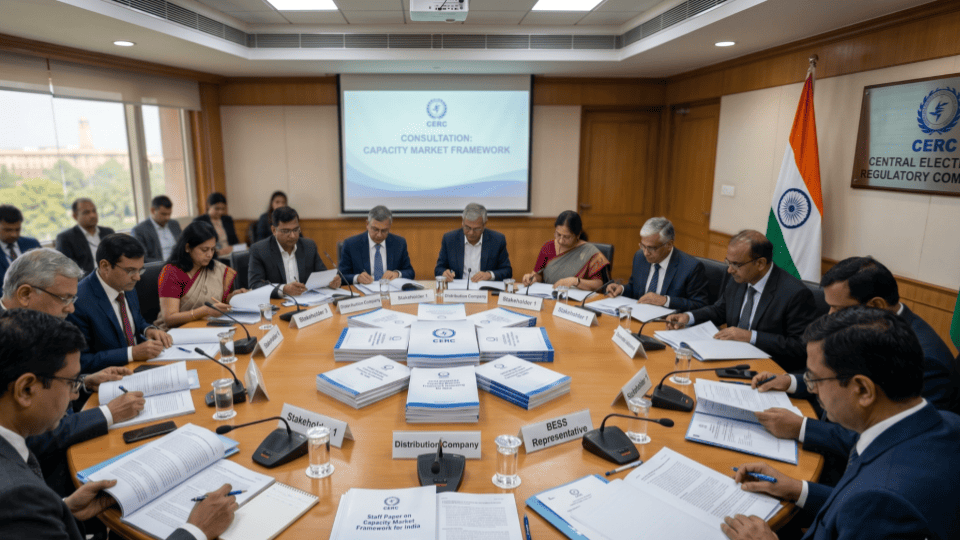
On April 30, 2026, the Central Electricity Regulatory Commission (CERC) released a staff paper outlining a proposed framework for the introduction of capacity markets in India. The primary objective of this regulatory proposal is to address systemic gaps in electricity resource adequacy (RA), reserve availability, and the operational efficiency of the short-term market. The Commission has set a deadline of May 27, 2026, for stakeholders to submit formal comments and suggestions regarding the paper.
The Current Gap: Limitations of the PPA-Based System
The framework identifies several limitations within the existing Power Purchase Agreement (PPA) system that currently hinder long-term grid reliability. Under the current structure, resource adequacy is treated as a long-term dimension of grid planning that lacks a mechanism to guarantee that contracted capacity is always assured for dispatch. According to the CERC, the PPA-based model does not sufficiently ensure that resources are available to meet system requirements during periods of peak demand.
Specific challenges identified in the staff paper include:
- Capacity availability issues during periods of system stress: Current market structures do not consistently guarantee that power is ready for dispatch during critical intervals.
- Gaps in ensuring 24×7 reliable power: The existing system faces difficulties in providing continuous, reliable electricity to all consumers.
- Inability to guarantee assured dispatch: Technical and contractual structures often fail to ensure that capacity is maintained in a state of readiness for the system operator.
Synthesizing data from resource adequacy standards, the framework defines “capacity unavailable during system stress” as the combination of forced outages, planned maintenance, and non-usable capacity at peak load. These factors create a divergence between total installed capacity and the capacity actually available to the grid during severe conditions.
Key Proposals: Market Design Options
The CERC staff paper proposes three distinct market design models to strengthen the reliability of the Indian power sector. A central component of these models is the transition toward “Capacity Payments,” which the paper defines as a shift from “energy-only” compensation to “availability-based” compensation. This mechanism pays for the readiness of a resource to meet peak load, rather than solely for the electricity it generates.
The framework also utilizes “Reliability Must-Run” (RMR) designations. In the context of this proposal, RMR refers to specific generation units required by the system operator to remain online to ensure grid stability, regardless of whether those units are cleared by market prices.
The three proposed models are:
1. Capacity Market for Resource Adequacy/Capacity Obligation
This model establishes a formal requirement for obligated entities, such as Distribution Companies (DISCOMs), to contract sufficient capacity to meet their projected peak demand plus a mandated reserve margin.
2. Reserve Capacity Market
This model focuses on the availability of secondary and tertiary reserves. It is designed to ensure the system operator has sufficient flexible resources to maintain grid frequency and stability.
3. Secondary Short-term Capacity Market
Intended for existing capacities, this model provides a platform for the trading of capacity obligations among market participants. This allows entities to manage short-term resource shifts and fulfill their adequacy requirements through a flexible trading environment.
Integration of Storage and Firmed Renewable Energy
The proposed framework assigns specific roles to Battery Energy Storage Systems (BESS) and firmed renewable energy to manage the increasing penetration of intermittent generation. According to the paper, BESS offers critical utility for ramping support, reserve provision, and peak shifting—storing excess midday solar energy for evening demand.
The framework emphasizes the role of Firm and Dispatchable Renewable Energy (FDRE) as a 24×7 power solution. Technical data suggests that solar + storage configurations can now deliver near 24×7 clean power at a price point under ₹5/kWh, making it a viable alternative to traditional thermal generation. The framework proposes that storage assets serve as capacity-linked assets with guaranteed offtake, providing the “deployment agility” required for fast-growing grids.
International Context and Benchmarking
The CERC paper draws upon global models to inform the proposed Indian framework, specifically referencing regulatory structures in the United Kingdom, Germany, and the United States. The paper highlights several distinct approaches utilized in the US market:
- California: Employs a system driven by Integrated Resource Planning (IRP) where resources receive Resource Adequacy (RA) credits.
- Texas (ERCOT): Operates an energy-only market where storage and flexible assets respond to strong price signals rather than formal capacity obligations.
- PJM: Utilizes a capacity market that provides duration-linked credits, where resources earn value through both energy and capacity participation.
These benchmarks demonstrate how RA credits and capacity participation mechanisms are utilized globally to ensure system stability as generation mixes evolve.
Next Steps: Regulatory Timeline and Consultation
The release of this staff paper initiates a formal public consultation process. The CERC has extended an invitation for stakeholder feedback to refine the technical and operational aspects of the framework.
Stakeholders must submit their comments by May 27, 2026. Following the conclusion of the consultation period, the Commission will evaluate the submissions to determine the subsequent steps in the regulatory process for the implementation of the capacity market framework.
Leave a Comment