
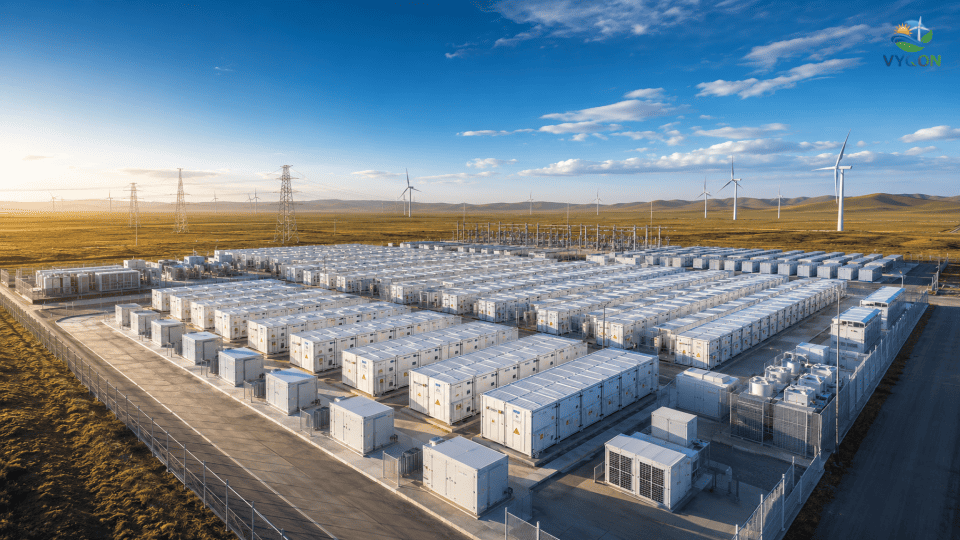
China has connected a 1 GW/4 GWh battery energy storage system (BESS) in the Inner Mongolia Autonomous Region, adding a gigawatt-scale grid-forming storage facility to one of the country’s major renewable-energy regions. The DongSu Substation New Energy Storage Special Action project achieved grid connection on August 3, 2026, following successful initial energization and connection on its first attempt.
Located near Mandulatu in Sonid Left Banner, Xilingol League, the project was developed with an investment of approximately CNY 3 billion (around USD 445 million) by Wanbang Digital Energy. The facility occupies approximately 28 hectares and has a rated power capacity of 1 GW with an energy-storage capacity of 4 GWh, giving it a four-hour storage duration at rated output. Local government sources have described the facility as the world’s largest single-site grid-forming LFP battery storage plant.
Project at a Glance
- Capacity: 1 GW / 4 GWh
- Storage duration: 4 hours
- Battery technology: LFP
- Grid technology: Grid-forming
- Location: Near Mandulatu, Sonid Left Banner, Xilingol League, Inner Mongolia
- Investment: Approximately CNY 3 billion (USD 445 million)
- Site area: Approximately 28 hectares
- Expected annual discharge: Approximately 1 TWh
- Grid connection: August 3, 2026
- Investor: Wanbang Digital Energy
The scale of DongSu is significant not only because of its 4 GWh energy capacity, but also because grid-forming capability has been deployed at a 1 GW power rating. The project is expected to discharge approximately 1 TWh of electricity annually, indicating its intended role as a substantial operating resource within the regional power system.
Grid-Forming Capability at Gigawatt Scale
The defining technical feature of the project is its grid-forming power-conversion architecture. The system is designed to establish and maintain electrical voltage and frequency references, allowing the BESS to contribute directly to grid operation. This capability is particularly relevant as power systems incorporate increasing amounts of inverter-based wind and solar generation.
For Inner Mongolia, this capability has particular system value. The region is a major renewable-energy development area, with large-scale wind and solar projects placing increasing requirements on transmission capacity, flexibility and system stability. DongSu combines its four-hour storage duration with grid-support functionality, enabling the facility to serve both energy-management and power-system requirements.
The 4 GWh storage capacity provides a large-scale resource for energy shifting. Electricity can be absorbed during periods of strong renewable generation and subsequently discharged when system demand increases or renewable output declines. At the same time, the grid-forming system can provide voltage and frequency support, allowing the facility to contribute to stability alongside its energy-storage function.
This combination is important for renewable-heavy power systems because the operational requirement is no longer limited to balancing energy over time. Large storage assets can also be required to respond to system conditions and provide power-system services. DongSu therefore represents a move toward BESS installations that combine energy shifting with active grid-support capability.
Potential Role in Grid Restoration
Grid-forming storage can also be designed to support black-start operations following a major grid outage. For a large-scale installation such as DongSu, this provides an additional potential system application beyond normal charging and discharging operations.
The combination of a large LFP battery capacity and grid-forming power electronics consequently gives the project a broader operational role within the electricity system. Its value is associated not only with the quantity of energy stored but also with how that stored energy and the associated power-conversion system can support grid operation.
Alignment with China’s Renewable-Energy Strategy
The commissioning of DongSu also comes as China accelerates the deployment of grid-forming technology. China’s renewable-energy plan for the 2026–2030 period, released in July 2026, calls for greater use of grid-forming equipment, high-accuracy power forecasting and integrated dispatch, together with the development of more “system-friendly” wind and solar projects.
These priorities are closely aligned with the operating requirements of renewable-rich regions. Improved forecasting can support more accurate management of variable wind and solar generation, while integrated dispatch can coordinate renewable generation, storage and other grid resources according to system conditions.
For DongSu, this creates a direct connection between large-scale storage deployment and the wider modernization of China’s renewable-power infrastructure. The project provides four-hour energy-shifting capability while adding grid-forming functions that can support the electrical characteristics required by a system with a high share of inverter-based generation.
A New Benchmark for Grid-Forming BESS
The DongSu project stands out through the combination of 1 GW power capacity, 4 GWh energy capacity, four-hour duration, LFP battery technology and grid-forming capability at a single site. Its expected annual discharge of approximately 1 TWh further demonstrates the scale of its intended operation.
Most importantly, local government sources have described DongSu as the world’s largest single-site grid-forming LFP BESS. This qualification is significant: the project’s distinction is specifically associated with the combination of LFP storage and grid-forming technology at single-site scale, rather than simply its total energy-storage capacity.
The August 3 grid connection therefore represents more than another addition to China’s rapidly expanding battery-storage fleet. DongSu demonstrates the increasing deployment of BESS as a multi-functional grid asset, combining large-scale renewable-energy shifting with voltage and frequency support and potential grid-restoration applications.
At 1 GW/4 GWh, the project provides a substantial flexible resource for Inner Mongolia’s renewable-energy system and establishes a notable benchmark for the deployment of grid-forming LFP storage at gigawatt scale.
References
Leave a Comment