
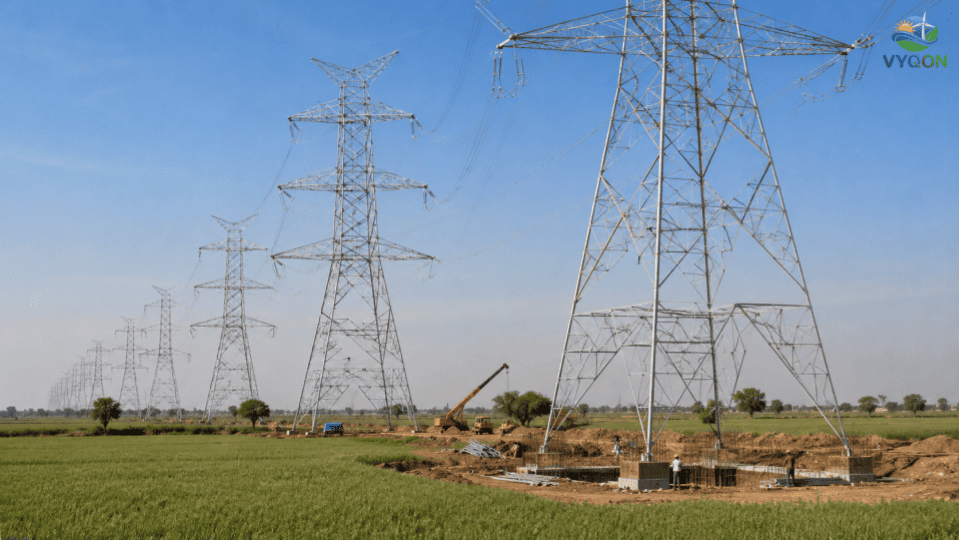
The Gujarat Department of Energy and Petroleum officially issued a Government Resolution (GR) on July 4, 2026, establishing a landmark framework for land compensation regarding power transmission infrastructure. Agriculture Minister and government spokesperson Jitu Vaghani announced the policy, which received “in-principle approval” from the state’s Finance, Revenue, and Agriculture departments. The notification serves as a direct administrative response to sustained farmer agitations, most notably in the Morbi district, where landowners had stalled projects managed by Adani Energy Solutions Ltd (specifically its vehicle, Halvad Transmission Ltd) intended to evacuate power from the renewable energy park at Khavda.
From Jantri to Market Value: The New Metric
The core shift in the state’s strategy is the transition from static, Jantri-based rates to current market dynamics. The previous system, which provided 200% of the Jantri (circle) rate, has been replaced by a mandate to pay twice the prevailing market value as determined by a specialized committee.
This market-linked metric applies to two distinct technical areas:
- The Tower Base Area: The land permanently occupied by the physical footprint of the transmission tower.
- The Right of Way (RoW) Corridor: The stretch of land underneath and adjacent to the transmission lines, the width of which is technically determined by the specific transmission voltage of the line.
The policy aims to prioritize farmer interests while balancing the financial burden on Transmission Service Providers (TSPs) and preventing excessive tariff increases for end consumers.
Restructuring the Payment Timeline
To resolve long-standing disputes over disbursement delays, the state has eliminated the traditional staggered payment schedule in favor of an upfront, digital delivery system.
- Before: Staggered three-stage installments (40% foundation, 40% tower erection, 20% stringing).
- After: 100% upfront, lumpsum payment before physical work commences.
All compensation will be delivered via direct digital deposit into the verified bank accounts of landowners to ensure administrative transparency.
Technical Expansion: Tower Base and Right of Way (RoW) Rates
The government has revised the formulas for compensable areas and established a new hierarchy for Right of Way access rights.
Tower Base Calculation
The compensable area for tower bases now includes the actual footprint plus a mandatory extension of 1 meter on all four sides. For a 765 kV transmission line, this revision expands the compensable area from the previous 625 square meters to 729 square meters. Landowners receive 200% of the MRC-determined market value for this designated area.
RoW Payout Hierarchy
For the RoW corridor, compensation is fixed as a percentage of the market value based on the administrative classification of the land:
- Rural Areas: 30% of market value.
- Municipalities and Nagar Panchayats: 40% of market value.
- All Other Urban Planning Areas: 45% of market value.
- Municipal Corporations and Metropolitan Areas: 60% of market value.
The Market Rate Committee (MRC): Composition and Valuation Process
A District-level Market Rate Committee (MRC) will now serve as the final authority on land valuation, moving away from general market speculation to a structured, independent assessment.
Committee Structure and Appointment
Chaired by the District Collector, the MRC includes representatives from the affected landowners and the TSP. On the day of the committee meeting, three independent land valuers—empanelled by the Insolvency and Bankruptcy Board of India (IBBI)—are appointed. One valuer is selected by the landowners, one by the TSP, and one by the Collector. These valuers must submit sealed reports within 21 days.
The Lottery System and Valuation Logic
The “Reference Market Rate” is determined through a unique three-step logic:
- The Lottery: The District Collector randomly selects and opens two of the three sealed reports.
- The 20% Rule: If the difference between the two opened valuations is less than 20% of the lower value, the average of the two is used. If the difference exceeds 20%, the rate is offered at 10% above the lower valuation.
- The Tie-Breaker: If the 10% adjustment is not accepted, the third sealed report is opened. The final Reference Market Rate is then calculated by taking the average of the two lowest valuations among the three total reports.
Crop Loss and Administrative Scope
The resolution provides additional protections for non-land assets and defines the policy’s retrospective reach.
- Certified Crop and Tree Loss: Compensation for crops and fruit trees is linked to rates fixed by the Agriculture Produce Market Committee (APMC). These losses must be formally certified by the local Sarpanch, Talati, or Mamlatdar.
- Policy Applicability: The rules apply to all new transmission projects of 66 kV and above. Crucially, the benefits are extended to all projects currently in progress where work is not yet complete, even if compensation was originally fixed under the old Jantri-based norms.
The issuance of this Government Resolution provides District Collectors with the explicit authority to allow transmission work to proceed without hindrance once the MRC has determined the market price. Even as final agreements are processed, the legal determination of the price by the committee grants TSPs the right to commence physical construction, effectively providing the administrative mechanism required to stabilize Gujarat’s expanding energy infrastructure.
Leave a Comment