
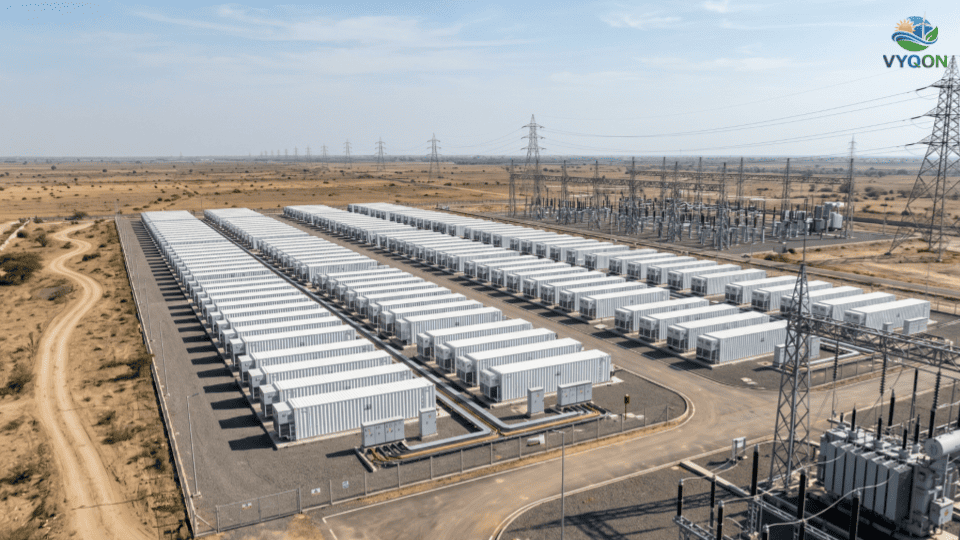
On June 22, 2026, Gujarat Urja Vikas Nigam Limited (GUVNL) issued a Request for Selection (RfS) for the development of 450 MW / 900 MWh of standalone Battery Energy Storage Systems (BESS) across the state. This initiative, executed through a tariff-based competitive bidding process, is designed to mitigate capital intensity for developers while strengthening grid infrastructure. The project serves as a cornerstone for GUVNL’s strategy to facilitate the seamless integration of intermittent renewable energy and ensure high-fidelity “on-demand” storage capacity for the state’s power mix.
Financial Support and Regulatory Framework
The tender utilizes federal financial mechanisms to bridge the viability gap for utility-scale deployment. A key feature is the inclusion of support under the 2025 VGF framework (Tranche-II), which reflects a strategic reduction in funding levels to account for declining global battery prices and improved commercial viability.
- Scheme: Viability Gap Funding (VGF) under Power System Development Fund (PSDF) Phase-IX.
- Support Level: ₹18 lakh per MWh (reflecting the updated 2025 framework, down from previous outlays of ₹46 lakh/MWh).
- Contract Type: Battery Energy Storage Purchase Agreement (BESPA).
- Contract Duration: 12 years.
Infrastructure and Geographic Scope
The standalone BESS capacity will be allocated across 10 strategic substations. While the tender seeks 450 MW of storage capacity, the cumulative evacuation infrastructure at these locations is estimated to support approximately 800 MW, providing significant operational headroom.
| Substation Name | Allocated Capacity (MW) |
| Choraniya AIS | 150 MW |
| Virpore AIS | 125 MW |
| Veloda AIS | 70 MW |
| Moti Gop | 60 MW |
| Motipaneli | 60 MW |
| Otha | 60 MW |
| Sagapara | 60 MW |
| Visavadar | 60 MW |
| Savarkundla | 60 MW |
| Dhrangadhra | 60 MW |
Technical Specifications and Operational Requirements
To ensure grid reliability and institutional-grade performance, GUVNL has established rigorous mechanical and operational mandates:
- C-rate: Systems must be capable of charging and discharging at a 0.5 C-rate.
- Group Dispatch Capability: The BESS must be capable of being charged or discharged in clusters ranging from 50 MW/100 MWh to 100 MW/200 MWh.
- Efficiency: Mandatory AC-to-AC round-trip efficiency (RtE) of 85% on a monthly basis.
- System Availability: Minimum guaranteed annual availability of 95%.
- Local Content: Minimum of 20% local content requirement for project procurements.
- Software: Mandate for the Energy Management System (EMS) software to be indigenously developed within India.
- Cell Integrity: The use of refurbished battery cells is strictly prohibited.
Bidder Eligibility and Financial Criteria
Interested participants must satisfy the following technical and financial benchmarks to qualify for the bidding process:
- Technical Experience: Bidders must demonstrate a track record in transmission (66 kV to 765 kV) or substation projects with a cumulative cost of at least ₹100 crore. Alternatively, experience in conventional power (1 MW min), renewable energy (1 MW min), or existing BESS (10 MWh min) is required.
- Net Worth: A minimum net worth of ₹74 lakh per MW as of FY 2025-26 (or within seven days of the bid deadline).
- Bid Size: Minimum bid size of 65 MW / 130 MWh (representing a single project).
Administrative Timeline and Submission Process
Bidders must adhere to the following chronological milestones and fee requirements:
- Query Deadline: June 29, 2026, at 5:00 PM.
- Pre-Bid Meeting: July 2, 2026, at 12:00 PM (via video conferencing).
- Online Bid Submission Deadline: July 13, 2026, at 5:00 PM.
- Hard-Copy Submission Deadline: July 16, 2026.
- Technical Bid Opening: July 17, 2026, at 12:00 PM.
- Submission Fees: Document cost (₹29,500), Processing fee (₹15 lakh + GST), and Earnest Money Deposit (EMD) of ₹5 lakh per MW.
- Performance Deposit: Selected bidders are required to provide a deposit of ₹12.50 lakh per MW.
- TENDER PORTAL: https://www.bharat-electronictender.com/etshome/ETSPreReq.aspx
Operational Dispatch Protocol
The BESS will function as a grid-connected asset drawing charging power from the Gujarat Energy Transmission Corporation (GETCO) network. Power injection will be governed by dispatch instructions issued by the State Load Dispatch Center (SLDC) in coordination with GUVNL. As the off-taker, GUVNL assumes responsibility for providing the charging power required to cycle the systems.
Leave a Comment