
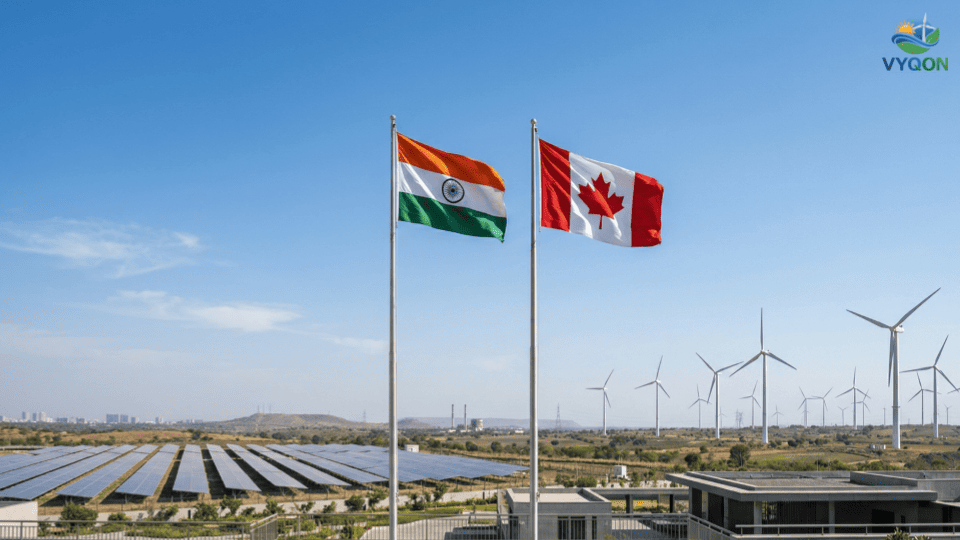
Canadian Prime Minister Mark Carney conducted an official state visit to India from February 27 to March 2, 2026. Following the leadership transition in Canada in March 2025, the visit was designated as a “strategic reset” to rebuild trust and normalize relations after the diplomatic tensions of 2023–2024. This engagement builds upon the “New Roadmap” for normalization drafted during the June 2025 G7 Summit in Kananaskis. The visit resulted in the signing of commercial agreements valued at C5.5 billion (approximately US4.04 billion based on a 1.36 CAD/USD exchange rate), anchored by the civil nuclear supply contract.
The Civil Nuclear Agreement and Uranium Supply Terms
A central component of the bilateral reset is a long-term agreement between Canada’s Cameco Corporation and India’s Department of Atomic Energy (DAE). This arrangement follows a previous five-year contract signed in 2015. The agreement supports India’s expanding nuclear infrastructure; the country currently operates 25 reactors with 18 additional reactors forthcoming. India aims to achieve a nuclear capacity of 100 GW by 2047.
Cameco–India Uranium Contract Specifications (2027–2035)
| Specification | Details |
| Total Volume | Nearly 22 million pounds (approximately 10,000 tonnes) of uranium ore concentrate (U3O8) |
| Contract Duration | 9 years |
| Delivery Period | 2027 to 2035 |
| Estimated Value | C2.6 Billion (US1.9 Billion) |
| Pricing Terms | Market-related terms based on UxC and TradeTech benchmarks (US$86.95/lb benchmark at signing) |
Renewable Energy and Storage Memorandum of Understanding (MoU)
Canada and India’s Ministry of New and Renewable Energy (MNRE) have signed an MoU on Clean Energy Cooperation. This agreement establishes an institutional framework for technical collaboration in specified sectors:
- Large-scale solar deployment.
- Wind energy and small hydro.
- Grid-level and battery energy storage.
- Bioenergy and Green Hydrogen.
- Sustainable Aviation Fuel (SAF).
- Application of Artificial Intelligence (AI) in the energy sector.
To facilitate this cooperation, the two nations have established a joint working group and committed to convening a Canada–India Renewable Energy and Storage Summit in 2026. Canada has also officially applied for membership in the International Solar Alliance (ISA) and is transitioning to full membership in the Global Biofuels Alliance (GBA).
Strategic Framework and Broader Energy Cooperation
The partnership was further detailed during the renewed India-Canada Ministerial Energy Dialogue held between India’s Minister of Petroleum and Natural Gas, Shri Hardeep Singh Puri, and Canada’s Minister of Energy and Natural Resources, The Hon. Timothy Hodgson. A central component of this dialogue was the Critical Minerals MoU, through which India endorsed the G7 Critical Minerals Action Plan to build resilient supply chains for clean energy manufacturing and technology.
The partnership also addresses conventional energy commodities:
- Liquefied Natural Gas (LNG): Canada is working toward a production target of 50 million tonnes of LNG per annum by 2030 and is positioning itself as a supplier for the Indian market.
- Other Commodities: Both nations intend to deepen cooperation regarding the supply of crude oil and Liquefied Petroleum Gas (LPG).
In the broader economic context, the two countries aim to conclude a Comprehensive Economic Partnership Agreement (CEPA) in 2026. This agreement is part of a strategic effort to reach a bilateral trade target of C70 billion (US51.47 billion) by 2030, representing a doubling of current trade levels.
Leave a Comment