
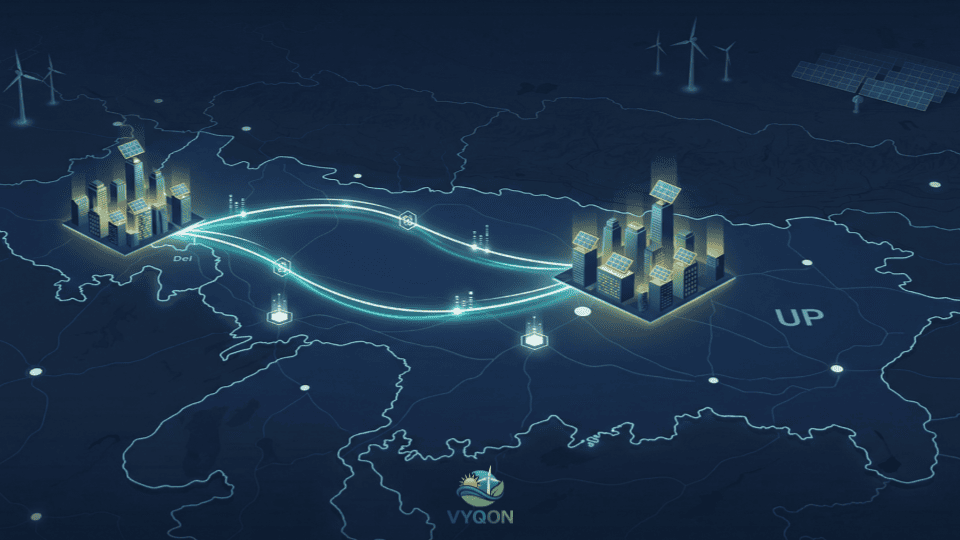
Regulators in Delhi and Uttar Pradesh have dismantled traditional barriers to decentralized power, clearing a landmark “regulatory sandbox” for India’s first interstate Peer-to-Peer (P2P) renewable energy trading pilot. Through separate orders issued on February 11, 2026 (DERC) and February 18, 2026 (UPERC), the commissions approved a six-month demonstration under the India Energy Stack (IES) framework. This pilot allows prosumers—households and businesses with rooftop solar—to bypass traditional utility-centric models and sell surplus electricity directly to consumers across state lines, validating a decentralized marketplace intended to empower small-scale renewable participants.
The India Energy Stack (IES): Digital Infrastructure and Version 0.3
The pilot serves as a live application of the India Energy Stack (IES), a Digital Public Infrastructure (DPI) overseen by REC Limited as the nodal agency. While early trials relied on previous iterations, the Ministry of Power rolled out the current Version 0.3 framework in February 2026 to unify fragmented digital systems across the power value chain. The IES utilizes blockchain technology for automated contract execution and financial settlement through four functional layers:
- Data Layer: Facilitates the secure and interoperable exchange of distributed energy records and real-time data flows.
- Identity Layer: Assigns persistent unique IDs and “Verifiable Credentials” to meters, assets, and consumers, acting as a digital passport for the grid.
- Exchange Layer: Ensures semantic consistency across the ecosystem using common data models and standardized taxonomies.
- Consent Layer: Employs the Data Empowerment and Protection Architecture (DEPA) to manage consumer-controlled data sharing and privacy.
The technical architecture integrates the Digital Energy Grid (DEG) and the Unified Energy Interface (UEI) to ensure that transactions remain interoperable between different utility jurisdictions.
Project Roadmap: Phased Implementation
The pilot is structured to test the scalability of multi-state coordination across the National Capital Region (NCR).
- Pilot Duration: Approved for a fixed six-month “sandbox” period.
- Phase I (Fast Track): Commencing February 15, 2026. This phase involves Pashchimanchal Vidyut Vitran Nigam Limited (PVVNL) in Uttar Pradesh, alongside Tata Power Delhi Distribution Ltd. (TPDDL) and BSES Rajdhani Power Ltd. (BRPL) in Delhi. Notably, BRPL was fast-tracked into Phase I following amendments to the pilot’s concept note in January 2026.
- Phase II: Scheduled to expand the pilot to include Dakshin Haryana Bijli Vitran Nigam (DHBVN) 3–6 months after the commencement of Phase I.
Regulatory Parameters and Commercial Framework
The commissions carved out specific financial dispensations to ensure the economic viability of small-scale trades. A critical distinction exists regarding network usage: DERC rejected claims for wheeling charges within Delhi’s territorial limits, labeling them “superfluous,” while UPERC approved recovery for its jurisdiction.
| Parameter | Approved Rate/Status | Distribution/Responsibility |
|---|---|---|
| Wheeling Charges (Delhi/DERC) | ₹0 (Rejected) | No charges applicable within the territorial limit of NCT Delhi. |
| Wheeling Charges (UP/UPERC) | ₹1.01/kWh | Approved for the UP-side of the transaction. |
| Transaction Charges | ₹0.42/kWh (incl. GST) | Shared equally (₹0.21 each) by the buyer and the seller. |
| Cross-Subsidy Surcharge (CSS) | Waived | Fully exempted for the duration of the pilot. |
| Additional Surcharge | Waived | Fully exempted for the duration of the pilot. |
| Under-injection Penalties | Waived | Penalty mechanism deferred for the pilot period. |
| Under-drawl Penalties | Waived | Penalty mechanism deferred for the pilot period. |
Technical Constraints and Accounting Rules
To maintain grid discipline while encouraging participation, the regulators established the following technical parameters:
- Eligible Participants: Restricted to prosumers and consumers with a sanctioned load of ≤ 200 kW (on the Delhi side).
- Scheduling (Interstate Pilot): To facilitate cross-border trade, scheduling is based on a full-day (6:00 AM – 6:00 PM) day-ahead basis, rather than the standard 15-minute time blocks used in intra-state transactions.
- Capacity Factor (CUF) Deviation: The commissions lifted the standard 20% Capacity Utilization Factor (CUF) restriction. This is a specific deviation from the 2024 P2P Guidelines intended to maximize the generation and consumption of local green energy.
- Metering Requirements: All participating premises must utilize Post-paid Smart Meters or ToD-compliant (Time of Day) Energy Meters integrated with the DISCOM’s billing system.
- Priority Settlement: P2P transactions will be integrated into DISCOM bills, with settlement for these units given priority over conventional utility supply charges.
Institutional Stakeholders
The interstate pilot is facilitated by a coalition of regulators and technology partners:
- Regulators: UPERC and DERC provided the legal scaffolding through Petition Nos. 2345/2026 and 06/2026.
- Nodal Agency: REC Limited.
- Participating DISCOMs: PVVNL, TPDDL, and BRPL.
- Technology Facilitators: The India Smart Grid Forum (ISGF) provided the foundational “Concept Note” and pilot design, with PowerXchange serving as the technology partner for the Digital Energy Grid.
Leave a Comment