
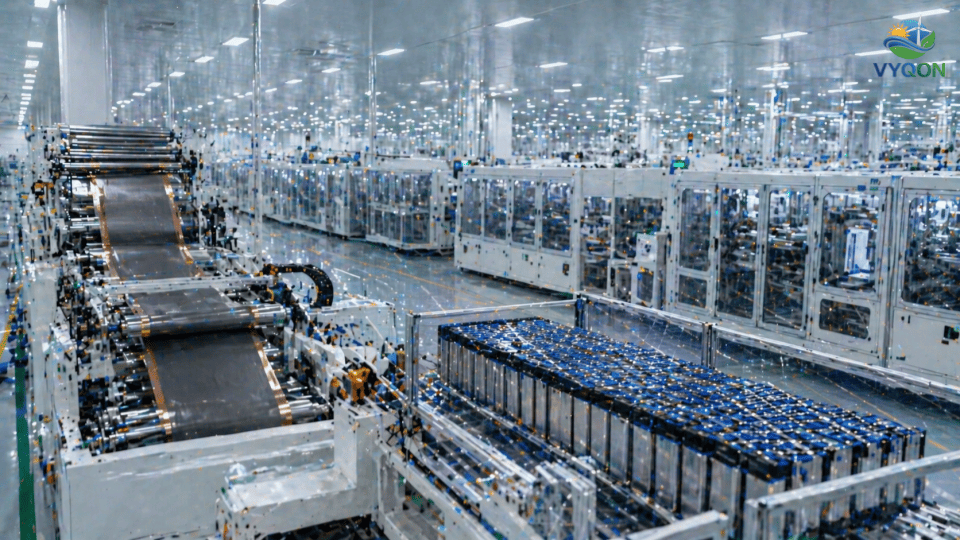
The Government of India has announced it will invite bids for 10 GWh of grid-scale battery energy storage systems (BESS) by May 2026. Renewable Energy Secretary Mr. Santosh Sarangi confirmed the initiative, which serves as a cornerstone for the nation’s efforts to manage the intermittency of solar and wind power. The move is designed to enhance grid stability and provide the necessary infrastructure to support the large-scale integration of variable renewable energy into the national power mix.
The Production Linked Incentive (PLI) Framework
The upcoming tender is integrated into the “National Programme on Advanced Chemistry Cell (ACC) Battery Storage,” which operates with a total budgetary outlay of ₹18,100 Crore. While the program’s overarching goal is to establish 50 GWh of domestic ACC manufacturing capacity, 10 GWh of this total has been specifically earmarked for stationary and grid-scale storage applications.
Under this “PLI-style” framework, the government aims to incentivize domestic value addition and reduce capital intensity. To date, 40 GWh of the total capacity has already been awarded to four beneficiary firms, including Ola Cell Technologies and Reliance. Recent progress includes a program agreement signed with Reliance New Energy Battery for 10 GWh under the dedicated stationary storage allocation. This brings the total awarded capacity for Reliance entities to 15 GWh, following a previous 5 GWh award to Reliance New Energy Battery Storage Ltd.
Economic Metrics and Cost Analysis
The economic feasibility of large-scale BESS has improved significantly due to sharp declines in battery pricing and targeted fiscal policy. According to recent data, storage costs have plummeted:
- 2022-23 Cost: ₹10.18 per kWh
- Recent Cost: Approximately ₹2.1 per kWh
This cost reduction is further supported by the Union Budget 2026, which extended Basic Customs Duty (BCD) exemptions on capital goods used in lithium-ion cell manufacturing to include equipment specifically for BESS applications. From a macroeconomic perspective, the shift toward domestic manufacturing and recycling is projected to yield substantial energy sovereignty benefits, with estimated forex savings of US$8–10 billion annually by 2035.
Strategic Context and National Regulatory Mandates
India’s current BESS deployment stands at 204.5 MW (505 MWh), a figure that remains a fraction of the infrastructure required to meet the 500 GW renewable energy target by 2030. To bridge this gap, the government is utilizing the Viability Gap Funding (VGF) scheme, which provides financial support for up to 40% of capital costs to enable 43 GWh of BESS deployment by 2030-31.
Crucially, the Ministry of Power issued a directive in December 2025 mandating a minimum of 20% local content for BESS projects implemented under the VGF program. This regulatory hurdle is designed to spur domestic industrial depth but arrives as the Ministry of Heavy Industries identifies several supply chain vulnerabilities, including:
- Gaps in skilled manpower and specialized technology availability.
- Heavy reliance on imported critical equipment and machinery.
- The non-availability of essential upstream components, specifically Cathode Active Materials (CAM) and Anode Active Materials (AAM).
Future Demand Projections
Central Electricity Authority (CEA) projections indicate a steep growth curve for storage requirements to ensure round-the-clock (RTC) renewable supply. As peak power demand is expected to reach approximately 270 GW, the storage requirements are defined as follows:
- By 2030: 336.40 GWh of total storage (comprising 208.25 GWh from BESS and 128.15 GWh from Pumped Storage Projects).
- By 2031-32: 411 GWh of total energy storage capacity.
Key Energy Storage and Renewable Targets
| Metric/Requirement | Target/Capacity | Timeline |
| Grid-Scale Battery Bid Target | 10 GWh | May 2026 |
| Renewable Energy Capacity Target | 500 GW | 2030 |
| Immediate Storage Requirement (CEA) | 336.40 GWh | 2030 |
| Total Energy Storage Requirement (CEA) | 411 GWh | 2031-32 |
| VGF Deployment Support | 43 GWh | By 2030-31 |
| VGF Financial Support | Up to 40% Capital Cost | 2030 |
| Total ACC Program Goal | 50 GWh | – |
| Current BESS Deployment | 204.5 MW (505 MWh) | Present |
Execution and Energy Security
The planned May 2026 tender marks a transition from policy intent to the active execution of India’s energy storage strategy. By linking financial incentives with local content mandates and customs duty exemptions, the government is attempting to build a self-reliant value chain. This structured approach aims to secure national energy sovereignty, mitigate global supply-chain risks, and reduce long-term reliance on fossil fuels through a resilient and flexible power grid.
Leave a Comment