
Overview
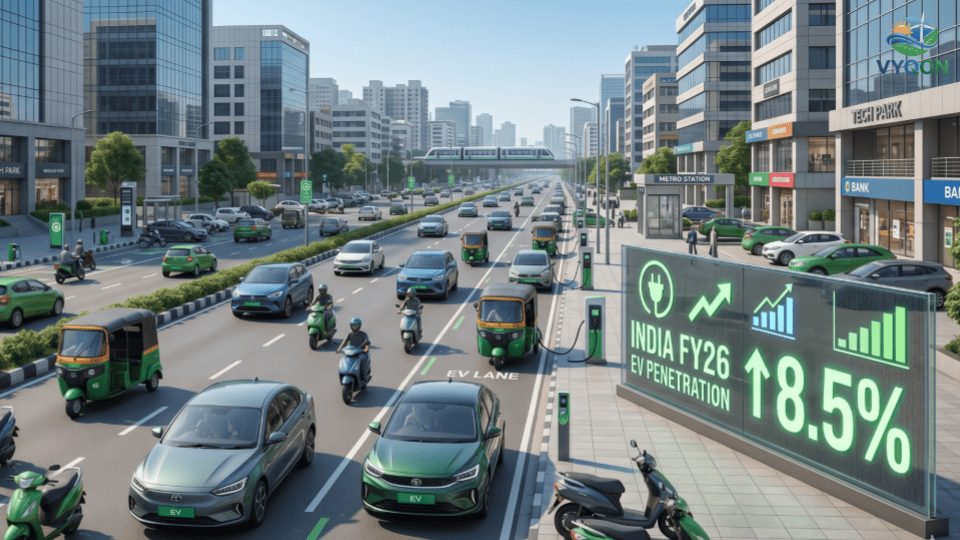
The Indian electric vehicle (EV) market demonstrated sustained expansion during the 2025-26 fiscal year (FY26). Total registrations for the period surpassed 2.5 million units (recorded as 2.45 million units in preliminary year-to-date figures), representing a year-on-year (YoY) growth of approximately 24%. Overall EV penetration reached 8.5% in FY26, a significant increase from the 7.7% recorded in FY25.
The following table compares key market performance indicators across the last two fiscal years:
| Metric | FY24-25 | FY25-26 |
| Total EV Registrations | ~1.97 Million Units | > 2.45 Million Units |
| EV Penetration Rate | 7.7% | 8.5% |
Segment Performance
Market growth was distributed across several vehicle categories, characterized by intensifying competition among legacy manufacturers and shifts in policy incentives:
- Two-Wheelers (E-2W): This segment remained the primary market driver, totaling 1.4 million units sold and accounting for 57% of total EV registrations. A major structural shift occurred as legacy Original Equipment Manufacturers (OEMs)—TVS Motor, Bajaj Auto, and Hero MotoCorp—leveraged their dealer networks to capture 61% of the segment. This rise in traditional OEM dominance contrasted with the sharp decline of former market leader Ola Electric, whose market share fell from 22.1% in April 2025 to 5.4% by March 2026.
- Three-Wheelers (E-3W): The market share for electric variants in the three-wheeler category reached 57% by March 2026. While the electric three-wheeler cargo (E-3W C) segment maintained steady growth due to Total Cost of Ownership (TCO) benefits in last-mile logistics, the passenger segment (E-3W P) saw a moderation in sales after December 2025. This slowdown was directly attributed to the exhaustion of PM E-DRIVE incentives for the L5 vehicle category.
- Passenger Electric Vehicles (e-PVs): The passenger EV market recorded an 83.6% surge in sales, with total retail registrations reaching 199,923 units. Market dynamics became increasingly competitive; Tata Motors maintained leadership but saw its market share decline sharply from approximately 57% in FY25 to 39% in FY26. This loss of dominance followed new launches and improved product positioning from JSW MG Motor, Mahindra, and Hyundai.
- Electric Commercial Vehicles (e-CVs) & Goods Vehicles: The electric goods vehicle (E-GV) segment, encompassing light, medium, and heavy trucks, recorded a massive 172% YoY growth. This expansion was primarily driven by the first-time inclusion of medium and heavy e-trucks under the PM E-DRIVE incentive scheme, alongside large-scale fleet conversions by e-commerce entities aiming to satisfy corporate environmental, social, and governance (ESG) targets.
Market Milestones
India’s EV ecosystem achieved several infrastructure and policy milestones in FY26, though infrastructure density remains variable across regions.
Infrastructure and Policy
- As of late 2025/early 2026, the total count of operational public charging stations reached 29,277 units.
- Karnataka leads the nation with 5,880 stations and a superior charging density of one station per 150 EVs. In contrast, the national average EV-to-charger ratio stands at 1:235. Delhi leads in geographical density, with one charging station every three square kilometers.
- Government support is anchored by the ₹10,900 crore PM E-DRIVE scheme and the ₹18,100 crore PLI-ACC outlay for battery storage. Within the PM E-DRIVE budget, ₹2,000 crore is specifically earmarked for charging infrastructure, while ₹4,391 crore supports the deployment of 14,028 e-buses in major metropolitan hubs.
Consumer Insights and Technology Data from the 2026 Deloitte Global Automotive Consumer Study indicates that 95% of Indian buyers are ready to pay for software-defined vehicle (SDV) features, signaling a shift toward digitally integrated mobility. However, this appetite for technology is tempered by privacy concerns, with 73% of consumers expressing apprehension regarding the sharing of personal device data. Hybrids continue to be viewed by a significant portion of the market as a critical transition technology.
Identified Challenges to Adoption Despite sustained growth, several structural barriers continue to influence the pace of EV adoption:
- Gaps in the availability of public charging infrastructure (cited by 43% of consumers).
- Extended charging times compared to internal combustion engine (ICE) refueling (41%).
- Concerns regarding battery safety and long-term lifecycle performance (38%).
Leave a Comment