
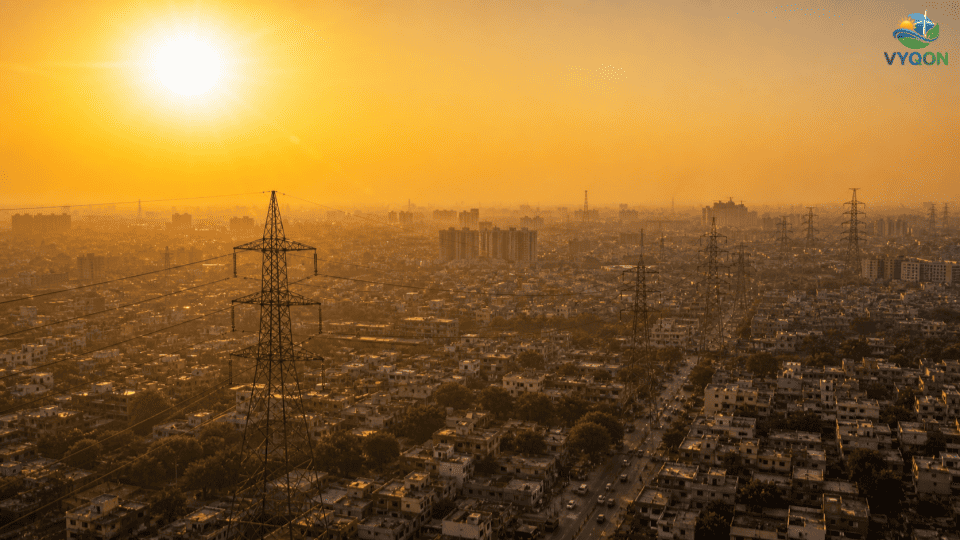
India’s national power grid reached a significant operational milestone on April 25, 2026, successfully meeting an all-time high peak electricity demand of 256.1 GW at 15:38 hours. This record-breaking achievement occurred without widespread shortages, even as the system navigated its fifth historic peak established within a single seven-day window. The new milestone surpasses the previous high of 250 GW recorded in May 2024, signaling a permanent upward shift in the nation’s load profile.
Year-on-Year Growth and Demand Drivers
Electricity consumption in April 2026 surged by 8.9% compared to the same period in the previous year. This growth was fueled by a premature and intense heatwave that gripped much of the country, significantly inflating cooling loads.
Environmental data highlights the severity of this climatic impact:
- Extreme Maximum Temperatures: Regional stations reported punishing conditions, with Banda in Uttar Pradesh recording a maximum temperature of 47.6°C.
- Elevated Night-time Minimums: Minimum temperatures in several regions failed to drop below 34.7°C, preventing infrastructure from cooling and sustaining high residential air-conditioning loads throughout the night.
- Persistent Thermal Stress: Sustained temperatures exceeding 40°C across 50 of the world’s hottest cities—all located in India during this period—triggered a “data-grounded reckoning” for grid resilience.
Supply-Side Performance and Capacity Additions
The demand was “fully met” through a combination of advance resource adequacy planning and a record capacity addition of approximately 65 GW during the 2025–26 financial year. This expansion has been critical in diversifying the generation portfolio, particularly in absorbing the nearly 9% growth in consumption.
At the 15:38 peak, the generation mix was dominated by thermal units, though solar provided a massive 21.5% contribution. Notably, the disparity between solar output and storage (BESS/PSP) remains a critical bottleneck, with storage accounting for just 0.1% of the total mix.
Source-wise Contribution at Peak Demand (256,117 MW)
| Source | Contribution (MW ex-bus) | Percentage of Total Generation |
| Thermal | 171,342 | 66.9% |
| Solar | 55,065 | 21.5% |
| Hydro | 11,269 | 4.4% |
| Nuclear | 6,147 | 2.4% |
| Gas | 5,122 | 2.0% |
| Wind | 4,866 | 1.9% |
| Others | 2,049 | 0.8% |
| Storage (PSP & BESS) | 257 | 0.1% |
Technical Coordination and System Strength Analysis
Coordinating this surge required seamless real-time synchronization between the National Load Despatch Centre (NLDC), Regional Load Despatch Centres (RLDCs), and State Load Despatch Centres (SLDCs). Despite maintaining a grid frequency of 50.00 Hz, technical analysts have raised concerns regarding “weak grid” conditions.
The Southern Regional Power Committee (SRPC) and GRID-INDIA have identified a declining Short Circuit Ratio (SCR < 5) at major Renewable Energy (RE) pooling stations, such as Koppal in the South and Fatehgarh/Bhadla in the North. This low system strength has led to frequent voltage oscillations ranging from 0.1 Hz to 20 Hz. Furthermore, discrepancies in the New WBES Portal and REMC schedule revisions have complicated intraday balancing, leading to instances of significant Over Drawl (OD) and Under Drawl (UD) by state utilities.
Infrastructure Risks and Operational Constraints
The NLDC and SRPC have issued urgent directives to manage the physical and technical risks posed by the current load:
- Transmission Vulnerabilities: High ambient heat has increased conductor sag, reducing ground clearance and risking flashovers. Utilities are now mandated to use drone-based patrolling, thermal scanning, and proactive vegetation management to prevent line trippings.
- Fast Frequency Response (FFR): Under CEA Clause B2(4)(ii), all RE plants >10 MW are now required to provide immediate primary frequency response (at least 10% of max AC power within 1 second) to stabilize the grid during high-frequency events (>50.3 Hz).
- Telemetry Gaps: Analysis shows a critical failure in weather data telemetry from RE stations, with Irradiance and Wind data availability often falling below 10%, hampering accurate forecasting.
- Forced Outages: System reliability was strained by approximately 21 GW of coal and nuclear capacity being unavailable due to forced shutdowns and maintenance during the peak period.
Outlook: The 270 GW Barrier
The Ministry of Power anticipates that demand will likely scale the 270 GW barrier in May 2026. While daytime solar peaks are manageable, the primary challenge remains the “non-solar” or evening peak, where demand remains high but solar generation is absent.
Current night-time shortfalls have already reached 5.4 GW, equivalent to the load of 2.7 million rural homes. To mitigate this, the Ministry has directed the maximum dispatch of all flexible resources, including gas and hydro, and has requested all stakeholders to optimize maintenance schedules to ensure every available megawatt is on-bar during the remaining summer months.
Leave a Comment