
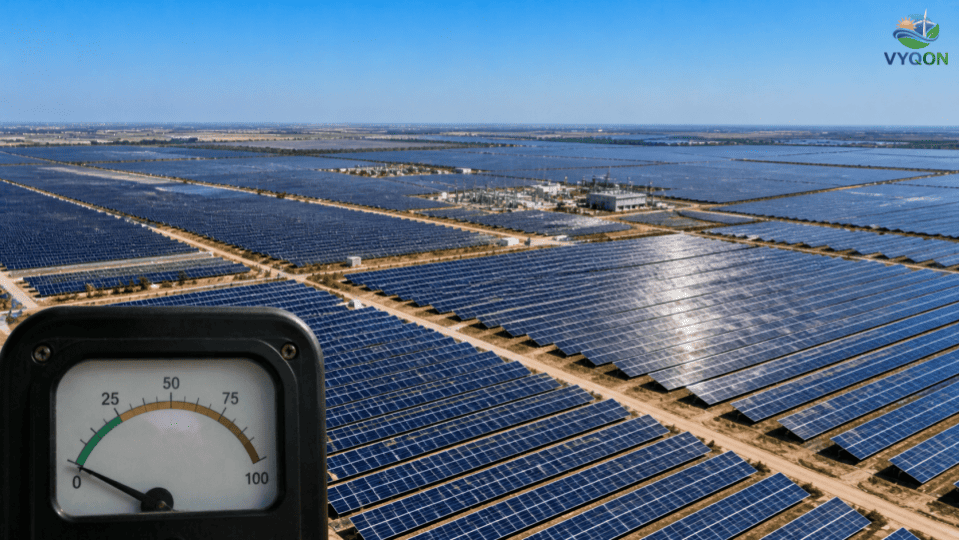
In the January-March quarter of the 2025-26 fiscal year (Q4 FY26), India’s power grid reached a critical inflection point, necessitating the curtailment of 31 GW of renewable energy capacity. According to data from the Centre for Research on Energy and Clean Air (CREA), these losses occurred despite peak power demand reaching a record 245 GW on January 9, 2026. The crisis is fundamentally driven by structural and operational bottlenecks, specifically inadequate transmission capacity to evacuate green power and limited system flexibility to manage the increasing share of variable renewable energy (VRE).
Data Breakdown: The Curtailment Paradox
The Indian energy sector is grappling with a “Paradox of Growth.” While the grid is successfully adding record-breaking solar capacity, it is increasingly unable to absorb the generated energy during peak production hours.
- Direct Curtailment Split: Of the 31 GW curtailed, solar accounted for 27 GW (72 MU), while wind generation saw 4 GW (6 MU) restricted.
- Continued Generation Growth: Paradoxically, solar generation grew by 24% year-on-year (YoY), rising from 39.5 billion units (BU) in Q4 FY25 to 48.9 BU in Q4 FY26.
- Total Quarterly Output: Overall quarterly generation reached 464 BU, a 3% YoY increase, though growth has moderated compared to previous years.
- Environmental and Economic Cost: This curtailment represents more than just a technical loss; it resulted in 2.11 million tonnes of foregone CO2 abatement—equivalent to the annual emissions of 0.4 million Indian households. Economically, while generators are compensated through the Deviation and Ancillary Service Pool Account, the system incurred costs estimated between USD 63 million and USD 76 million (INR 5,750–6,900 million).
The Scale of Emergency Interventions
Beyond direct curtailment, the National Load Dispatch Centre (NLDC) relied heavily on Tertiary Reserve Ancillary Service (TRAS) as a “third line of defense” to maintain frequency. Under TRAS-down events—emergency interventions triggered when demand is lower than forecast—an additional 83 GW of solar (103 MU) and 11 GW of wind (17.5 MU) were curtailed. These figures underscore that operational instability is now a primary hurdle to decarbonization.
Regional Focus: Gujarat as a High-Penetration Testbed
Gujarat has emerged as the epicenter of India’s integration challenge, acting as a real-world stress test for the national grid’s ability to handle high VRE penetration.
- State-Level Losses: Gujarat recorded the nation’s highest curtailment figures, with 20 GW (57 MU) of solar and 3 GW (4.6 MU) of wind restricted.
- Khavda Station Crisis: The Khavda station observed the most intense TRAS-down events, with approximately 18 GW (23 MU) of solar and 5 GW (10 MU) of wind curtailed.
The regional concentration of these losses highlights a persistent mismatch between high-renewable resource zones and the grid’s ability to either flex local thermal generation or transport surplus power to distant demand centers.
Technical Drivers: The Thermal Flexibility Bottleneck
The structural root of curtailment lies in the inability of the coal-based thermal fleet to provide sufficient “downward flexibility.” This is exacerbated by “Duck Curve” pressures, where solar surges at midday are followed by a steep evening ramp-up requirement of nearly 60 GW.
- Minimum Technical Load (MTL) Constraints: Most coal plants are currently mandated to a 55% MTL. To meet the evening peak, these plants must stay online during the day, leaving little headroom for solar.
- The October 12 Precedent: On October 12, 2025, a record 23 GW was curtailed despite the coal fleet operating at a 60% load factor. This suggests the bottleneck is not purely technical but also contractual and commercial, as many units—particularly at the intra-state level—are constrained from hitting even their 55% technical floor.
- January 9 Peak Analysis: During the 245 GW peak on January 9 (at 10:00 AM), thermal power still contributed 67% (165 GW) of total generation. The necessity of keeping this massive coal fleet synchronized and at technical floors forced the rejection of available clean energy.
Reported Solutions and Policy Recommendations
To mitigate the systemic waste of clean electricity, the Central Electricity Authority (CEA) and CREA have proposed a multi-lever roadmap for grid modernization.
- Reduction of Minimum Technical Load (MTL): Regulators are pushing to lower the thermal floor from 55% to 40% by December 2030. The CEA recently found no significant equipment damage attributable to low-load operations, countering industry concerns.
- Transmission Infrastructure Expansion: The CEA has planned 1,37,500 ckm of new transmission lines and 8,27,600 MVA of substation capacity to integrate a projected 900 GW of renewables by 2036.
- Energy Storage Deployment: India’s storage pipeline has reached 247 GWh, consisting of 138 GWh of Pumped Storage Projects (PSP) and 111 GWh of Battery Energy Storage Systems (BESS). While currently limited, 6 GWh of BESS is expected to be commissioned by December 2026.
- Grid Flexibility Enhancements: Recommendations include “two-shift” operations for older, smaller thermal units—allowing them to shut down during midday solar peaks—and accelerating the deployment of smart meters (currently only at 19% of sanctioned levels) to enable demand-side management.
The Transition from Capacity to Flexibility
As of March 2026, India’s total installed capacity reached 533 GW, with non-fossil sources accounting for a landmark 53% (including 150 GW of solar). However, the record curtailment of Q4 FY26 demonstrates that the success of the energy transition no longer depends on simply adding capacity, but on the grid’s ability to manage it. The system must evolve from a “capacity-centric” model to a “flexibility-ready” framework. Without rapid investment in storage, transmission, and deeper thermal cycling, a rising share of India’s clean energy investments will remain underutilized.
Leave a Comment