
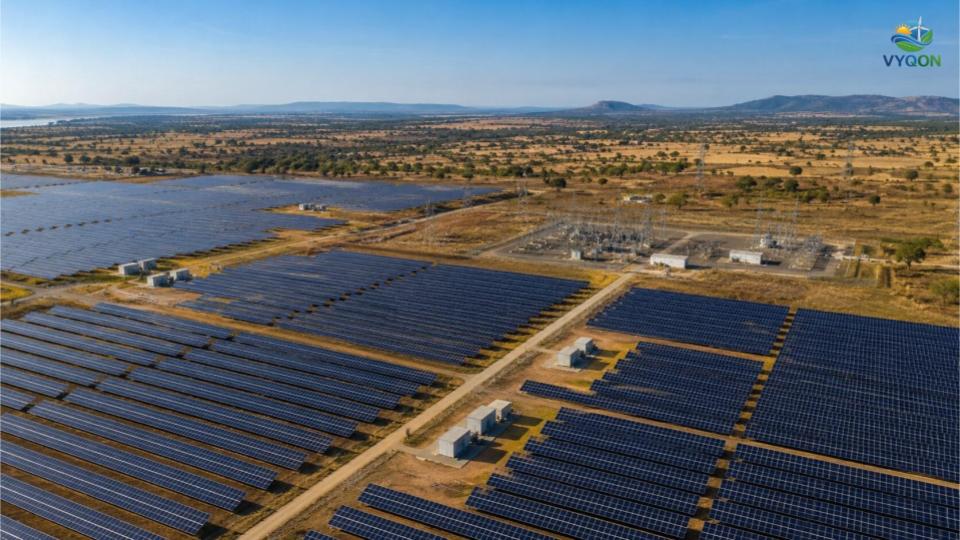
Kalpa Power has announced that it has secured a 286 MWp utility-scale solar project in Madhya Pradesh. The award is a substantial addition to the company’s development portfolio and brings another large project into one of India’s fastest-growing renewable-energy states.
The public announcement confirms the project capacity and state, but it does not identify the exact site, buyer, tariff, commercial structure or commissioning schedule. Those details will determine the project’s final economics. Even so, a 286 MWp award is large enough to require disciplined land, transmission, procurement and construction planning from the beginning.
What Has Been Confirmed
Kalpa Power disclosed the award through its official company channel and described it as a 286 MWp utility-scale solar project in Madhya Pradesh. Supporting industry reports published on 26 and 27 August repeat the same headline capacity. Kalpa has not yet released a detailed project note containing the offtaker, location, execution scope, contract value or expected commercial-operation date.
That distinction is important for readers and investors. The project is a confirmed company announcement, but assumptions about whether it is an EPC contract, an owned generating asset, an open-access project or part of a public procurement would be premature. Future filings, power-purchase information and grid approvals should provide a fuller commercial picture.
Why 286 MWp Is a Meaningful Development
A project of this size moves beyond a routine rooftop or small open-access installation. It will require hundreds of thousands of photovoltaic modules, multiple inverter stations, internal roads, drainage, monitoring systems and a high-voltage pooling arrangement. The exact land footprint will depend on module efficiency, terrain, design density and environmental constraints, but the development challenge is clearly utility-scale.
The capacity also creates a meaningful supply-chain requirement. Module deliveries must be sequenced with mounting structures, cables, transformers and switchgear so that storage at site does not become a bottleneck. Quality control becomes especially important because a repeated defect across thousands of identical components can affect generation across a large portion of the plant.
Madhya Pradesh as a Solar Growth Market
Madhya Pradesh combines strong solar irradiation, sizeable land parcels and access to major electricity networks. The state has already hosted large solar developments and continues to attract projects serving utilities, commercial buyers and interstate demand. Kalpa’s announcement said the state’s renewable capacity has grown from 438 MW to more than 11,000 MW, illustrating the scale of the market’s transformation.
A large project can strengthen that growth only when generation and transmission are completed in step. Developers must confirm the available evacuation capacity, technical connection requirements and any network upgrades early in the schedule. A finished solar field without a ready transmission route cannot create the expected commercial value.
From Award to a Construction-Ready Project
The next phase will normally involve land control, topographical and geotechnical studies, detailed engineering, permits and grid coordination. Survey work will shape the block layout, while soil conditions will determine the most suitable foundation and pile-driving approach. Hydrology studies are equally necessary because seasonal water movement can damage access roads, cable trenches and equipment foundations if drainage is treated as an afterthought.
Engineering teams must then convert the rated DC capacity into an efficient AC system. Module selection, string length, inverter loading, cable losses and transformer design all influence the energy delivered at the grid meter. The best design is not simply the one with the lowest initial cost; it must balance capital expenditure, yield, reliability, maintenance access and long-term degradation.
Execution Discipline Will Shape the Schedule
Utility-scale solar construction depends on coordination across many contractors and suppliers. Civil work must prepare the site without delaying structure installation. Electrical work must follow completed blocks closely enough to enable phased testing. The substation and transmission line often sit on the critical path because their equipment has longer manufacturing and approval lead times than standard solar components.
Safety systems must scale with the workforce. Traffic movement, lifting, electrical isolation, heat exposure and work at height all need project-specific controls. A compressed schedule can be achieved only when planning, material availability and safe execution improve together. Cutting inspection or commissioning steps would create faults that are harder and more expensive to correct after energisation.
Performance After Commissioning
Once operational, the plant’s value will depend on energy yield and availability rather than nameplate capacity alone. Operators will track performance ratio, inverter availability, module temperature, soiling losses, auxiliary consumption and grid downtime. Drone thermography and string-level analytics can help identify hotspots or underperforming sections before a small defect becomes a material generation loss.
Water use and cleaning strategy will also matter in a dry, dusty environment. The project may combine scheduled cleaning with weather data and measured soiling rates so that cleaning occurs when the recovered energy justifies the cost and water consumption. Vegetation management, spare-part planning and cyber-secure remote monitoring will support reliable operation over the project life.
What the Market Should Watch Next
The most useful next disclosures will be the project’s commercial model, buyer, location, AC capacity, tariff or contract value, transmission arrangement and targeted commissioning date. These facts will show whether the award strengthens Kalpa’s owned generation portfolio, its EPC order book or another part of its business. They will also allow a clearer comparison with other recent solar awards.
Kalpa says it aims to build a 5 GW portfolio by 2030 and reports experience across more than 300 projects. The 286 MWp Madhya Pradesh project is therefore strategically relevant, but execution milestones will be the real test. Land closure, financial arrangements, equipment orders, grid approvals and the start of construction should provide the next evidence of progress.
Conclusion
Kalpa Power’s 286 MWp award is a fresh utility-scale addition to India’s solar pipeline and a notable development for Madhya Pradesh. The announcement establishes the capacity, while leaving several commercial details for later disclosure. If the company converts the award into a transmission-ready, well-engineered and reliably operated plant, the project can contribute meaningful clean generation and strengthen Kalpa’s path toward its 2030 portfolio target.
Original References
1. Kalpa Power official company announcement
Kalpa Power’s official company page contains the original announcement confirming that it secured a 286 MWp utility-scale solar project in Madhya Pradesh and restating its 5 GW ambition for 2030.
Leave a Comment