
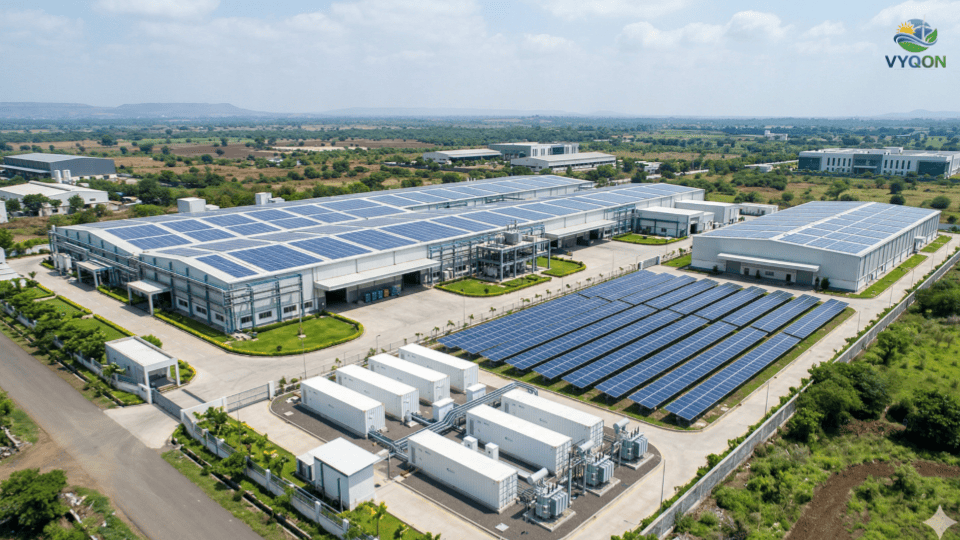
On March 18, 2026, the Government of Maharashtra notified the “Maharashtra Renewable Energy and Energy Storage Policy 2025-26 to 2035-36,” establishing the state as India’s first to mandate energy storage as a core requirement for renewable energy integration. Superseding the 2020 framework, the new policy transitions the state’s power sector from standalone renewable procurement to a model where energy storage is a mandatory enabler for grid stability and Resource Adequacy. A centerpiece of this directive is the provision of a 10-year electricity duty waiver for specific green energy projects, signaling a strategic shift toward firm, dispatchable power.
Technical Requirements for Waiver Eligibility
To qualify for the 10-year electricity duty waiver, projects must adhere to rigorous technical mandates. This specific fiscal incentive is targeted at Long-term Captive Green Energy Open Access projects that meet the following criteria:
- Mandatory Capacity Ratio: Energy storage systems (ESS) must maintain a capacity equivalent to at least 50% of the total renewable energy project capacity.
- Waiver-Specific Discharge Duration: While the general policy mandate requires a 2-hour storage discharge duration for projects commissioned by the end of FY 2029-30, projects seeking the 10-year electricity duty waiver must meet a higher performance standard of at least 4 hours of discharge duration.
- Mandatory Threshold for New Projects: From April 1, 2026, storage integration is mandatory for all new solar PV and wind projects above a threshold of 100 kW.
- Technology Scope: The mandates apply to solar PV, wind, and wind-solar hybrid configurations, with the policy also explicitly recognizing Pumped Storage Projects (PSP) as a long-duration pathway alongside Battery Energy Storage Systems (BESS).
Scope of Benefits and Financial Exemptions
Eligible long-term captive projects integrated with storage are granted significant fiscal relief to optimize project economics. These exemptions apply strictly to energy storage systems drawing power for intermediate storage purposes for in-state use.
| Incentive Type | Waiver Status/Condition |
| Electricity Duty | Exempt for a 10-year period |
| Transmission Charges | Fully Exempt for in-state consumption |
| Wheeling Charges | Exempt (includes distribution demand and wheeling charges) |
| Cross-Subsidy Surcharges | Fully Exempt |
Policy Timeline and Long-Term State Targets (2030–2036)
The 2025–2036 policy framework outlines a phased implementation schedule designed to align the state’s industrial load base with decarbonization targets.
FY 2029-30 Target The state aims to achieve a 50% renewable energy share in its total power mix. This includes a specific goal to deploy 10 GW of new solar, wind, or hybrid capacity integrated with co-located energy storage, featuring a minimum 2-hour discharge duration.
FY 2035-36 Target By the end of the policy period, Maharashtra targets a 65% renewable energy share of total power needs. This envisages an implied cumulative capacity of 100 GW of renewable energy and the deployment of 25 GW of storage-integrated renewable energy projects.
Storage Obligation Distribution licensees (DISCOMs) are mandated to procure energy storage capacity equivalent to 100 GWh/day by FY 2035-36. This is approximately equivalent to 20 GW of storage at a 5-hour duration, or roughly 10% of the state’s total power demand.
Renewable Charging Condition To ensure storage contributes to actual decarbonization, storage obligations are deemed met only if at least 85% of the stored energy is sourced from renewable energy on an annual basis.
Regulatory Background: Grid Connectivity and Infrastructure
The policy defines clear infrastructure requirements to facilitate grid integration and ensure system strength. The minimum connectivity threshold for any energy storage system seeking to link with the intrastate transmission system (InSTS) is 5 MW. For standalone ESS projects, developers must apply for a grant of connectivity for the higher of the quantum of its proposed maximum injection of power to the InSTS or its proposed maximum draw from the InSTS.
Regarding metering, the policy aligns with the MERC (Distribution Open Access) Second Amendment Regulation 2023 and subsequent MSEDCL circulars. Low Tension (LT) consumers with a Contract Demand lower than 1 MW opting for Green Energy Open Access must install Four Quadrant Bidirectional (Import + Export) Smart LT-ToD meters. These meters must be provided through an Advanced Metering Infrastructure Service Provider (AMISP) and include both a Main and Check meter as per Central Electricity Authority (CEA) regulations.
This strategic framework arrives following a Supreme Court affirmation of the state’s authority to recalibrate fiscal concessions. The Court ruled that tax exemptions are policy concessions rather than permanent vested rights, allowing the state to modify incentives in the public interest. However, the Court introduced a mandatory “fairness buffer,” ruling that any withdrawal of such concessions can only take effect after a one-year notice period, providing a vital transition window for industrial financial planning.
Leave a Comment