
Project Framework
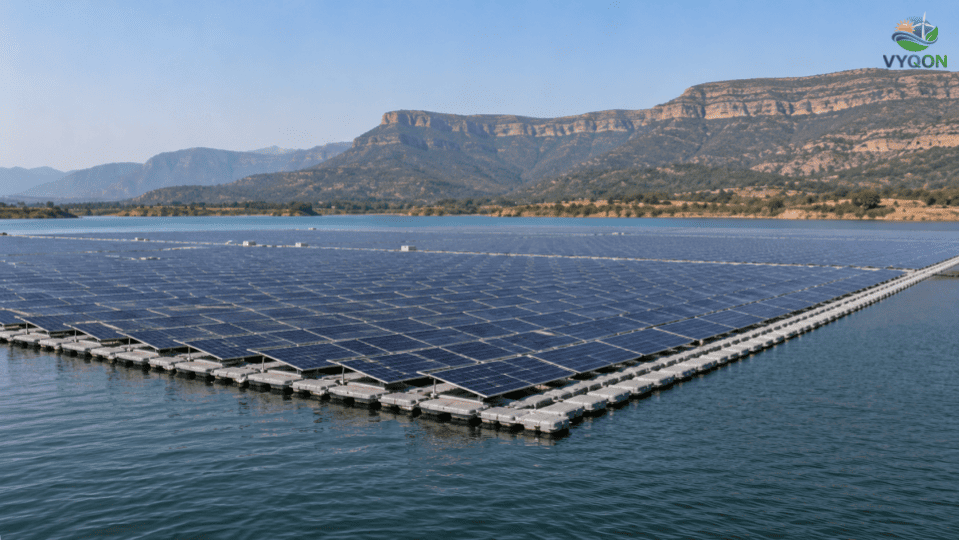
The Maharashtra Krishna Valley Development Corporation (MKVDC), operating under the Chief Engineer of the Water Resources Department, Pune, has issued a significant request for Expressions of Interest (EoI) to develop a massive 807 MW floating solar and battery storage portfolio. The initiative, structured on a Public Private Partnership (PPP) basis, involves the Development, Operation, Maintenance, and Management of Floating Solar PV (FSPV) integrated with Battery Energy Storage Systems (BESS) across six strategic reservoirs.
While the scale of this invitation is unprecedented for the state, infrastructure analysts remain cautious. Maharashtra has historically struggled to bridge the gap between policy ambition and project execution. Previous flagship attempts, such as the 105 MW Erai Floating Solar Park, have stalled repeatedly due to grid evacuation infrastructure delays and the cancellation of connectivity approvals. This latest push by MKVDC represents a critical test of whether the state can overcome systemic structural challenges—ranging from high evacuation costs to the complexities of Design, Build, Finance, Operate & Transfer (DBFOT) models—and finally capitalize on its leading national potential.
Technical Specifications and Capacity Distribution
The project envisions an aggregate capacity of 807 MW for FSPV and 403 MW/807 MWh for BESS. To ensure grid stability and technological uniformity, all installations must comply with the latest Central Electricity Authority (CEA) technical standards for Solar and BESS integration. The aggregate capacity is distributed across the following waterbodies, primarily managed via the Satara administrative division:
| Reservoir/Waterbody Name | District Location | Project Scope (DBFOT Basis) |
| Manikdoh | Pune / Satara Admin | FSPV + BESS Development & Management |
| Veer | Satara / Pune | FSPV + BESS Development & Management |
| Ghod | Pune / Satara Admin | FSPV + BESS Development & Management |
| Pimpalgaon Joga | Pune / Satara Admin | FSPV + BESS Development & Management |
| Ekrukh | Solapur / Satara Admin | FSPV + BESS Development & Management |
| Urmodi | Satara | FSPV + BESS Development & Management |
Procurement Calendar and Critical Deadlines
The procurement process is divided into two distinct phases: a prerequisite consultancy phase for feasibility and the subsequent developer tender. Bidders must note the different timelines associated with these components to ensure compliance.
Consultancy Component (Feasibility & BTCA):
- Pre-Bid Meeting: December 23, 2025 (MAHAPREIT Office/Online)
- Technical Bid Opening: January 13, 2026
Developer Tenders (MKVDC Implementation):
- Published Date: July 01, 2026
- Bid Submission Deadline (Closing Date): July 22, 2026
- Bid Opening Date: July 24, 2026
- Validity Period: 120 days from the date of opening.
- TENDER PORTAL: https://mahatenders.gov.in/nicgep/app
Bidder Eligibility: Technical and Financial Criteria
MKVDC has established stringent qualification benchmarks to filter for high-competency developers. A maximum of two members are permitted in a consortium.
Financial Qualifications
- Average Annual Turnover: Minimum ₹5.00 Crores during the last three financial years (FY 2022-23, 2023-24, and 2024-25).
- Net Worth: Must be positive.
- Consortium Dynamics: The Lead Member must contribute at least 50% of the turnover requirement; the combined consortium must meet 100%.
Technical Qualifications
- Operational History: Minimum of 7 years as of the bid submission date.
- Cumulative Experience: Demonstrated history in consultancy or execution of grid-connected FSPV projects totaling at least 25 MW.
- Project Specificity: At least one single FSPV project of 10 MW or greater must have been completed within the last five financial years.
Required Professional Expertise (Consultancy Component)
For the prerequisite Bankable Techno-Commercial Assessment (BTCA) and feasibility phase, the appointed consultancy must deploy a specialized technical team. This team is tasked with addressing the “fail-to-float” risks that have plagued previous Maharashtra tenders, such as bathymetry complexities and mooring failures.
- Team Leader/FSPV Lead: 10+ years experience in utility-scale solar; 3+ years in FSPV.
- Hydrology/Bathymetry Specialist: 5+ years in water-level analytics and reservoir sedimentation.
- Mooring/Structural Engineer: 5+ years in floating structures and wind/wave load assessment.
- Electrical & Interconnection Engineer: 8+ years in power evacuation and substation bay planning.
- GIS/Remote Sensing Analyst: 5+ years in FRL/MDDL delineation and constraint mapping.
- E&S Specialist: 7+ years in environmental screening and gender-disaggregated engagement.
- Financial Analyst: 7+ years in LCOE analysis and DBFOT financial modeling.
Regional Context: Maharashtra’s Floating Solar Potential
This MKVDC initiative is a vital attempt to realize the untapped renewable potential of Maharashtra’s water resources. According to the National Institute of Solar Energy (NISE), India possesses a floating solar potential of 102.18 GWp. Maharashtra holds the highest share of this potential at 16.28 GW, yet it remains one of the states with an abysmal track record of actual implementation.
By targeting the utilization of 1,946 sq. km of water surface area across these six reservoirs, the state aims to bypass land-acquisition hurdles that have historically slowed ground-mounted projects. If successful, this 807 MW push could signal a shift from policy aspiration to genuine infrastructure deployment, finally establishing Maharashtra as a leader in the national floating solar landscape.
Leave a Comment