
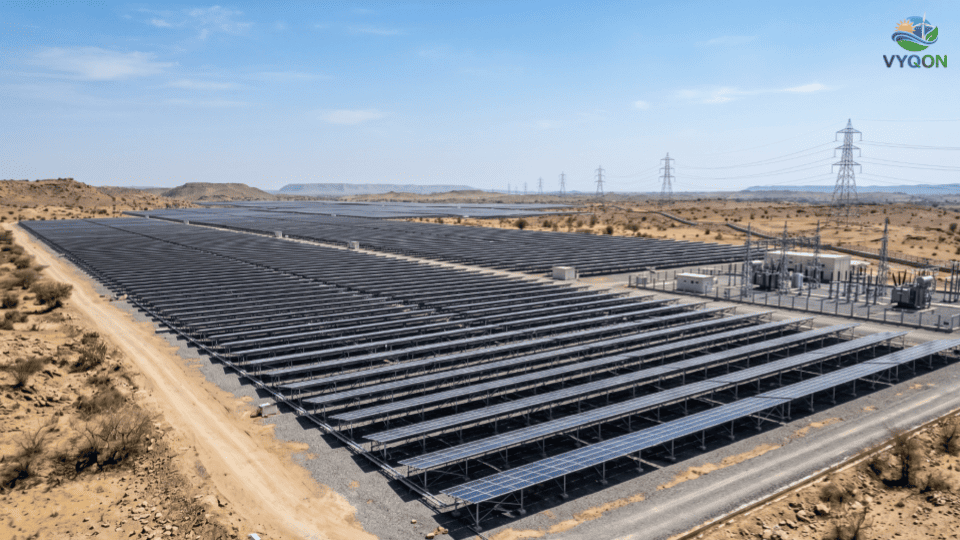
On June 23, 2026, the Ministry of New and Renewable Energy (MNRE) issued a pivotal notification enabling “provisional commissioning” for utility-scale, captive, and commercial & industrial (C&I) solar projects. This time-bound intervention provides urgent relief to developers caught in a commissioning impasse following the June 1, 2026, implementation of mandatory domestic solar cell sourcing under the Approved List of Models and Manufacturers (ALMM) List-II. The directive creates a limited, one-month window for projects physically installed before the June 1 deadline to commence operations while their formal exemption applications are being processed.
Project Eligibility and Technical Prerequisites
To resolve the current regulatory gridlock, the MNRE has established a dual-category eligibility framework. Project developers must satisfy rigorous technical milestones to qualify for provisional status.
- Category I: Projects where 100% of the solar PV modules were physically installed at the site before June 1, 2026, but which failed to achieve formal commissioning by that date.
- Category II: Projects that demonstrate “effective steps” were taken prior to the deadline, requiring the simultaneous fulfillment of the following:
- Possession of at least 75% of the total project land (via registered ownership, lease, or allotment).
- Documented achievement of financial closure.
- Receipt of in-principle grid connectivity with a specified start date.
- Formal approval of electrical drawings prior to May 1, 2026.
- Evidence that either 100% of the required modules reached the site or more than 50% were installed before June 1, 2026.
Mandatory Digital Submission & Documentation Developers are cautioned that the application process is exclusively digital; no physical applications will be accepted. Submissions must be made via the National Institute of Solar Energy’s (NISE) Domestic Content Requirement (DCR) portal. Required evidence includes:
- Certifications from the relevant Electrical Inspectorate confirming DC-side and module installations.
- Geo-tagged and GIS-tagged photographs of the project site.
- GST invoices and e-way bills for all major components.
- An active application for ALMM List-II exemption submitted on the NISE portal by the June 30, 2026, deadline.
Claims will be scrutinized by an Expert Committee constituted by the Ministry, which will recommend relief on a project-wise basis. Developers should note that commissioning remains provisional and subject to the final decision of this committee; a denial of exemption may trigger contractual penalties or clawback risks.
Mandates for DISCOMs and State Authorities
A core objective of this notification is to de-link a project’s ALMM-II exemption status from its operational rights. The MNRE has issued a binding directive to State Nodal Agencies (SNAs), DISCOMs, and central commissioning authorities, prohibiting them from withholding the following based solely on pending exemptions:
- Grid connectivity and power injection.
- Power wheeling and energy banking agreements.
- Commercial Operation Date (COD) recognition.
- Scheduling registrations and energy settlement.
Commissioning authorities must document any delays in writing, specifically noting if the delay originated from the approving authority’s internal processes.
Context: The “Capacity Gap” and Regulatory Impasse
The current “stranded asset” scenario was catalyzed by the May 25, 2026, Office Memorandum, which ruled out blanket extensions for ALMM List-II compliance. This led many state agencies to abruptly halt commissioning for projects that were physically ready but used imported cells.
This policy friction is rooted in a significant structural Capacity Gap: while India’s module assembly capacity stands at approximately 108 GWp, domestic solar cell manufacturing capacity lags at just 27-28 GWp. This shortfall means domestic production currently covers only one-quarter of the modules required to meet the mandate, particularly for high-efficiency TOPCon cells.
Furthermore, the broader policy environment remains influenced by the Ministry of Finance notification (April 29, 2026) regarding the West Asia crisis. This notification classifies the situation as “war” for force majeure purposes, allowing for case-by-case extensions of not less than two months and not more than four months for affected contractual obligations.
Operational Timelines and Absolute Cutoffs
The MNRE has explicitly characterized this as a “limited and transitional intervention” to clear the existing backlog. It is not an extension of the broader June 1 compliance deadline.
Critical Compliance Windows
| Milestone | Date / Deadline |
| Installation Cutoff for Eligibility | June 1, 2026 |
| NISE DCR Portal Application Deadline | June 30, 2026 |
| Provisional Commissioning Window Opening | June 23, 2026 |
| Window Duration | One Month (Closing July 23, 2026) |
Special Provisions for Residential Rooftop Sector
Specific relief measures have been tailored for the residential sector under the PM Surya Ghar: Muft Bijli Yojana to ensure the momentum of distributed solar is maintained.
- “Give It Up” Campaign: Residential consumers who voluntarily forgo government subsidies are granted an extended exemption from ALMM List-II cell requirements until March 31, 2027, provided they apply through the scheme’s national portal.
- Rooftop Commissioning Deadline: For other non-subsidy rooftop projects installed before June 1, 2026, a separate commissioning window remains open until July 15, 2026.
- Simplified Compliance: To expedite the process, rooftop developers may substitute formal Electrical Inspectorate certifications with GIS-tagged site photographs, invoices, and self-certifications.
Leave a Comment