
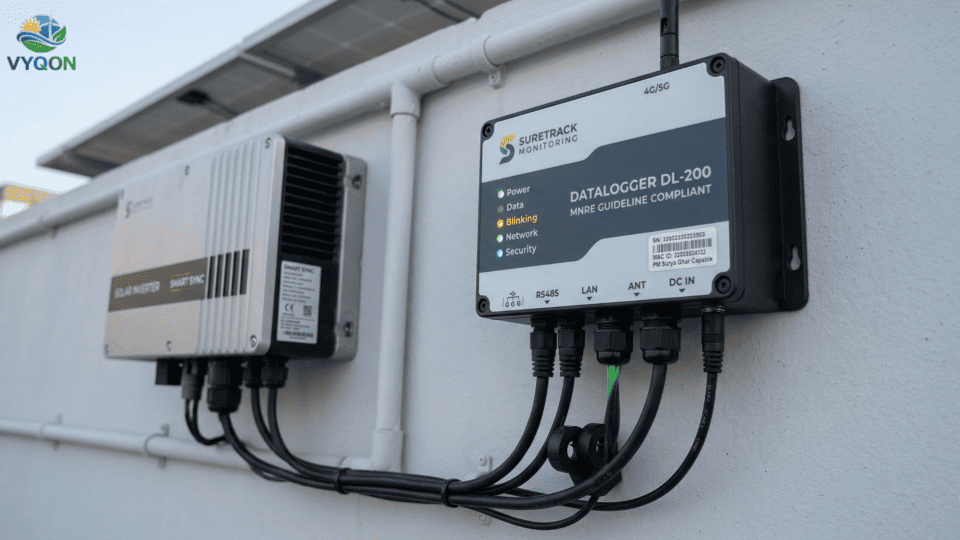
The Ministry of New and Renewable Energy (MNRE) has released a comprehensive set of draft “Firmware Development Guidelines for Device Local Configuration & Remote Communication APIs” to standardize the monitoring infrastructure for India’s massive rooftop solar expansion. Issued on April 2, 2026, the framework establishes mandatory technical protocols for all Remote Monitoring Systems (RMS) and dataloggers deployed under the “PM Surya Ghar: Muft Bijli Yojana.” The Ministry stipulates that standardization is essential to manage the increasing complexity of rooftop solar deployments, ensuring nationwide interoperability, data integrity, and the protection of grid stability as the scheme targets 10 million households.
Technical Framework and API Specifications
The MNRE prescribes a rigid technical architecture that manufacturers and firmware developers must adopt. The Ministry mandates that all APIs, payload fields, routes, and parameters be implemented exactly as specified, with no renaming, omissions, or modifications permitted. This standardization aims to mitigate compliance issues that have historically surfaced among smaller inverter players and importers of white-label hardware.
A central requirement is the implementation of a UUID-based structure for telemetry, ensuring that all data points are accurately identified across the national network. The guidelines define specific parameter mapping requirements for different hardware profiles:
- Single-Phase Inverters: 23 mandatory parameters.
- Three-Phase Inverters: 43 mandatory parameters.
- Single-Phase DLMS Solar Energy Meters: 31 mandatory parameters.
- Three-Phase DLMS Solar Energy Meters: 38 mandatory parameters.
To facilitate historical analysis, the draft introduces a mandatory Offline Data Retrieval API. This interface must support day-wise downloading of system records through a paginated format utilizing record offsets and counts. Furthermore, the firmware must track and report connection status through six defined stages, ranging from initial certificate loading to the successful handshake and publication to the broker.
Cybersecurity Architecture and Grid Sovereignty
The guidelines prioritize national energy sovereignty by addressing the risks posed by millions of inverters communicating with foreign third-party servers. The MNRE notes that such configurations could be exploited for unauthorized control or coordinated mass-shutdown commands. Consequently, the framework mandates that all inverters connect directly to India-hosted national servers.
Authentication and Encryption
The security architecture relies on a token-based session management system. Users must authenticate via a local HTTP-based configuration interface using a username and password. Upon successful login, the device generates an authentication token valid for exactly 30 minutes; all subsequent API requests must include this token in the authorization header for validation.
Data integrity is enforced through:
- Certificate-Based Security: Every RMS device must be provisioned with rootCA.pem, client.pem, and key.pem. Crucially, the Ministry stipulates that the private key cannot be exposed, returned, or logged at any stage.
- Protocol Standards: The framework mandates Transport Layer Security (TLS) and AES-256 encryption for all data payloads.
- Device Identification: Identification is tied to hardware-level IMEI numbers. Every unit must feature a label or QR code displaying its IMEI, serial number, and default credentials to ensure secure commissioning.
Hardware Connectivity and Communication Protocols
The draft prescribes specific physical and wireless interface standards to ensure dataloggers can operate reliably across diverse Indian environments. Communication is facilitated through Machine-to-Machine (M2M) SIMs, which are governed by Indian telecom rules to enforce known, secure network paths.
The following table summarizes the mandatory hardware specifications:
| Interface Type | Technical Standards / Protocols |
| Serial Interfaces | RS485, RS232, Modbus-RTU |
| Wi-Fi Connectivity | IEEE 802.11 b/g/n (2.4 GHz, CH1~CH13) |
| Cellular / LAN | 4G/5G Cellular, Local Area Network |
| Short-Range Wireless | BLE 5.2 (Bluetooth Low Energy) |
| Uplink Protocol | MQTT (IEC20922) |
| Meter Communication | DLMS (Device Language Message Specification) |
To prevent data loss during network outages, devices must include internal storage (Flash/EEPROM) ranging from 16 MB to 256 MB and a mandatory Internal Real-Time Clock (RTC) for accurate timestamping. For areas with total internet failure, an optional SMS-based fallback is defined, allowing the transmission of daily generation reports to a pre-authorized master mobile number.
Monitoring and National Portal Integration
The RMS is required to perform periodic data pushes to the centralized National Portal at 5-minute intervals. Beyond routine reporting, the system must support event-based alerts for faults and provide on-demand data access for real-time monitoring by the MNRE or its designated agencies. This centralized approach is designed to fast-track generation tracking and fault detection while ensuring that EPC performance remains transparent to both the government and consumers.
Implementation Timeline and Stakeholder Consultation
The current draft builds upon a regulatory trajectory that began with initial compliance requirements in July and December 2025. While integration testing for new protocols was scheduled to commence on September 1, 2025, the April 2026 guidelines provide the final technical specifications for full-scale deployment under the 30 GW program.
The MNRE has invited feedback from a broad range of stakeholders, including:
- Inverter and datalogger manufacturers.
- Power Distribution Companies (DISCOMs).
- System integrators and EPC contractors.
- Technical institutions and domain experts.
Comments must be submitted within 15 days of the memorandum’s issuance, with a firm deadline of April 11, 2026.
Submission Instructions
Stakeholders are directed to submit their suggestions and comments to the Ministry of New and Renewable Energy as per the instructions in the official office memorandum. Manufacturers seeking to utilize the interim testing platform to validate their equipment against these standards must provide company credentials, model details, and a signed OEM declaration to the Ministry for certification.
Leave a Comment