
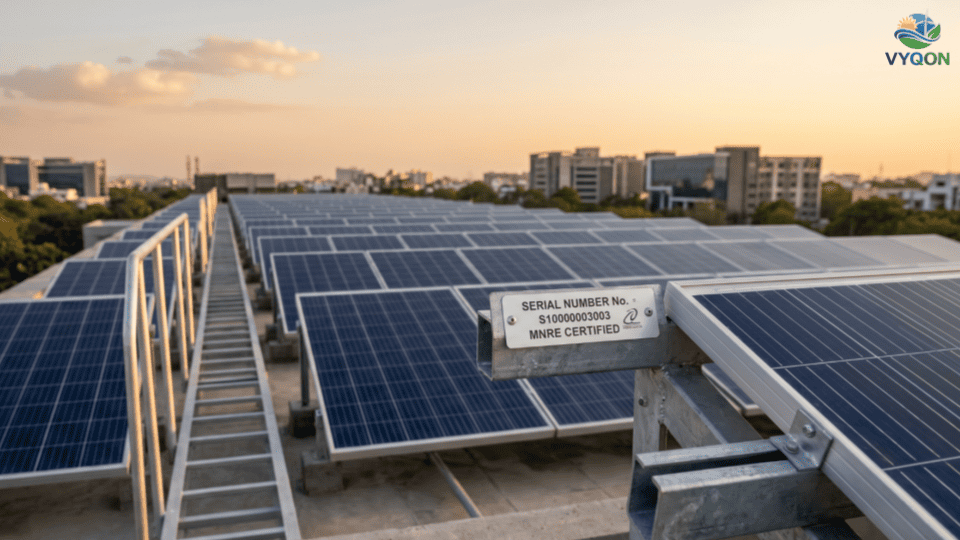
NEW DELHI, May 8, 2026 — In a move to fortify the “bankability” of India’s residential solar surge, the Ministry of New and Renewable Energy (MNRE) has issued a definitive Standard Operating Procedure (SOP) for solar PV module warranty management and claims settlement. The memorandum, signed by Scientist-D Anubhav Uppal on May 6, 2026, represents the final regulatory pillar for the ₹75,021-crore PM-Surya Ghar: Muft Bijli Yojana and the PM-KUSUM scheme. By codifying these mandates, the government aims to safeguard massive public and private investments against technical failure and manufacturer insolvency over the 25-year lifecycle of distributed renewable energy assets.
Scope, Applicability, and Policy Integration
The SOP is compulsory for all solar PV module manufacturers participating in MNRE-sponsored schemes. This framework does not exist in a vacuum; it is designed to complement the Revised Quality Control Order (QCO) 2025, which mandates minimum efficiency thresholds of 18% for monocrystalline and 17% for polycrystalline modules. Furthermore, it aligns with the BEE Star Labelling Programme, where enlistment requires a minimum 3-star rating and a 500Wp capacity. Together, these regulations ensure that only high-performance, durable technology enters the Indian market.
Standardized Warranty Terms and the “6-Month Rule”
The SOP enforces a rigid two-tier warranty structure to counter the historical 1% annual degradation rate observed in long-term field studies:
- Product Warranty: A minimum 10-year coverage period for defects in design, materials, and workmanship.
- Performance Warranty: A 25-year guarantee ensuring minimum specified power output.
The 6-Month Commencement Rule: To prevent the storage of modules in suboptimal conditions, the warranty period begins on the date of installation, provided it occurs within six months of the manufacturer’s invoice. Crucially, if installation is delayed beyond this window, the warranty duration is subject to a “proportionate reduction”—effectively shortening the 25-year protection period for every month of delay past the deadline.
Performance Claim Triggers and Technical Testing Protocols
A performance claim is deemed valid if the measured wattage falls below the nameplate wattage after accounting for manufacturer-specified tolerance, applicable degradation, and measurement uncertainty. This “manufacturer-defined tolerance” remains a critical technical benchmark for industry surveillance.
To validate claims, the following protocols are mandatory:
- Testing Requirements: Electroluminescence (EL) and I-V (Current-Voltage) testing are required during both commissioning and the claims process.
- Standards & Accreditation: Testing must be conducted by NABL-accredited laboratories in strict compliance with BIS and IEC standards.
- The Written Agreement Clause: While costs for third-party testing are initially split 50/50 between the consumer and manufacturer, the SOP mandates that both parties must agree to this arrangement in writing before testing begins. The party found at fault eventually bears the total cost.
Claim Settlement, Refunds, and Service Level Agreements (SLAs)
When a module is found faulty, manufacturers must replace the unit with a new module of equivalent or higher specifications. The SOP explicitly bans the use of refurbished or remanufactured modules. If replacement is impossible, a full refund of the original purchase price is required—with no deduction for annual depreciation, a major victory for consumer protection.
To ensure administrative accountability, manufacturers must adhere to the following digital-trigger SLAs:
| Milestone | Timeline Requirement |
| Complaint Acknowledgment (via Digital Portal) | 24–48 Hours |
| Site Inspection | Within 7 Days |
| Module Replacement | Within 30 Days |
| Supply Timeline (if fresh manufacturing required) | Up to 90 Days |
Digital Integration and Long-Term Financial Continuity
The SOP effectively ends the era of paper-based warranty cards by mandating deep integration with the national Domestic Content Requirement (DCR) portal. The B2C DCR Certificate now functions as the sole, official warranty certificate. Consumers access manufacturer portals via OTP authentication linked to their DCR-registered mobile number, streamlining the “trigger” for the 24-48 hour acknowledgment window.
Insolvency and Bankability: Recognizing the 25-year risk horizon, the MNRE mandates that manufacturers maintain legal and financial arrangements to ensure warranty continuity even in cases of restructuring, mergers, or dissolution. To meet this requirement, manufacturers are increasingly leveraging IRDAI-approved insurance products from providers like New India Assurance, Tata AIG, and HDFC ERGO. These policies offer “Buyer’s Cover,” allowing consumers to claim directly against the insurer if a manufacturer becomes insolvent.
The SOP concludes by clarifying that DISCOMs and implementing agencies are strictly excluded from warranty disputes, which remain a contractual matter between the manufacturer and the consumer.
Leave a Comment