
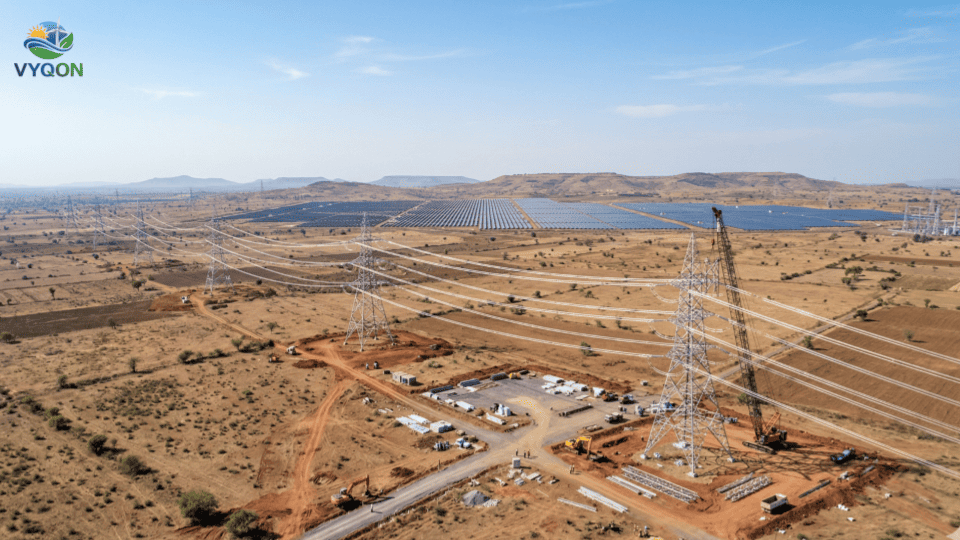
NEW DELHI/AHMEDABAD — Ahmedabad-based infrastructure major Montecarlo Limited has emerged as the successful bidder in a high-stakes auction conducted by PFC Consulting Limited (PFCCL), a wholly-owned subsidiary of Power Finance Corporation. The contract, awarded under the Tariff-Based Competitive Bidding (TBCB) mechanism, tasks Montecarlo with establishing an expansive intra-state transmission system to evacuate 7 GW of solar power from the Dharashiv and Beed districts of Maharashtra.
Auction Details and Financial Terms
Montecarlo Limited secured the project by quoting annual transmission charges of ₹1.44 billion (~$15.45 million). As part of the winning mandate, the company has formally acquired the project’s Special Purpose Vehicle (SPV), NES Dharashiv Transmission Limited.
The acquisition was finalized on March 12, 2026, with Montecarlo paying a total consideration of ₹3,61,11,559 (approximately ₹3.61 crore) to PFCCL for 100% equity in the SPV. The auction saw Montecarlo outperform a competitive field of established industry incumbents, including the Power Grid Corporation of India Limited (PGCIL), Adani Energy Solutions, Resonia Ltd, and the state-owned Maharashtra State Electricity Transmission Company Limited (MSETCL).
Technical Scope and Infrastructure Requirements
The project involves a complex multi-voltage network centered on a new pooling station at Washi. The technical specifications and transmission elements required for the system include:
- Substation Specifications: Establishment of a 400/220/132 kV Air Insulated Switchgear (AIS) substation at Washi.
- Transformation Capacity:
- Installation of two 500 MVA, 400/220 kV Inter-connecting Transformers (ICT).
- Installation of two 300 MVA, 400/132 kV Inter-connecting Transformers (ICT).
- Transmission Line Network: Construction of several double-circuit (D/C) lines to form the system’s backbone:
- A 400 kV D/C line connecting the Washi substation to the proposed 765/400 kV Pune (East) substation.
- 220 kV D/C lines connecting Washi to the existing substations at Manjarsumba and Paranda.
- A 132 kV D/C line connecting Washi to the existing Kalamb substation.
- Bay Requirements: Construction of two line bays each at the terminating stations of Manjarsumba, Paranda, and Kalamb to facilitate connectivity.
- Voltage Regulation: Integration of a 125 MVAR bus reactor at the 400 kV level to ensure grid stability and voltage regulation.
- Future Integration: Infrastructure provisions to accommodate 16 future solar generation projects, including eight 220 kV line bays and eight 132 kV line bays.
Project Framework and Timeline
The project is structured under the Build-Own-Operate-and-Transfer (BOOT) model. Montecarlo will hold the assets for an operational tenure of 35 years, after which the system will be transferred to the Maharashtra State Transmission Utility at zero cost and free of encumbrances.
The implementation timeline is set for 24 months from the effective date. While Montecarlo has maintained an active presence in the energy vertical since 2011—executing distribution and pooling substation projects across India—this award represents a significant strategic milestone. By outbidding national and state-level giants like PGCIL and MSETCL, Montecarlo has marked a formidable entry into the TBCB power transmission space.
Regional Impact and Strategic Context
This project is a cornerstone of the “Network Expansion Scheme in Maharashtra,” specifically designed to unlock the renewable potential of high-resource zones in the Aurangabad and Osmanabad regions. By establishing Washi as a central pooling point, the project facilitates the delivery of green energy to major industrial load centers in Pune and Mumbai.
Significantly, this project is strategically integrated with the NES Pune East New Transmission Ltd project, which was awarded to PGCIL on the same day. The 400 kV D/C line originating from Montecarlo’s Washi substation will terminate at PGCIL’s upcoming Pune (East) substation, creating a highly integrated renewable energy corridor. This macro-level network expansion is vital for addressing regional grid congestion and supporting India’s national mandate to scale non-fossil fuel capacity toward 2030 targets.
Leave a Comment