
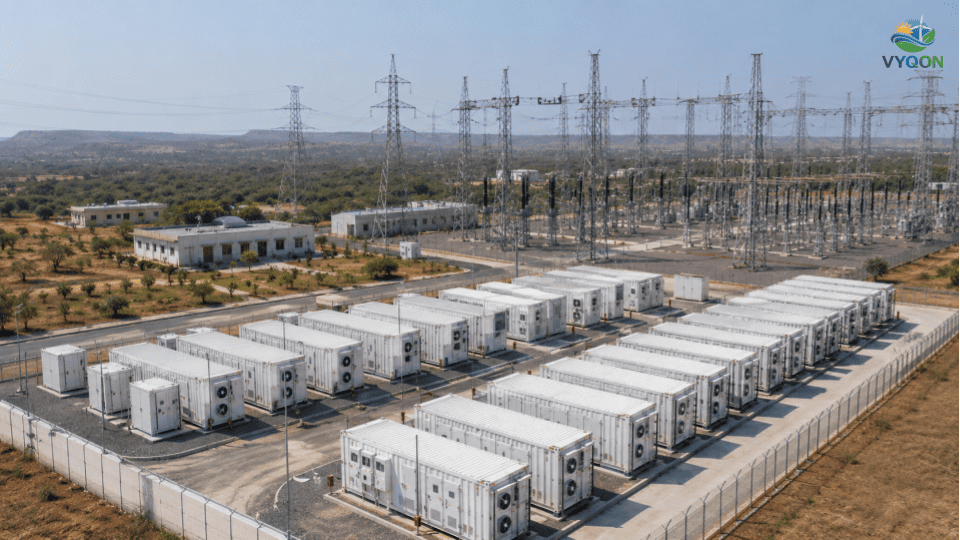
Madhya Pradesh Power Management Company Limited (MPPMCL), acting as the lead procurer, and Uttar Pradesh Power Corporation Limited (UPPCL) have invited bids for a landmark joint procurement of 282.5 MW / 1130 MWh of battery energy storage capacity. This project, to be developed under a Build, Own, and Operate (BOO) model, represents a critical step in regional grid firming. Following a strategic three-month extension approved by the Ministry of Power to maximize competitive participation, the final bid submission deadline has been set for July 30, 2026.
Commercial Logic and Joint Procurement Structure
The joint framework is underpinned by the complementary seasonal demand profiles of the two neighboring states. While Madhya Pradesh (Procurer-1) will utilize the capacity from November to April, Uttar Pradesh (Procurer-2) will tap into the storage from May to October. This arrangement, finalized following a joint high-level meeting on April 25, 2025, is designed to extract maximum utility from a single asset.
For UPPCL, the commercial rationale is particularly compelling. Regulatory filings indicate that under this joint bidding scenario, the state projects savings ranging from Rs. 1.34/kWh to Rs. 2.39/kWh. In contrast, a solo bid by the state was estimated to yield negligible savings or even a potential loss of Rs. 0.11/unit, highlighting the economies of scale and operational efficiencies inherent in the shared procurement model.
Rigorous Technical Specifications and Performance Metrics
The tender mandates a 4-hour BESS configuration with single-cycle discharging operations over a 15-year Battery Energy Dispatch and Purchase Agreement (BEDPA) tenure. To ensure asset longevity and performance reliability, the procurers have established strict technical thresholds:
- Cycle Utilization: The system must be engineered to support approximately 6,300 cycles over the contract period.
- Degradation Limits: Developers must adhere to a maximum annual degradation cap of 2%, with a mandatory minimum capacity retention of 70% at the end of the 15-year term.
- On-Demand Dispatch: While the Battery Energy Storage System Developer (BESSD) is responsible for arranging charging energy—which must be sourced from renewable projects to ensure RCO/RPO compliance—the actual discharge will be on an “on-demand” basis controlled by the procurers.
Enhanced Viability Gap Funding (VGF) Mechanism
To bolster project bankability, the tender utilizes a Viability Gap Funding (VGF) mechanism supported by the Ministry of Power. Funding is capped at INR 12 Lakhs per MWh or 30% of the project capital cost, whichever is lower, with a total VGF pool of INR 135.60 crore.
Significantly, the disbursement structure has been updated to release 70% of the total VGF amount by the Commercial Operation Date (COD). This front-loaded financial support, to be paid out across five tranches, is intended to reduce the initial debt burden on developers and improve the overall internal rate of return (IRR) for the project.
Connectivity and Policy Enablers
The project requires Inter-State Transmission System (ISTS) connectivity. To incentivize rapid deployment, a 100% waiver of ISTS charges is available, provided the project achieves COD by June 30, 2028. Crucially, developers must ensure that the BESS is co-located with the renewable energy charging source at the same ISTS substation to qualify for this waiver.
Bidders should also note a recent pivotal policy shift: the Ministry of Power has granted a one-year relaxation of industrial registration requirements (DPIIT norms). Effective from January 9, 2026, this waiver applies to lithium-ion technology involving technology transfers from land-border sharing countries, effectively lowering the entry barrier for global battery OEMs and addressing current domestic supply chain constraints.
Financial and Technical Eligibility Criteria
The tender sets high benchmarks for financial robustness and local content compliance:
- Earnest Money Deposit (EMD): Required at INR 24.8 Lakh per MW, provided via bank guarantee with a 12-month validity period. The procurers will accept e-BGs for this requirement.
- Net Worth: Bidders must demonstrate a minimum net worth of INR 796 Lakh per MW (based on FY 2024-25).
- Local Content Rules: A 50% minimum local content requirement is mandated, specifically including the indigenous development of the Energy Management System (EMS) application software.
- Cell Technology: The use of refurbished battery cells is strictly prohibited; only commercially proven, new technology will be considered.
Strategic Geographic Flexibility
Unlike earlier state-specific intrastate tenders—such as the 750 MW / 1,500 MWh tender issued solely for Madhya Pradesh—this ISTS-connected procurement offers significant geographic flexibility. Developers are granted location discretion, allowing for project development anywhere in India, provided they can secure the requisite ISTS connectivity and land parcels. This “location-agnostic” approach enables developers to optimize their sites based on land costs and RE resource availability, further driving down the competitive tariff.
Bid Submission Timeline
- Pre-bid Meeting: May 29, 2026 (Bhopal).
- Online Bid Submission Deadline: July 30, 2026 (15:00 IST).
- Hard Copy Submission: Required within 48 hours of the online closure.
- Techno-commercial Bid Opening: Conducted concurrently with hard copy receipt.
- TENDER PORTAL: https://www.mppmcl.com/e-tender
Leave a Comment