
Official Directive from RVPNL
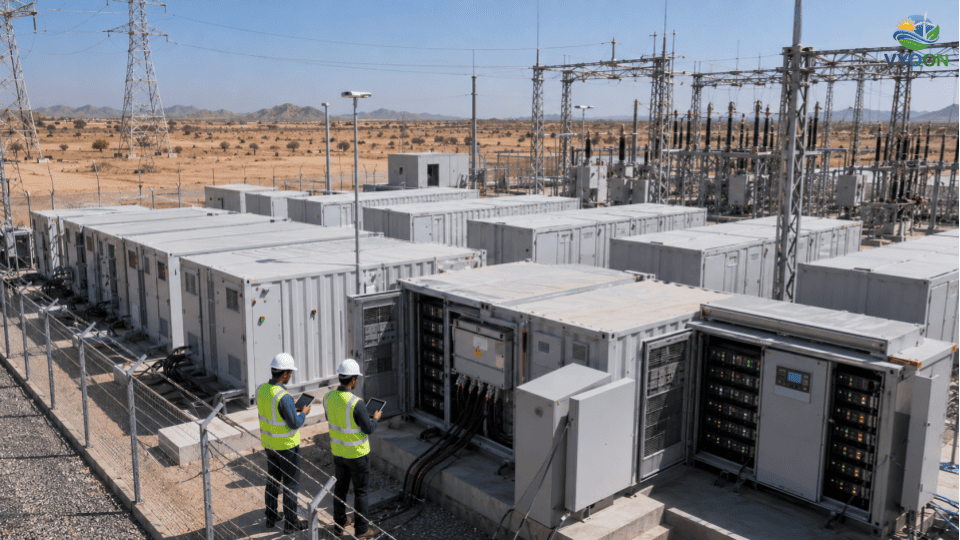
Rajasthan Rajya Vidyut Prasaran Nigam Limited (RVPNL) has issued a notification detailing a Standard Operating Procedure (SOP) for the First-Time Charging (FTC) of Battery Energy Storage Systems (BESS). This framework specifically governs BESS units integrated with renewable energy (RE) projects. The directive is issued under the Rajasthan Integrated Clean Energy Policy 2024, which seeks to establish a comprehensive green energy ecosystem. This policy includes a collective target of 10,000 MW for Hydro, Pumped Storage Plants (PSP), and Battery Energy Storage Systems by the 2029-30 fiscal year.
Scope and Applicability of the SOP
The newly introduced framework applies to BESS installations integrated with RE projects regardless of their current status. The scope encompasses:
- Already commissioned projects.
- Upcoming installations.
- Projects under the “captive” category and other various classifications.
This notification functions in continuation of a prior office letter dated January 7, 2026, which addressed requirements for renewable energy connectivity to RVPN Grid Sub-Stations (GSS). The SOP is designed to standardize the technical and administrative processes required for storage systems to commence operations within the state’s power infrastructure.
Compliance and Procedural Framework
The SOP introduces standardized procedures to ensure all BESS installations linked to renewable energy projects meet state regulatory requirements. While the directive formalizes the charging process, it builds upon the broader regulatory timeline established in the Rajasthan Integrated Clean Energy Policy 2024, which requires renewable energy projects to obtain necessary clearances and registrations to maintain grid connectivity.
Technical Validation and Testing Requirements
Developers are required to complete a series of technical validations to ensure system safety and grid compatibility. According to the directive, the following requirements must be met:
- Execution Process: Developers must follow the specific execution steps for the FTC of integrated BESS as outlined in Annexure-2 of the SOP.
- Simulations and Testing: Systems must undergo specified tests and simulations as detailed in Annexure-B.
- Regulatory Alignment: All testing and simulation results must align with the parameters referenced in the January 7, 2026, communication regarding RE connectivity.
Grid Integration and Operational Standards
To maintain the stability of the RVPN grid, BESS units must adhere to established national and state operational benchmarks. Key compliance parameters include:
- CEA Standards: Submission of comprehensive reports demonstrating full compliance with the Central Electricity Authority (CEA) Grid Connectivity Standards.
- Statutory Guidelines: Adherence to all applicable statutory guidelines governing renewable energy and storage integration.
- GSS Connectivity: Maintenance of technical standards required for connection to RVPN Grid Sub-Stations as previously mandated in early 2026.
Enforcement and Consequences of Non-Compliance
The Rajasthan Integrated Clean Energy Policy 2024 mandates that all renewable energy projects, including those utilizing BESS on the CTU, STU, or DISCOM networks, must be registered with the Rajasthan Renewable Energy Corporation (RREC). Failure to comply with registration and SOP requirements results in several enforcement actions:
- Grid Disconnection: Any power plant or BESS unit installed without RREC registration and competent authority approval is liable for disconnection from the grid.
- Administrative Restrictions: Developers must submit a certificate of RREC registration to the Sub-Registrar or authorized government officers to finalize the registration of sale or lease deeds for project land.
- Operational Approval: Lack of registration or failure to follow the FTC SOP may invalidate the status of existing grid connections and halt the approval process for new projects.
The implementation of this SOP marks a formalization of the technical requirements for energy storage systems within the state. The directive is currently in force, guiding developers through the necessary simulations, tests, and registration protocols required under the Rajasthan Integrated Clean Energy Policy 2024. These measures are part of the state’s ongoing effort to meet its long-term clean energy and storage capacity targets.
Leave a Comment