
Lead: Industrial Framework for Decarbonizing Indian Steel
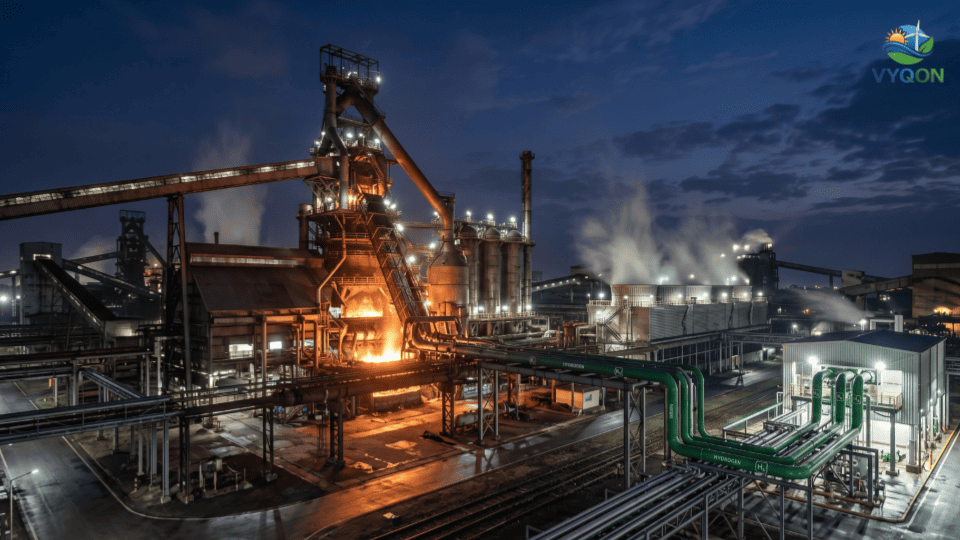
On April 7, 2026, the Steel Authority of India Limited’s (SAIL) Bokaro Steel Plant (BSL) and Forbes Marshall finalized a contract to implement a large-scale hydrogen injection project. This agreement represents the largest hydrogen injection initiative currently deployed within the Indian steel industry. The project aims to integrate hydrogen into primary ironmaking operations to mitigate carbon emissions in one of the country’s most energy-intensive industrial clusters.
Project Framework and Technical Implementation at Blast Furnace-1
The technical deployment is localized at Bokaro’s Blast Furnace-1 (BF-1). The project execution involves a tripartite collaboration of engineering and research entities:
- Research & Development Centre for Iron & Steel (RDCIS): SAIL’s research wing provides process parameter optimization and technical oversight.
- Primetals Technologies (UK): Acts as the primary engineering partner for the execution of hydrogen delivery architectures.
- Forbes Marshall: Responsible for the design and supply of specialized gas control systems, instrumentation, and pressure-conditioning skids.
The implementation facilitates a transition in the furnace’s chemical environment, substituting a portion of carbon-intensive coke and pulverized coal with hydrogen as the primary reducing agent. This shift targets a reduction in the solid fuel rate by utilizing hydrogen’s superior reduction kinetics within the furnace shaft.
Policy Alignment: National Green Hydrogen Mission and Global Commitments
The Bokaro project is a core industrial application of India’s National Green Hydrogen Mission, which targets the domestic production and utilization of green hydrogen to reduce carbon intensity. The initiative establishes a direct operational link to India’s COP26 climate commitments through the following strategic interventions in “hard-to-abate” sectors:
- Emission Trajectory: Directly contributes to the national goal of reducing the carbon footprint of integrated steel plants.
- Asset Modernization: Demonstrates a viable pathway for the decarbonization of existing ‘BF-BOF’ (Blast Furnace-Basic Oxygen Furnace) infrastructure.
- Energy Diversification: Alleviates reliance on imported coking coal by incorporating hydrogen-rich gas streams into the ironmaking process.
Operational Impact and Infrastructure Optimization
The project focuses on retrofitting existing infrastructure rather than greenfield development, allowing SAIL to leverage current capital assets while meeting tightening environmental regulations. This modernization coincides with a broader INR 20,000 crore expansion of the Bokaro Steel Plant, which is projected to increase crude steel capacity from 5.25 MTPA to 7.55 MTPA.
Quantifiable CO₂ Reductions In traditional blast furnace operations, global trials indicate that approximately 2.1–2.8 kg of H_2 per tonne of crude steel (tcs) is required to achieve a 1% reduction in CO_2. Current industry benchmarks, such as those reported by Tata Steel and Thyssenkrupp, suggest that partial hydrogen injection can achieve CO_2 intensity reductions ranging from 7–10% to as high as 20% at maximum stable injection rates.
Forbes Marshall System Benefits The implementation utilizes specialized engineering standards to ensure process stability and efficiency:
- Precision Conditioning: The system-based station/skid design provides accurate pressure and temperature conditioning for steam, hydrogen, and nitrogen, addressing load variations and system redundancy.
- Manufacturing Standards: Critical components, including oxygen blowing skids, are manufactured in a “clean room atmosphere” to ensure the high-purity standards required for gas handling and to avert operational hazards.
- Utility Efficiency: The solutions are engineered to reduce specific utility consumption per ton of crude steel through optimized flow control and the mitigation of gas leakages.
Technical Context: The Role of Hydrogen in Modern Ironmaking
Traditional ironmaking relies on carbon monoxide (CO) as the primary reductant. Hydrogen (H_2) serves as a superior reducing agent due to its faster reaction kinetics and the generation of water vapor (H_2O) rather than CO_2 as a byproduct. In the context of furnace bed interactions, the introduction of hydrogen-rich streams can improve kinetics through the reaction [CO+OH=CO_2+H_2], which enhances heat generation and improves the porosity and reduction efficiency of the material bed.
Comparative Pathways and Efficiency Metrics While blast furnace injection is a critical bridge technology, technical analysis from Transition Asia highlights significant efficiency differentials between transitional and transformative pathways:
- Hydrogen Demand: A H_2-DRI (Hydrogen-based Direct Reduction of Iron) process requires approximately 62 kg H_2/tcs for near-zero emission production.
- Efficiency Gap: H_2-DRI is 40–60% more efficient per unit of hydrogen than blast furnace injection. In a blast furnace, a significant portion of injected H_2 exits with the top gas without reacting.
- Objective Constraints: Hydrogen injection in blast furnaces is technically limited by the requirement for coke to maintain the furnace’s physical structure and gas permeability. Consequently, while BF injection provides an immediate route for emission cuts in expanding plants like Bokaro, it remains a transitional step compared to the deep decarbonization potential of H_2-DRI.
Leave a Comment