
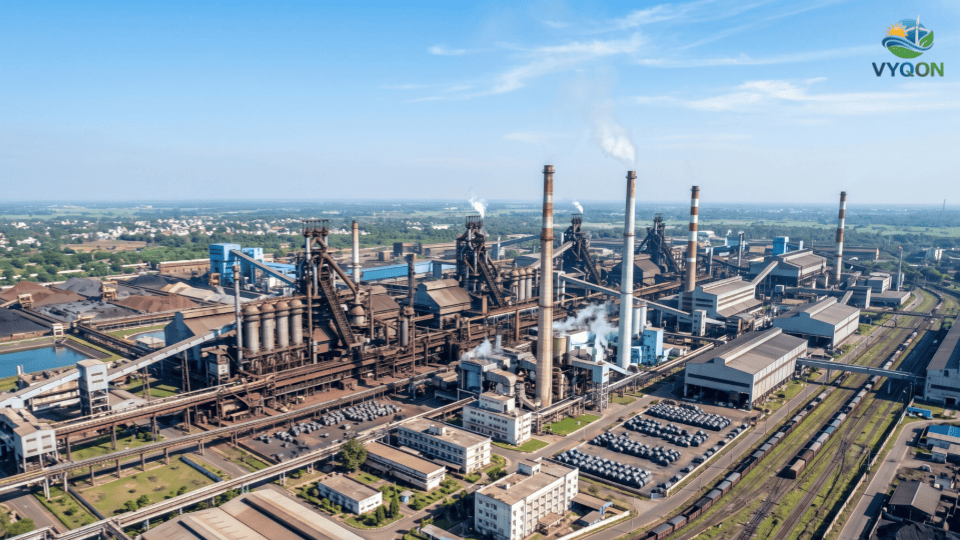
Steel Authority of India Limited (SAIL) concluded the 2025-26 fiscal year with a record crude steel output of 19.43 million tonnes (MT) and total sales of 20.14 MT. This sales volume represents an 11.5% year-on-year (YoY) increase from the 18.07 MT recorded in the previous fiscal period. The performance marks a historic operational peak for the Maharatna PSU, occurring against a backdrop of significant domestic infrastructure investment and evolving global trade dynamics.
Operational Metrics and Plant Performance
The company achieved record production volumes across its integrated facilities, supported by improved efficiency parameters in the Blast Furnace-Basic Oxygen Furnace (BF-BOF) route.
- Crude Steel Output: 19.43 MT
- Saleable Steel Production: 19.176 MT
Rourkela Steel Plant (RSP) Technical Highlights
RSP reported its highest-ever annual performance, driven by optimized capacity utilization:
- Saleable Steel: 41.65 lakh tonnes (2.1% YoY growth).
- Blast Furnace Operations: Blast Furnace-1 and Blast Furnace-5 recorded outputs of 10.7 lakh tonnes and 32.46 lakh tonnes of hot metal, respectively.
- Downstream Units: The Hot Strip Mill-2 (HSM-2) produced 26.7 lakh tonnes of HR coils. The new sheet shearing line recorded 3.14 lakh tonnes of HR plates, an 18.7% YoY increase.
- Specialized Plate Plant: Output for the defense sector reached a record 3,905 tonnes, surpassing the previous 2017-18 benchmark of 3,366 tonnes.
Market Expansion and Global Contextual Headwinds
SAIL established a market presence in Bhutan as part of a strategic shift in its international trade portfolio. Total exports reached 2.9 lakh tonnes, a 162% YoY growth. This expansion comes as India maintains its position as the world’s second-largest crude steel producer, with a total output of 122.402 MT between January and September 2025 (10.5% YoY growth).
However, the reporting period was characterized by significant global headwinds. China’s overcapacity—driven by a domestic property market crisis—led to a surge in low-priced exports, depressing international prices. Concurrently, US trade tariffs and the impending EU Carbon Border Adjustment Mechanism (CBAM) have necessitated a pivot toward regional markets. Domestically, HRC and TMT prices softened in October 2025 due to high supply and subdued trading activity during the festival season.
Infrastructure Integration and Fiscal Policy Alignment
SAIL delivered a record 1.25 MT of steel to Indian Railways, supported by peak long rail production at the Universal Rail Mill. This supply chain remains critical to the Union Budget 2026 infrastructure roadmap, which allocates ₹12.2 lakh crore for public capital expenditure.
Strategic demand drivers for SAIL’s product mix include:
- Railways: A pipeline of seven new high-speed rail corridors and the Dankuni-Surat dedicated freight corridor.
- Logistics: The ₹10,000 crore Container Manufacturing Scheme is expected to stimulate demand for specialized steel sheets and coils.
- Urbanization: Targeted development in Tier-2 and Tier-3 cities continues to drive demand for TMT bars and heavy structurals.
Decarbonization and Technical Pilot Achievements
To address the sector’s emission intensity—currently averaging 2.5 tCO2 per tonne of crude steel in India—SAIL has initiated a hydrogen gas injection pilot at Bokaro Steel Plant’s Blast Furnace-1.
Technical Parameters and Progress:
- Hydrogen Injection: Partnering with Forbes Marshall and the Research and Development Centre for Iron and Steel (RDCIS), the project involves injecting hydrogen at the tuyere level to partially replace coke and pulverized coal.
- Milestones: SAIL has already achieved a 20% reduction in carbon footprint during Phase-I of its decarbonization roadmap.
- 2030 Benchmark: The company aims to achieve an emission intensity of less than 2.3 tonnes of CO2 per tonne of crude steel by 2030-31.
- Financial Framework: These initiatives are supported by a ₹455 crore government allocation for steel sector pilots and the proposed ₹20,000 crore Carbon Capture, Utilization, and Storage (CCUS) fund over five years.
Future Capacity Expansion and Raw Material Security
SAIL has received approval for a ₹1,00,000 crore capital expenditure plan to increase total capacity to 35 MTPA by 2030.
- IISCO Steel Plant: A greenfield expansion to 4 MTPA is underway with a four-year completion timeline. The unit will focus on API-grade steel for the oil and gas sector and automotive components.
- Durgapur Steel Plant: Implementation of a new 1.4 MTPA TMT mill has commenced.
- Bokaro Steel Plant: Preparation of the Detailed Project Report (DPR) for further expansion is currently managed by appointed consultants.
- Raw Material Supply: Through International Coal Ventures Ltd (ICVL), SAIL plans to double coking coal capacity at its Mozambique operations from 2 MTPA to 4 MTPA, following technical coal quality assessments.
Corporate Leadership and PSU Status
As a Maharatna Public Sector Undertaking under the Ministry of Steel, SAIL possesses the financial autonomy required for its multi-year expansion projects. Following the resignation of Amarendu Prakash, Krishna Kumar Singh has assumed additional/interim charge of the company to oversee the transition toward the 2030 production and environmental targets.
Leave a Comment