
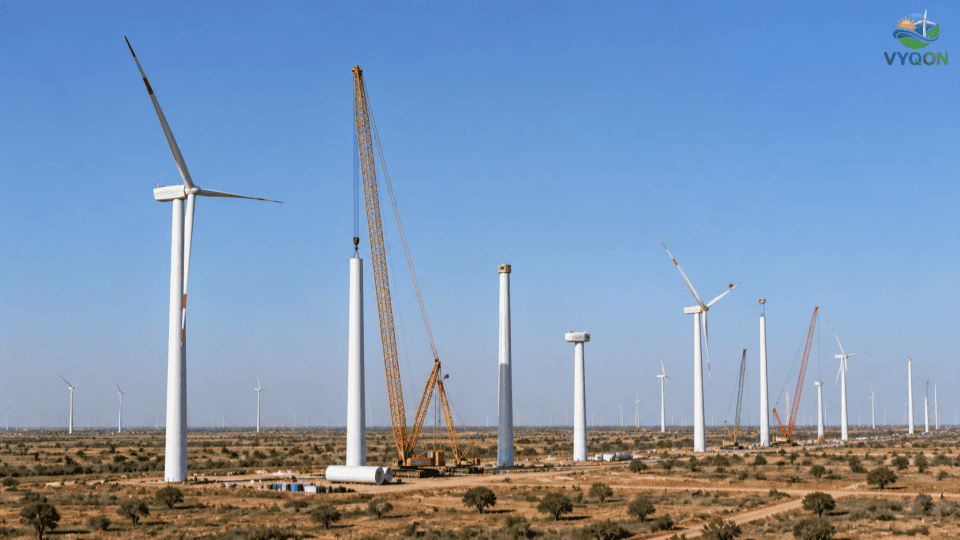
In the push toward a modernized, high-penetration renewable energy grid, the integration of utility-scale wind power into the Inter-State Transmission System (ISTS) is governed by a rigorous regulatory framework. This process is orchestrated by the Central Transmission Utility (CTU), the primary authority responsible for the Grant of Connectivity and the administration of the “Connection Agreement.” The mandatory submission of technical, administrative, and dynamic simulation data is not merely a bureaucratic hurdle; it is a critical safeguard for national grid stability, ensuring that new generating stations interact harmoniously with the existing transmission infrastructure under both steady-state and transient conditions.
ISTS Connectivity Procedure and Agreement Framework
The regulatory journey for an applicant seeking ISTS connectivity is a strictly defined multi-step progression. The process transitions from an initial intimation to a final, legally binding agreement that dictates the technical terms of the physical interconnection.
- Grant of Connectivity (FORMAT-CON-3): The CTU issues an initial intimation, acknowledging the viability of the connection at a specific point.
- Submission of Technical Particulars (FORMAT-CON-4): The applicant must then furnish exhaustive technical data, maps, and simulation models.
- Intimation of Connection Details (FORMAT-CON-5): Crucially, the CTU processes the FORMAT-CON-4 data and issues this “final answer,” detailing the specific technical parameters and requirements the project must meet.
- Signing of the Connection Agreement (FORMAT-CON-6): This represents the final contractual step before physical interconnection.
Where connectivity is granted to an ISTS point belonging to a licensee other than the CTU, the regulations mandate a tripartite agreement involving the applicant, the CTU, and the respective inter-State transmission licensee. Once executed, the Nodal Agency provides copies of the agreement to the concerned State Load Despatch Centres (SLDC) and Regional Load Despatch Centres (RLDC) to ensure operational transparency across the grid hierarchy.
Administrative and Site Documentation Requirements
Regulatory compliance begins with administrative precision. Applicants must provide comprehensive organizational details, including the legal status of the company (Generating Station/Captive Plant or Bulk Consumer) and contact designations for both primary and alternate representatives.
Geographical and engineering data must be submitted according to the standards defined in the application’s schedules:
- Geographical Mapping (Schedule I): A Survey of India topo sheet must clearly mark the proposed project site.
- Site Plan Specifications (Schedule II): Applicants must provide hard and soft copies (AutoCAD 2000 or higher) detailing the connection point, generator locations, transformer placements, and site buildings.
- Electrical Single Line Diagram (Schedule III): A comprehensive SLD must detail all significant items of the plant, from the generation level to the point of common coupling.
Technical Specifications for Wind Generating Stations
The regulatory framework benchmarks wind power projects against standardized infrastructure configurations. For instance, a reference 300 MW wind farm typically requires a land footprint of approximately 600 acres.
Power Aggregation and Reticulation
The internal collection network—often described as a system of “twigs and feeders”—aggregates power from individual Wind Turbine Generators (WTGs).
- Generation Level: Individual turbines, typically rated at 3 MW or less, generate power at approximately 660 V / 690 V.
- Medium Voltage (MV) Reticulation: This power is immediately stepped up to a 33 kV reticulation system.
- Grid Interconnection: The pooled 33 kV power is then stepped up through high-voltage (HV) transformers to 220 kV or 400 kV for injection into the EHV grid.
Mandatory Simulation Components
To satisfy grid stability requirements, applicants must provide models that capture the dynamics of the following eight components:
- Generator/Converter
- Electrical Control (including fault ride through)
- Drive-Train Model
- Aerodynamics
- Pitch Controller
- Torque Controller
- Power Plant Controller (PPC)
- Energy Storage (where applicable)
Furthermore, the CTU mandates the provision of harmonic profiles for inverters and detailed voltage/reactive power control strategies to mitigate potential power quality issues.
Dynamic Modeling and Simulation Standards
The CTU requires “fit-for-purpose” electromechanical transient simulation models to predict the wind farm’s response to grid disturbances. The regulatory preference is for validated Generic Models; User-Defined Models (UDM) are required only in cases where validated generic models are unavailable.
Model Type Comparison
| Model Type | Software/Format Requirements | Integration Time Step and Duration |
| Generic Models | PSS/E Standard Models (Schedule X) | 1ms to 20ms; duration up to 600s |
| User-Defined Models (UDM) | Encrypted *.dll files (PSS/E) | 1ms to 10ms; duration 100s+ |
WTG Technologies and PSS/E Models
The modeling requirements vary by turbine technology as categorized in Schedule X:
- Type-1 (Fixed-speed induction): Uses models like WT1G1 (Generator) and WT2T1 (Drive-train).
- Type-2 (Variable-resistance induction): Uses WT2G1 and WT2E1 (External resistance controller).
- Type-3 (DFIG): Requires a complex suite including REGCA1 (Converter), REECA1 (Controls), WTDTA1 (Drive-train), WTARA1 (Aerodynamics), and WTPTA1 (Simplified pitch controller).
- Type-4 (Full converter): Utilizes REGCA1, REECA1, WTDTA1, and REPCA1 (Plant Controller).
Financial and Data Certification
The integrity of the application rests on a formal certification by the applicant’s Authorized Signatory. This official must verify that all data pertains strictly to the sought connection and commit to providing any additional data requested by the CTU. Financial instruments, including Earnest Money Deposits (EMD) and Performance Bank Guarantees (PBG), must be furnished in strict adherence to the regulatory formats provided in the application annexures.
Consolidated List of Schedules (I–X)
The following schedules constitute the mandatory checklist for a complete technical application:
- Schedule I: Survey of India topo sheet.
- Schedule II: Site plan (AutoCAD format).
- Schedule III: Electrical Single Line Diagram (SLD).
- Schedule IV: Rating of Generating Units (Unit ratings and capability curves).
- Schedule V (Short Circuit Studies): Technical parameters including Direct Axis Transient Reactance (Xd’), Sub-transient Reactance (Xd”), and Negative/Zero Phase Sequence Reactance.
- Schedule VI (Dynamic Simulation Data): Requires detailed generator data including Inertia (H), Armature Leakage Reactance (Xl), Synchronous Reactances (Xd, Xq), and Open Circuit Time Constants (Tdo’, Tqo’, Tdo”, Tqo”).
- Schedule VII: Two-Winding Transformer Data.
- Schedule VIII: Three-Winding Transformer Data.
- Schedule IX: Generic Models of Solar Farms (Included as an inter-industry reference for potential hybrid or adjacent installations).
- Schedule X: Generic Models of WTGs/Wind Farms (The primary reference for wind technology modeling).
Leave a Comment