
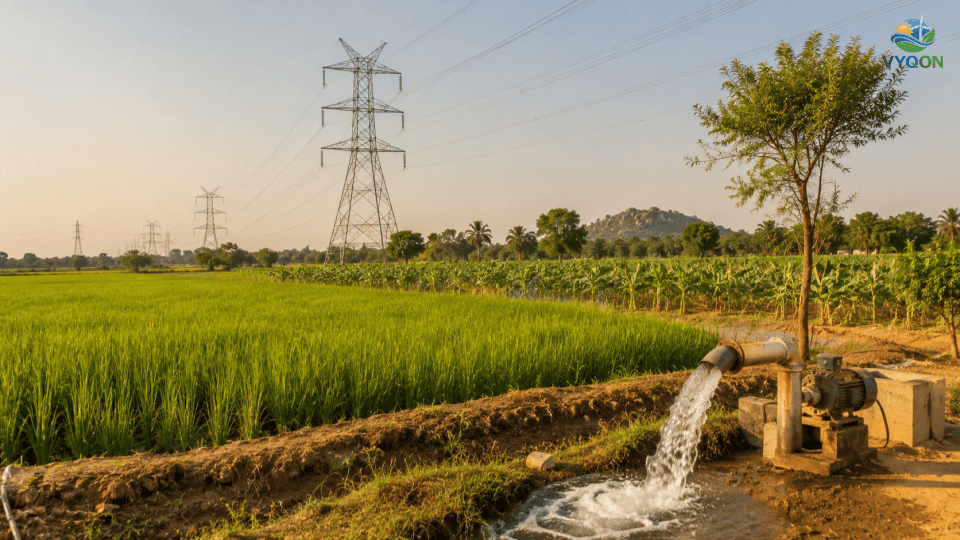
The Launch of India’s Specialized Agricultural DISCOM
The Telangana State Electricity Regulatory Commission (TGERC) has formally cleared the path for a major structural overhaul of the state’s power sector, approving the distribution license for the Telangana Rythu Power Distribution Company Limited (TGRPDCL). Positioned as India’s first specialized “Rythu DISCOM,” the entity is legally mandated to commence business operations on November 10, 2026. As the state’s third power distribution company, TGRPDCL will assume responsibility for the agricultural and water supply loads currently managed by the Southern and Northern distribution utilities (TGSPDCL and TGNPDCL), targeting a sector that accounts for approximately 42% of the total energy consumption in Telangana.
Regulatory Approval and Legal Framework
The license grant follows a July 12, 2026, order by the TGERC, processed under Section 14 of the Electricity Act, 2003, and Distribution Licence Regulation No. 4 of 2016. However, the road to approval revealed significant regulatory friction. While the state government initially targeted an April 1, 2026, commencement, the formal petition was not filed until April 6, 2026. This delay was preceded by a “deficiency letter” issued by the Commission on March 25, 2026, which demanded critical missing documentation, including director profiles and net worth certificates.
During the public hearing on May 29, 2026, the Federation of Telangana Chambers of Commerce and Industry (FTCCI) raised high-impact objections regarding the entity’s “Statement of Objectives” and long-term viability. Critics characterized the application as “materially incomplete,” noting that TGRPDCL presumed approval before furnishing mandatory business plans. Despite these concerns, the TGERC set a four-month rollout deadline, mandating that parent DISCOMs must not halt or delay new agricultural connections during the transition period.
Organizational Mandate: Making the Invisible Visible
TGRPDCL is designed as a fiscal tool to unmask the “invisible” cost of power subsidies. Historically, agricultural consumption—often unmetered—was buried within the consolidated accounts of the parent DISCOMs, acting as a fiscal shock absorber that obscured operational inefficiencies. By ring-fencing these categories, the state aims to isolate the true subsidy burden.
The consumer categories transferred to TGRPDCL include:
- Agricultural Consumers: Approximately 30 lakh connections state-wide.
- Lift Irrigation Schemes (LIS): Major government-led irrigation projects.
- Mission Bhagiratha: Composite protected water supply schemes.
- Hyderabad Metropolitan Water Supply and Sewerage Board (HMWS&SB).
- Municipal Water Supply: Specifically connections utilizing separate distribution transformers.
Policy Continuity and the Metering Architecture
The TGERC has explicitly ruled that the restructuring will not alter the state’s free agricultural power supply policy. Furthermore, the Commission rejected the implementation of individual metering for agricultural pump sets, citing political and practical hurdles.
Instead, the reform’s technical centerpiece is a Smart Metering initiative at the transformer level. The plan involves installing smart meters on approximately 5.22 lakh agricultural Distribution Transformers (DTRs) to enable precise energy accounting. However, as of the license grant, the Rs. 1,306 crore procurement contract for these meters has not been tendered. Without this measurement architecture, TGRPDCL risks operating “blind” in its initial years, unable to distinguish technical technical losses from unmetered consumption.
Financial and Asset Profile of TGRPDCL
The financial foundation of TGRPDCL reveals a stark “structural tension” between its minimal capital base and its massive inherited liabilities. Analytical scrutiny highlights that while the entity has an equity base of just Rs. 5 Crore, it inherits nearly Rs. 5,000 Crore in assets and a debt burden exceeding Rs. 35,000 Crore.
Financial and Asset Profile of TGRPDCL
| Financial Component | Value (Approximate) |
| Paid-up Share Capital | Rs. 5 Crore |
| Book Value of Transferred Assets | Rs. 4,929 Crore |
| Total Arrears (Government Receivables) | Rs. 35,983 Crore |
| Specifically Transferred Arrears (~79%) | Rs. 28,486 Crore |
| Payables to State GENCOs | Rs. 26,950 Crore |
| Working Capital Burden | Rs. 9,032 Crore |
| Estimated Annual Subsidy Requirement | Rs. 8,000 Crore |
Note: Debt financing for distribution activities is currently listed in regulatory filings as “yet to be tied up,” representing a significant operational risk for liquidity and generator payments.
Corporate Governance and Leadership
TGRPDCL is incorporated under CIN U35100TS2026SGC213226. The leadership is headed by Sri Musharraf Ali Faruqui, IAS, as Chairman and Managing Director (CMD). While Faruqui previously served as CMD of TGSPDCL, analysts note his background is in Microelectronics and Excise, reflecting a “generalist” administrative appointment rather than specialist utility management.
The Board of Directors is drawn entirely from government ranks and parent DISCOMs, including senior officials such as Navin Mittal (Special Chief Secretary, Energy) and D. Krishna Bhaskar (CMD, TGTRANSCO). This composition has sparked concerns regarding inherent conflicts of interest during upcoming negotiations over wheeling charges and Power Purchase Agreement (PPA) re-allocations.
Implementation Roadmap and the “Coordination Nightmare”
The TGERC mandate requires TGRPDCL to submit a comprehensive five-year business plan within three months of the license grant—a document that currently does not exist. Immediate requirements include the execution of transition MoUs and the establishment of at least two Consumer Grievance Redressal Forums.
Beyond administrative filings, the utility faces an impending “Coordination Nightmare.” Responsibility for the grid is now split: TGRPDCL owns the DTRs, while parent DISCOMs retain the upstream lines. This fragmentation is expected to trigger disputes over interface metering and emergency response times during peak irrigation seasons. The success of this reform will ultimately depend on whether TGRPDCL can transition from a “legally incorporated shell” into a functional utility capable of managing the volatile, seasonal demand of Telangana’s 29 lakh farmers.
Based on the sources provided, here is a list of the official government orders, regulatory filings, and corporate registrations mentioned in the documentation regarding the establishment of the Telangana Rythu Power Distribution Company Limited (TGRPDCL).
Official Sources and Regulatory Documentation
- Government of Telangana, Energy (Power.I) Department – G.O.Ms.No.44 (Dated: 17.12.2025) The foundational executive order establishing the legal basis for the third DISCOM, detailing its consumer categories and the restructuring of assets and liabilities from TGSPDCL and TGNPDCL.
- Ministry of Corporate Affairs (MCA), Government of India – Certificate of Incorporation (Dated: 18.03.2026) Official registration of the company under the Companies Act, 2013 (CIN: U35100TS2026SGC213226), confirming its legal existence with its own PAN, TAN, and GST registrations.
- Reference Details: Third DISCOM (TGRPDCL) Milestone Timeline – Analysis by Dr. Donthi Narasimha Reddy (Note: URL based on Source 10 PDF citations)
- Government of Telangana, Energy (Power.1) Department – G.O.Ms.No.4 (Dated: 11.03.2026) The formal notification of the first Board of Directors and the shareholding structure, recording the Governor of Telangana as the primary shareholder.
- Telangana State Electricity Regulatory Commission (TGERC) – Petition for Distribution Licence (O.P. No. 11 of 2026) The formal application filed by TGRPDCL on April 6, 2026, under Section 14 of the Electricity Act, 2003, seeking authorization to operate as a distribution utility.
- Reference Details: FTCCI Submission to TGERC Regarding TGRPDCL Licence (Note: URL based on Source 3 PDF citations)
- Telangana State Electricity Regulatory Commission (TGERC) – Common Order (Dated: 10.07.2026) The final regulatory decision granting the distribution licence to TGRPDCL and setting the official business commencement timeline.
Leave a Comment