
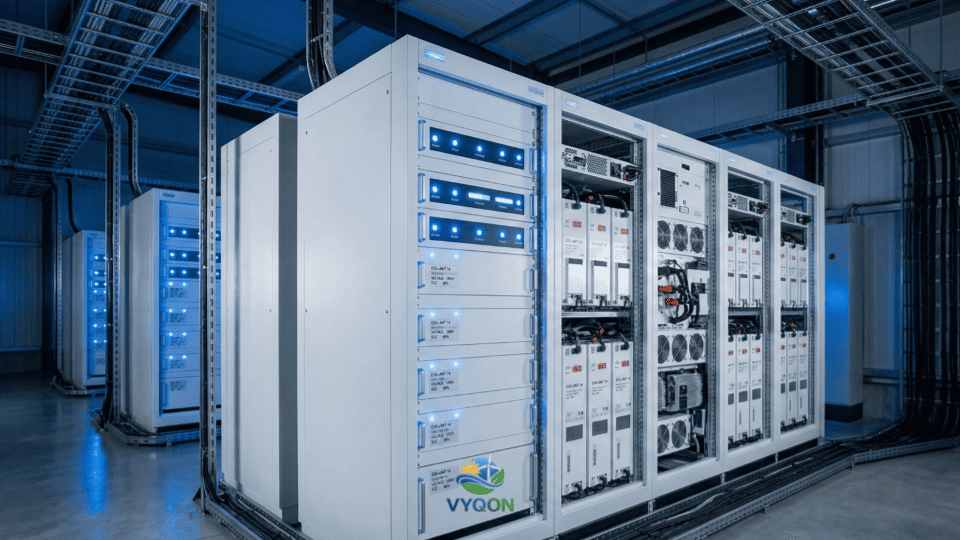
On March 20, 2026, the Central Electricity Regulatory Commission (CERC) notified the (Terms and Conditions of Tariff) (Second Amendment) Regulations, 2026. This regulatory milestone formally integrates “Integrated Energy Storage Systems” (IESS) into the existing tariff structures for thermal generating stations and Inter-State Transmission Systems (ISTS). For developers and utilities, this represents a shift from storage as an “add-on” to storage as a core, remunerative component of India’s power infrastructure.
Under Regulation 3A(8), an IESS is defined as a storage system co-located with a generating station or transmission system, connected via a common bus-bar. These systems are sanctioned to enhance flexibility, ensure grid reliability, or defer transmission investment as required by the NLDC, beneficiaries, or ISTS customers.
Cost Recovery Framework for Storage Systems
The amendment establishes a sophisticated two-part supplementary tariff structure. By linking cost recovery to specific operational roles, the Commission has effectively shifted performance risk to the developer while providing a clear path for capital servicing.
- Generation-Linked Storage (Regulation 64A):
- Supplementary Capacity Charges (SCCess): Costs are recovered through an Annual Fixed Cost (AFCess) model. This charge is shared by beneficiaries according to their percentage share in the capacity of the associated generating station.
- Mathematical Guardrails: Under Regulation 64A(2), the SCCess is calculated monthly but is subject to a cumulative ceiling. This mechanism ensures that the total recovery at any point in the year does not exceed the pro-rata AFCess, protecting beneficiaries from over-recovery during high-availability months.
- Transmission-Linked Storage (Regulation 29B & 78):
- Grid Reliability & Deferral: Costs for systems used to strengthen the grid or defer investment are recovered through the CERC (Sharing of Transmission Charges) Regulations, 2020.
- Secondary Business Usage: Per the proviso to Regulation 29B(5)(a), if an IESS is utilized for “other businesses,” revenue is governed by the specific regulations for utilizing transmission assets for non-core business purposes.
- Supplementary Energy Charges (Regulation 61A & 64B):
- Aggregate Cost Concept: Under Regulation 61A, the charging rate is not merely the energy cost. It represents the “Aggregate cost of electricity,” encompassing fixed charges, energy charges, and any other associated costs when energy is sourced from another station or the open market.
- Efficiency Incentives: If beneficiaries arrange the charging energy themselves, the supplementary energy charge rate is zero. This incentivizes efficient procurement by allowing beneficiaries to leverage their own portfolios or DSM-linked drawals during high-frequency periods.
Technical and Operational Norms
The framework introduces standardized performance benchmarks to ensure the “useful life” of the assets aligns with the recovery period.
Technical and Financial Norms for Integrated Energy Storage
| Parameter | Norm/Value | Regulatory Reference |
| Useful Life (Lithium-ion) | 15 years (subject to new tech provisos) | Regulation 3(87)(j) |
| Normative Annual Plant Availability Factor (NAPAFess) | 90% | Regulation 70(FF) |
| Round-trip Efficiency (RTEess) | 85% or actual, whichever is higher | Regulation 70(FF) |
| Auxiliary Energy Consumption (AECess) | 5% of input energy | Regulation 70(FF) |
| Return on Equity (Base Rate) | 14.00% | Regulation 30(4) |
| Depreciation Rate (Lithium-ion) | 6.33% | Appendix-I (oo) |
| Initial Spares Allowance | 4.00% of capital cost | Regulation 23(vii) |
O&M Expenses and Escalation Rules
The Commission has adopted an “actuals-linked” approach to Operation and Maintenance (O&M) costs, which poses a long-term risk for licensees. Initial O&M expenses are capped at 2.0% of the admitted capital expenditure (excluding IDC and IEDC) as of the COD.
While an annual escalation of 5.25% is permitted during the first two years of operation under Regulation 36(4), these expenses are subject to a rigorous “truing-up” process. The Commission reserves the right to revise O&M levels via separate orders based on actual expenditure data filed annually by the generating company or transmission licensee.
The ‘Gain-Sharing Model’ for Ancillary Services
Regulation 84A introduces a parity-based incentive model to encourage the use of storage for grid services.
- The 50:50 Split: When a storage system provides ancillary services or sells to the open market, the net gains (after adjusting for fixed and energy costs) are shared between the developer and the beneficiaries in a 1:1 ratio.
- Transmission Adjustments: For transmission licensees, such revenue must be adjusted against the yearly transmission charges to lower the burden on ISTS customers.
- Excess Efficiency Incentive: To reward superior technical maintenance, both generating stations (under Reg 64B(5)) and transmission licensees (under Reg 78(4)) are entitled to an incentive of 10 paise per kWh for excess energy discharge that exceeds the normative round-trip efficiency.
The Regulatory Sandbox Provision
To future-proof the sector against rapid technological shifts, Regulation 101A establishes a “Regulatory Sandbox” for Research, Development, and Innovation (RDI).
- Eligibility: Open to generating companies and transmission licensees with prior Commission approval.
- Financial Thresholds: Additional costs for innovative sandbox projects are capped at 1.0% of the Annual Fixed Cost or ₹100 Cr, whichever is lower. This provides a protected capital pocket for exploring non-lithium technologies or novel grid-balancing software.
Filing Timelines and Commercial Operation
Compliance with filing timelines is critical for cash flow management, particularly regarding the distinction between standard and VGF-supported projects.
- Standard Projects: Petitions for supplementary tariff determination must be filed within 90 days of the COD (Regulation 8(1)(d)).
- VGF Projects (Regulations 29A & 29B): Projects covered under the Viability Gap Funding (VGF) scheme follow a different schedule. Developers must file for approval at the subsequent stage within six months of the notification of these regulations.
- In-Principle Approval: For any new capitalization, entities must provide a 30-day notice to beneficiaries and file for in-principle approval, including a comprehensive cost-benefit analysis and a certified financing plan.
The date of commercial operation (COD) for any integrated storage system—whether whole, part, or phase-wise—is determined strictly in accordance with the provisions of the Grid Code (Regulation 5(3)).
Leave a Comment