
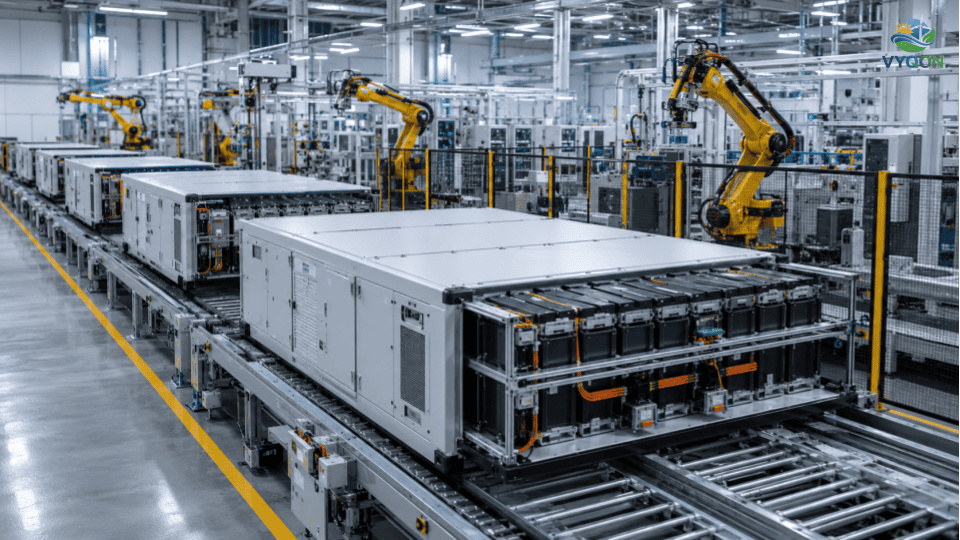
The commencement of the Rola facility marks a pivotal phase in a ₹10,000 crore roadmap toward a fully indigenized energy storage ecosystem and global supply chain resilience.
Production Commencement at Rola Facility
Waaree ESS, the energy storage subsidiary of Waaree Energies, has officially commenced production at its advanced Battery Energy Storage System (BESS) container manufacturing facility in Rola, Gujarat. The operational launch marks a significant 5.15 GWh capacity milestone, representing the critical first step in the company’s broader 20 GWh manufacturing roadmap. This facility positions Waaree at the forefront of India’s transition toward domestic energy self-reliance, catering to the burgeoning demand for large-scale storage solutions.
Capacity Logistics: Concurrent Cell and Pack Scaling
Distinguishing its manufacturing architecture from simple assembly, the Rola plant is designed to handle concurrent stages of the value chain. While the facility currently celebrates the commencement of BESS container production, the operational roadmap for the current financial year includes the following distinct capacities:
- 3.5 GWh capacity for lithium-ion cell production.
- 5.15 GWh capacity for battery pack manufacturing.
The scaling of these dual lines is supported by systemic backward integration and the utilization of higher cell energy density to maximize throughput. By managing both cell and pack manufacturing in-house, Waaree aims to mitigate bottlenecking and ensure a streamlined transition from raw chemistry to grid-ready containers.
Advanced Manufacturing and Industry 4.0 Integration
The Rola facility serves as a flagship for modern technical analysts, integrating “Smart Factory” principles to ensure precision and scalability. Key technological features include:
- Industry 4.0 standards for real-time data monitoring and process optimization.
- Automated Guided Vehicles (AGVs) for intelligent plant logistics and material movement.
- Automated assembly lines designed to reduce human error and increase cycle consistency.
- Advanced testing and Quality Assurance (QA) systems that utilize AI-driven efficiency protocols.
Technical Specifications: The LFP Advantage
Waaree has standardized its BESS products on Lithium Iron Phosphate (LFP) chemistry, citing its superior thermal stability and extended lifecycle. The LFP cells utilize a robust olivine crystalline structure, featuring strong chemical bonds that resist structural breakdown under intense thermal or electrical loads—a critical factor for utility-scale safety.
Technical Product Specifications
| Component | Specification |
| Battery Cell | 314 Ah capacity, >178 Wh/kg energy density, 10,000 cycles (at 70% SOH) |
| Battery Pack | 104.5 kWh nominal energy, 332.8V nominal DC voltage, liquid-cooled (glycol-water) |
| BESS Container | 5,015 kWh nominal capacity, >95.2% efficiency (at 0.25C rate), C5 anti-corrosion |
Safety remains central to the design, featuring active multi-stage fire safety and AI-driven monitoring to prevent thermal runaway.
Strategic Roadmap: “Waaree 2.0” and Global Integration
The Rola facility is a cornerstone of the “Waaree 2.0” strategy, shifting the company from a module-centric manufacturer to an integrated energy platform. This vertical integration aims to de-risk the company from global commodity volatility through several strategic moves:
- Financial Solvency: The BESS venture is supported by a ₹1,000 crore equity raise, part of a total ₹10,000 crore capital outlay through FY28.
- Supply Chain Indigenization: Plans are in place to localize the manufacturing of anodes, cathodes, and electrolytes to meet the government’s 100% domestic manufacturing mandate (2026–2028).
- Global Resilience: To bypass Chinese supply chain dominance and manage US tariff risks, Waaree has invested $30 million in United Solar Holding (Oman) for traceable polysilicon and acquired Meyer Burger assets to expand US-based manufacturing.
Purpose and Grid Applications
Targeting the utility-scale and Commercial & Industrial (C&I) segments, these BESS units are designed to address the inherent intermittency of renewable energy. Functional applications include:
- Renewable Integration: Smoothing power surges and storing excess energy for steady grid supply.
- Grid Stability: Providing rapid frequency and voltage regulation to maintain power quality.
- Peak Shaving: Optimizing costs by discharging power during high-demand periods.
- Black Start Capabilities: Providing initial power to restart local generating units after a system collapse.
Executive Perspective
Sunil Rathi, Executive Director of Waaree Group, emphasized the strategic importance of the facility in building a cohesive energy infrastructure:
“The commencement of our advanced BESS container manufacturing facility is an important step toward building a fully integrated energy storage ecosystem.”
Analyst Note: Waaree Energies’ aggressive move into BESS comes on the back of a stellar fiscal performance, with revenue rising 119% year-on-year to ₹7,565 crore in Q3. With a ₹60,000 crore order book, the company’s expansion into cell manufacturing and polysilicon traceability suggests a long-term play for dominance in the high-margin, vertically integrated cleantech sector.
Official Source
Waaree Energies Ltd. – Battery Energy Storage Solutions (BESS) URL: https://www.waaree.com/bess/
Leave a Comment