
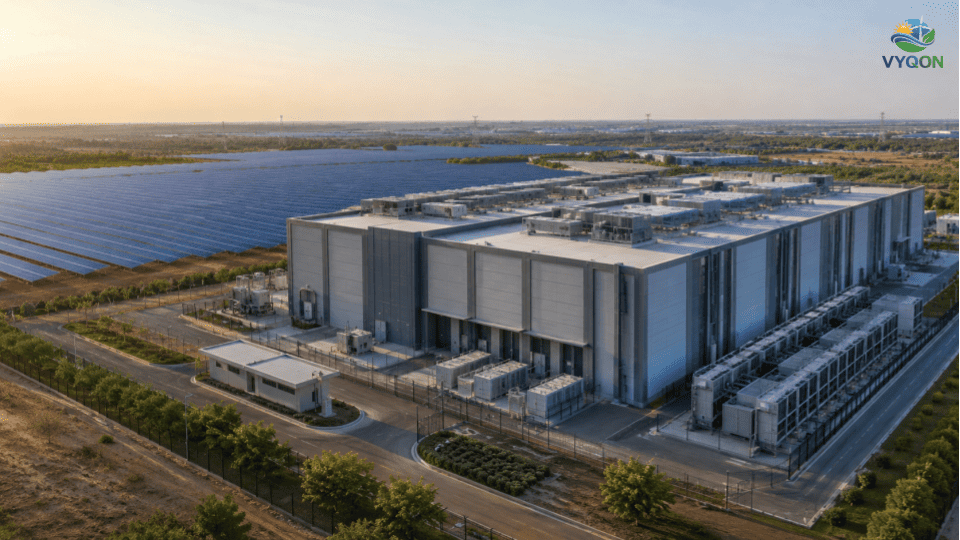
The Gujarat government officially launched the Viksit Gujarat Data Center Policy (2026-29) on July 9, 2026, in Gandhinagar, establishing a dedicated regulatory framework to transform the state into India’s primary hub for hyperscale and AI-ready infrastructure. Targeting a total investment of ₹6 lakh crore and a capacity goal of 7.5 GW (expandable to 8 GW), the policy aims to anchor the state’s vision of a $3.5 trillion economy by 2047. Market analysis by Nuvama Institutional Equities suggests the framework could reduce annual operating costs for eligible data centers by approximately 22%, significantly improving project viability for global hyperscalers.
The 51% Renewable Energy and Sustainability Mandate
The framework couples aggressive financial support with a stringent ESG regulatory floor, mandating high sustainability standards for all participating operators.
- Green Energy Mandate: At least 51% of the electricity consumed for core data center operations must be sourced from renewable energy. This requirement leverages Gujarat’s total installed power base of 69 GW, which includes a robust 47 GW of renewable capacity.
- Water Resource Management: To mitigate pressure on local freshwater, the policy requires the use of captive desalination plants for cooling and operational needs.
- Sustainability Support: To offset these mandatory infrastructure costs, the state provides a 20% capital expenditure support for desalination plants, capped at ₹2 crore per Million Litres per Day (MLD).
Power Infrastructure and Distribution Licensing
A key pillar of the Viksit Gujarat Data Center Policy (2026-29) is the optimization of power procurement and reliability through specialized licensing and transmission provisions.
- Deemed DISCOM Status: The policy allows eligible developers to obtain independent distribution licenses. This “Deemed DISCOM” status is a critical mechanism that facilitates seamless “Open Access” for the procurement of renewable energy from third-party producers.
- Redundancy and Reliability: The state will facilitate dual power feeders via independent transmission lines. Additionally, data center zones are guaranteed 24/7 water availability and round-the-clock, uninterrupted electricity supply.
- Regulatory Designation: Data center operations are officially classified as an “Essential Service” under the Gujarat Essential Services Maintenance Act (ESMA), 1972, ensuring operational continuity during industrial or labor disputes.
Fiscal Incentives and Tax Exemptions Framework
The policy provides a structured financial package distributed over a 20-year horizon. Notably, total financial assistance from all state sources is capped at 75% of the eligible fixed capital investment.
| Incentive Category | Policy Provision |
| Power Tariff Subsidy | ₹1 per unit for 20 years. |
| Electricity Duty | 100% reimbursement for 20 years. |
| Stamp Duty & Registration | 100% exemption for all land transactions. |
| Capital Subsidy | 2.5% on eligible fixed capital investment (Dholera region only). |
| Interest Subsidy | Up to 4% on term loans for 10 years (capped at ₹25 crore annually). |
| SGST Reimbursement | 100% on plant, machinery, building infrastructure, and eligible operational services. |
Regional Focus: Dholera SIR and Strategic Scale
The Dholera Special Investment Region (SIR) is designated as the primary anchor hub, with the state aiming to build the world’s largest data center city.
- Geographic Specialization: While major hubs like GIFT City and Ahmedabad remain active, the 2.5% capital subsidy is strictly confined to Dholera, which is slated to host a 7-8 GW cluster. This focus is supported by planned infrastructure including the Dholera Airport and a semi-high-speed rail link.
- Eligibility Threshold: Incentives are restricted to new, large-scale facilities with a minimum approved installed IT load of 150 MW.
- Building Code Relaxations: To accommodate high-density AI hardware, the policy permits up to 70% ground coverage and offers additional Floor Space Index (FSI), alongside flexibility in locating transformers and backup generators.
Corporate Commitments and Global Context
Investor demand has significantly outpaced the state’s initial projections, shifting the government’s role from attraction to capacity management.
- Capacity Rationing: The state has received interest from 14 investors with cumulative demand reaching nearly 15 GW. With the policy target set at 7.5 GW, the government is effectively rationing capacity to prioritize the most technologically advanced and sustainable projects.
- Reliance-Meta “Built-to-Suit” Project: Reliance Industries Ltd and Meta have partnered for a 168 MW AI-enabled facility in Jamnagar. This represents India’s first “built-to-suit” data center for a global technology leader, utilizing desalinated seawater and renewable power.
- Adani Group Platform: The Adani Group is currently developing a 5 GW data center platform powered by the Khavda renewable energy park, which features a planned capacity of 30 GW.
- Global Positioning: While India generates 20% of global data, it currently holds only 3% of global data center capacity (2-3 GW). This policy is a strategic move to bridge the gap and compete with established leaders like the United States (30 GW capacity) and China.
Official Sources:
- Viksit Gujarat Data Center Policy 2026–2029 (Official E-book): https://cmogujarat.gov.in/en/ebooks/viksit-gujarat-data-center-policy-indias-data-center-hub
- Department of Science and Technology (DST), Government of Gujarat: https://dst.gujarat.gov.in/Home/GujaratStateDataCenter
- Gujarat IT and ITeS Policy 2022–27: https://dstpolicy.gujarat.gov.in/public/assets/itpolicy/document/GR-IT-Policy-2022-2027.pdf
- Reliance Industries Limited Official Media Release: “Reliance and Meta to Develop AI-Enabled Data Centre in Jamnagar, Gujarat”
Leave a Comment