
The 8.13 TWh Curtailment Event
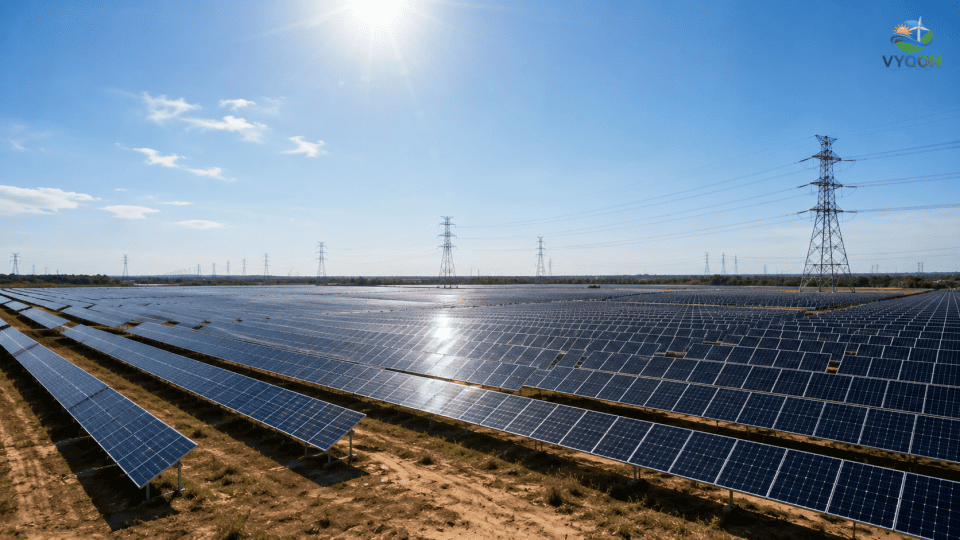
During the April–June 2026 period (Q1 FY27), India was forced to curtail 8,133 gigawatt-hours (GWh), or 8.13 terawatt-hours (TWh), of solar electricity. This massive restriction of clean energy occurred despite a severe heatwave that drove record-high demand across the national grid. According to the Ministry of Power, these measures were necessitated by two primary factors: the technical requirement to maintain absolute grid security and a persistent mismatch between the rapid commissioning of renewable energy projects and the slower readiness of the associated transmission infrastructure.
The volume of electricity lost during this single quarter represents approximately one-and-a-half days of India’s total national power consumption. To contextualize the scale of this “execution deficit,” the curtailed energy would have been sufficient to power nearly 1.4 million homes for an entire year.
Quantitative Breakdown of Quarterly Curtailment
Solar restrictions intensified as the quarter progressed, peaking in May before slightly easing in June. A significant portion of this was managed via Emergency Tertiary Reserve Ancillary Services (TRAS)—a technical mechanism used by the National Load Dispatch Centre to direct generators to reduce output during system-wide emergencies to prevent grid instability.
| Month (2026) | Solar Power Curtailed (GWh) | Key Observation |
| April | 2,417 | Curtailment under emergency TRAS averaged 15.76 GWh per day, up 73.5% from Q4 2025. |
| May | 3,235 | Quarterly high; occurred despite an all-time national peak demand of 270.82 GW on May 21. |
| June | 2,481 | Curtailment eased slightly from May levels but remained higher than initial April projections. |
Operational Root Causes: Infrastructure and Timeline Mismatches
The Q1 data exposes a systemic misalignment between generation incentives and grid-side capital expenditure. The “execution deficit” causing these bottlenecks is fundamentally tied to vastly different development timelines:
- Solar and Wind Projects: Typically commissioned within 12–18 months.
- Transmission Lines: Require 36–60 months due to complex civil construction, supply chain shortages for High-Voltage Direct Current (HVDC) equipment, and prolonged Right-of-Way (RoW) or land disputes.
- Environmental Constraints: Implementation in resource-rich states like Rajasthan and Gujarat has faced significant delays to comply with Great Indian Bustard (GIB) habitat undergrounding mandates.
Because generation outpaces evacuation capacity, nearly 21 GW—approximately 9% of India’s installed renewable capacity—currently relies on Temporary General Network Access (T-GNA). This stopgap measure allows generators to inject power only when spare transmission margin is available. Of this capacity, 12 GW faces active evacuation limits during peak generation hours. Regional challenges are most acute in Rajasthan, where projects have experienced curtailment levels between 70% and 95% during peak afternoon hours.
Broader Grid Context and Installed Capacity Milestones
Despite infrastructure friction points, India’s transition to non-fossil fuel energy continues at scale. On July 31, 2026, the country reached a milestone with 300.5 GW of installed non-fossil fuel capacity, crossing 60% of the 2030 national target.
Capacity additions for FY 2025–26 further illustrate the pivot:
- Non-Fossil Fuel Capacity Added: 55,225 MW.
- Fossil Fuel-Based Capacity Added: 9,470 MW.
- Battery Energy Storage Systems (BESS): 2,668.54 MW (Power Capacity) / 7,785.6 MWh (Energy Storage Duration) of BESS was deployed during 2026 to stabilize frequency and manage intermittency.
Financial Risks and Market Volatility
The Sustainable Project Developers Association (SPDA) has warned that persistent curtailment is creating severe economic distortions. Beyond the loss of clean electrons, the surplus has triggered extreme volatility on the Indian Energy Exchange (IEX). Spot electricity prices in the real-time market have crashed to near-zero levels during peak solar hours, only to surge to the regulatory ceiling of ₹10/unit at night.
The resulting financial implications for the B2B sector include:
- Asset Performance: Projects risk becoming Non-Performing Assets (NPAs) as revenues can fall below 5% of original projections during peak curtailment.
- Investor Attrition: Unpredictable “backing down” under T-GNA erodes Internal Rates of Return (IRRs), threatening future private and foreign capital inflows.
- Banking Exposure: Public financial institutions (PFC, REC, and IREDA) have a combined exposure exceeding ₹5.08 lakh crore in the sector, creating systemic risk if debt obligations are not met.
Official Responses and Policy Initiatives
Addressing Parliament, Minister of State for Power Shripad Naik emphasized that while curtailment is a necessary temporary measure for grid reliability, a coordinated modernisation plan is underway.
Key government initiatives to resolve the evacuation crisis include:
- Inter-State Transmission System (ISTS): Strengthening the high-voltage network that facilitates the transfer of power across state lines to reduce regional congestion.
- Strategic Projects: The bidding and conclusion of the 6 GW Barmer HVDC project in Rajasthan is expected within 3 to 6 months to address the massive western hub bottleneck.
- Regulatory Reform: CERC’s General Network Access (GNA) rules are being phased in to replace temporary access with firm transmission rights.
- Storage VGF Schemes: Approval of Viability Gap Funding for 13.22 GWh and an additional 30 GWh of BESS capacity.
- Integrated Planning: The National Electricity Plan now targets 47 GW of BESS integration by 2031-32 to absorb afternoon surpluses.
The Path Toward 500 GW
The curtailment of 8.13 TWh of solar power serves as a critical indicator that generation capacity alone cannot satisfy national climate goals. For India to achieve its 500 GW target by 2030, the expansion of the national grid must be precisely synchronized with generation commissioning. Mitigating the “execution deficit” through accelerated energy storage deployment and the completion of high-capacity HVDC corridors remains the only viable path to ensuring both energy security and the financial health of the renewable sector.
Official Source Citations
- Ministry of Power, Government of India. (2026). Rajya Sabha Unstarred Question No. 1752: Modernisation of the Power Sector and Reliable Electricity Supply. Answered on 03.08.2026. [View Source Document]
- Ministry of New and Renewable Energy (MNRE), Government of India. (2026). Rajya Sabha Unstarred Question No. 1106: Solar Energy Curtailment. Answered on 28.07.2026. [View Source Document]
- Central Electricity Authority (CEA), Government of India. (2025). Statement on Renewable Energy Grid Integration and Transmission Charges by Chairperson Ghanshyam Prasad. [Official Report Context]
Leave a Comment