
1. Introduction: From Scarcity to Optimization
The Ministry of Power has unveiled the Draft National Electricity Policy (NEP) 2026, marking the first comprehensive structural overhaul of India’s energy framework since 2005. While the 2005 policy was a product of the “Era of Scarcity”—defined by chronic deficits and the struggle for basic rural access—the 2026 mandate signals a transition to the “Era of Optimization.”
This shift is built upon the foundational achievements of the last two decades: the operationalization of a unified national grid in December 2013 and the milestone of universal household electrification reached in March 2021. With per capita consumption having climbed to 1,460 kWh in 2024–25, the policy focus moves beyond “megawatt counting” toward a sophisticated “Viksit Bharat @2047” vision centered on reliability, decarbonization, and fiscal discipline.
| Feature | NEP 2005 Focus (Era of Scarcity) | Draft NEP 2026 Mandate (Era of Optimization) |
| Primary Goal | Resolving power shortages; basic infrastructure expansion. | Decarbonization; high system reliability; “Viksit Bharat.” |
| Market Status | Rapid generation expansion; early-stage unbundling. | Advanced market design; financial viability; competition. |
| Grid Focus | Connectivity and rural access. | Stability; Resource Adequacy (RA); storage integration. |
| Consumer Role | Passive recipient/beneficiary. | Prosumer/Active Market Participant (P2P, V2G, storage). |
2. The “2,000 kWh” Target: Powering “Viksit Bharat”
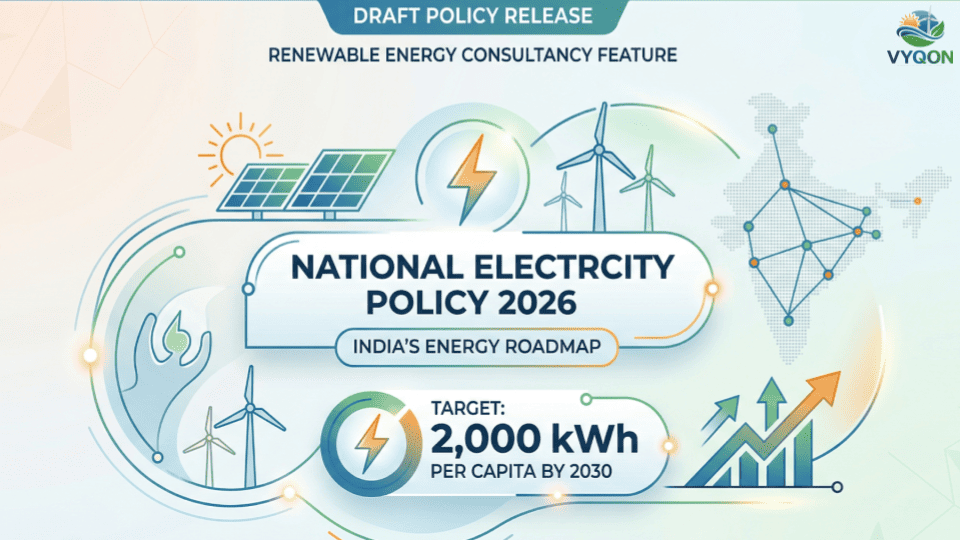
The Draft NEP 2026 treats electricity consumption as the primary metric for economic maturity. To support India’s trajectory toward a developed economy, the policy sets aggressive benchmarks for per capita electricity usage: increasing from the current ~1,460 kWh to 2,000 kWh by 2030, and ultimately scaling to 4,000 kWh by 2047.
This target necessitates a pivot from aggregate capacity addition to decentralized Resource Adequacy (RA) planning. Under the new framework, DISCOMs and State Load Despatch Centres (SLDCs) are required to prepare utility-level RA plans to ensure the optimal mix of resources is available to meet demand at the least cost, moving the sector from a focus on volume to one of system-wide reliability.
3. Clean Energy & The Nuclear Renaissance
Aligned with the SHANTI Act, 2025, the Draft NEP 2026 positions decarbonization at the heart of grid design. The policy targets a 45% reduction in emissions intensity by 2030 (relative to 2005 levels) and establishes a pathway toward net-zero by 2070.
- Nuclear Expansion: The policy envisages a major “Nuclear Renaissance,” targeting 100 GW of capacity by 2047. This includes the deployment of advanced nuclear technologies such as Small Modular Reactors (SMRs) and encourages the direct use of nuclear energy by large-scale commercial and industrial (C&I) consumers.
- Thermal Repurposing: Coal-based generation is being redefined as “grid support.” Beyond providing firm baseload, the policy explores the direct utilization of steam from thermal plants for industrial processes and district cooling, ensuring that traditional assets are “optimized” rather than simply retired.
4. Structural Reforms: The DSO Model and Urban Reliability
The distribution segment is slated for a radical organizational reset to resolve its status as the sector’s “weakest link.”
- DSO and Shared Networks: The policy introduces the Distribution System Operator (DSO) to manage the integration of distributed renewables, storage, and Vehicle-to-Grid (V2G) systems. Crucially, it proposes “Shared Distribution Networks” to enhance competition without the wasteful duplication of physical infrastructure.
- Retail Competition: In a significant departure from the 2005 framework, Regulatory Commissions may now exempt distribution licensees from the Universal Service Obligation (USO) for consumers with a contracted load of 1 MW and above, facilitating “competition beyond the wires.”
- Urban Reliability: Cities with a population of 10 lakh+ must achieve N-1 redundancy for distribution transformers by 2032.
- Efficiency Gains: National AT&C losses have already seen a sharp decline from 21.91% in FY21 to 15.04% in FY25, with the policy now mandating a shift to single-digit losses.
5. Market & Tariff Changes: Ending the “Utility Debt Trap”
To restore DISCOM health, the Draft NEP 2026 moves tariff regulation from “discretion to discipline.”
- Automatic Tariff Revisions: Tariffs will be linked to indices for automatic annual revision if State Commissions fail to pass timely orders. This discipline has already yielded results, with the national ACS-ARR Gap narrowing from ₹0.69/kWh (FY21) to just ₹0.06/kWh (FY25).
- Market Design & FSCs: The policy encourages a shift from traditional physical PPAs to Financially Settled Contracts (FSCs), such as Virtual Power Purchase Agreements (VPPAs) and Bilateral Contract Settlements (BCS). These instruments allow DISCOMs and consumers to buy/sell on the market at pre-agreed prices, potentially saving consumers ₹0.33/kWh by protecting them from market price spikes.
- Cross-Subsidy Rationalization: Manufacturing, railways, and metro railways are to be exempted from cross-subsidy surcharges to boost global competitiveness.
- Peer-to-Peer (P2P) Trading: A new framework allows prosumers to trade surplus energy from Distributed Renewable Energy (DRE) and storage directly.
6. Emerging Technologies: Smart Grids and Data Sovereignty
Modernization is grounded in technological indigenousness and data security.
- Indigenous SCADA: The policy mandates a transition to indigenously developed SCADA systems by 2030. Implementation is already sanctioned for 394 towns, backed by an outlay of ₹2,389 crore.
- Smart Distribution: A further ₹8,052 crore has been sanctioned for advanced works including GIS substations and undergrounding of HT/LT lines in congested urban areas.
- Smart Metering: Momentum is high, with 5.59 crore smart meters already installed as of early 2026. These provide real-time visibility and enable “Time-of-Use” tariffs.
- Data Sovereignty: To ensure system resilience, all power sector data must be stored within Indian borders.
7. Analyst’s Corner: Gaps and Implementation Risks
While the Draft NEP 2026 is conceptually robust, its success hinges on addressing several “second-generation” challenges:
- The Process Problem: Legal analysts emphasize that regulatory assets are often the result of systemic delays and tariff suppression. Without computerized verification and expedited adjudication, the “automatic” mechanisms may still face litigation-induced stays.
- Operational Discipline: Technical observers note the absence of state-level Automatic Generation Control (AGC). Grid security requires a non-negotiable focus on the Area Control Error (ACE) to ensure balancing responsibility is borne where it originates.
- Revenue Stabilization: The lack of a uniform Curtailment Compensation framework remains a risk for renewable investors. Analysts suggest that two-sided Contracts for Difference (CfDs) are essential to stabilize revenue for offshore wind and green hydrogen projects.
8. Conclusion: A Fundamental Reset
The Draft National Electricity Policy 2026 is less of a routine update and more of a fundamental reset. It acknowledges that the defining challenge of the next decade is not the scarcity of power, but the necessity of institutional consistency and market maturity. Whether this “second-generation reform” delivers a resilient, 4,000 kWh economy by 2047 depends entirely on moving from ambitious planning to disciplined, technologically-led execution.
Key Takeaways: Draft NEP 2026 at a Glance
Consumption Goal Target: 2,000 kWh/capita by 2030; 4,000 kWh by 2047.
Decarbonization Net-zero by 2070; 100 GW Nuclear by 2047; 45% emissions intensity reduction by 2030.
Efficiency Target single-digit AT&C losses; ACS-ARR Gap reduced to ₹0.06/kWh; Automatic tariff revisions.
Innovation DSO model; Shared Distribution Networks; Financially Settled Contracts (FSCs) for market-based procurement.
Reliability N-1 redundancy for 10 lakh+ cities by 2032; SCADA implementation in 394 towns.
Consumer Rights 1 MW+ USO exemption to foster retail choice; P2P energy trading for prosumers.
Leave a Comment