
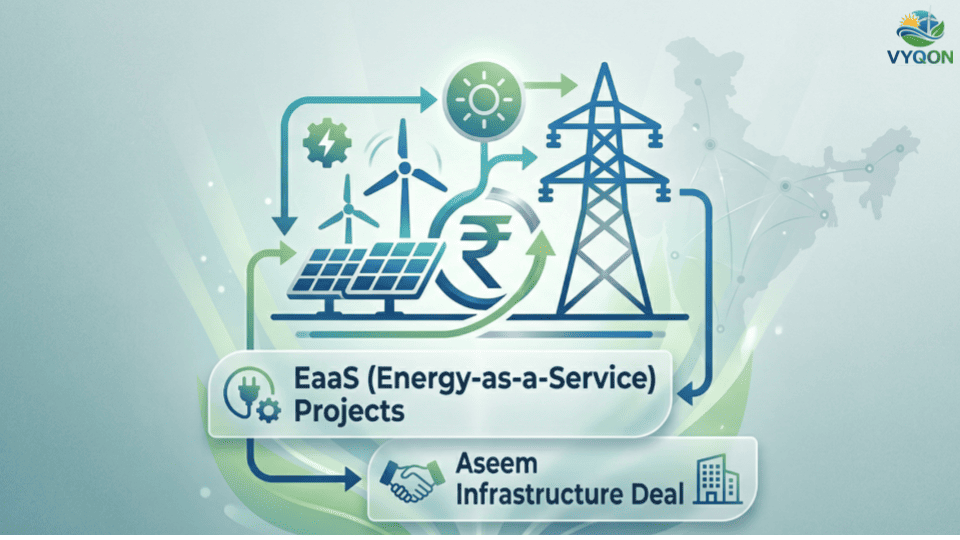
The Lead: A Milestone for Decentralized Energy Financing
The financial plumbing of India’s energy transition underwent a significant upgrade this week with the announcement of a ₹1.3 billion (approximately $15 million) long term debt financing facility. Secured by August Energy India from Aseem Infrastructure Finance Limited (AIFL), the deal marks a critical maturation of the Energy-as-a-Service (EaaS) asset class in the subcontinent.
This transaction is particularly notable as it represents August Energy’s first asset-level long-term project financing in India, signaling a decisive shift from an equity heavy funding model to a sophisticated debt-leverage structure. For the company, this move is a strategic “capital unlock,” allowing it to recycle early-stage equity to fund an ambitious 1 GW pipeline while proving the bankability of integrated, on-site industrial utilities to institutional lenders.
Key Deal Highlights
The core financial and structural components of the transaction, facilitated by advisory firm TruBoard Cleantech, include:
- Total Debt Amount: ₹1.3 Billion (approx. $15 Million).
- Primary Lender: Aseem Infrastructure Finance Limited (AIFL), a specialized NBFC-IFC backed by the National Investment and Infrastructure Fund (NIIF).
- Advisory Firm: TruBoard Cleantech.
- Target Sector: Commercial and Industrial (C&I) Energy-as-a-Service (EaaS).
- Typical Contract Duration: 10 to 15 years.
Decoding EaaS: The “Zero-CapEx” Revolution for Indian Industry
The EaaS business model is fundamentally restructuring industrial utility procurement by removing the barrier of upfront Capital Expenditure (CapEx). Under this “Integrated Utilities” framework, August Energy assumes 100% of the responsibility for design, installation, and operations, enabling industrial clients to shift utility costs to Operating Expenditure (OpEx) while guaranteeing uptime and efficiency.
This approach distinguishes itself by looking beyond simple power generation to optimize the entire utility stack via four technical pillars:
- Renewable Generation: On-site rooftop solar or grid-wheeled renewable energy (solar and wind) paired with storage to maximize decarbonization.
- Cooling-as-a-Service (CaaS): High-efficiency electric chillers and thermal storage systems designed for temperature-sensitive processes.
- Steam and Heat Recovery: Bioenergy and biomass systems that replace carbon-intensive fossil-fuel boilers.
- Power Quality and Reliability: The deployment of UPS systems and Battery Energy Storage Systems (BESS) to insulate critical production lines from grid instability.
Project Spotlight: The 1.5 GW Jaipur Milestone
A primary beneficiary of this financing is the EaaS deployment for a 1.5 GW solar module manufacturing facility near Jaipur. As India scales its manufacturing capacity under the Production Linked Incentive (PLI) scheme, this project serves as a benchmark for asset-light industrial expansion.
Technical Profile: Jaipur Manufacturing Utility Deployment
| Utility Component | Specification | Impact |
|---|---|---|
| Cooling | 480 Tons of Refrigeration (TR) | Provides clean-room stability with loop redundancy to withstand Rajasthan’s extreme ambient heat. |
| Compressed Air | 1,428 Cubic Feet per Minute (CFM) | Powers high-precision robotics via an EMS that dynamically adjusts output to eliminate energy waste. |
| Power Quality | 1,100 kVA UPS Capacity | Creates a “synthetic grid” for critical loads, providing total immunity from external voltage fluctuations. |
The Lender’s Perspective: Why Infrastructure Giants are Betting on EaaS
For Aseem Infrastructure (AIFL), the deal fits a rigorous mandate for “climate-positive” infrastructure backed by strong institutional underwriting. As an NIIF-backed entity with equity participation from Sumitomo Mitsui Banking Corporation (SMBC), AIFL views EaaS as a highly bankable asset class due to its predictable, long-term cash flows and lack of merchant power risk.
AIFL’s institutional credibility is reinforced by a 74% CAGR in its portfolio since FY21 and a maintained zero-NPA history. Its disciplined risk management is evidenced by an internal grading framework that avoids any projects below a ‘BBB-‘ rating; currently, 70% of its outstanding debt holds an external rating of ‘A-‘ or higher. This level of stability has attracted global attention, with the TPG Rise Climate fund reportedly considering a $1 billion equity investment to leverage AIFL’s green lending platform.
Looking Ahead: Scaling the Ecosystem
The synergy between innovative providers like August Energy and specialized lenders like AIFL is the primary engine for India’s low carbon industrial economy. August Energy aims to deliver over 1 GW of capacity within five years, focusing on high-density industrial clusters in states with supportive open-access policies.
The growth trajectory of the EaaS sector is supported by significant regulatory tailwinds:
- The 2026 launch of the carbon credit trading market, which will provide a secondary revenue stream for high-efficiency utility projects.
- The rapid maturation of the Battery Energy Storage System (BESS) market, which saw a 26% year over year capacity increase in 2025.
As manufacturing scales, the transition from equity led pilot projects to debt-backed industrial infrastructure confirms that the “Integrated Utilities” model has arrived as a cornerstone of the Indian energy landscape.
Leave a Comment