
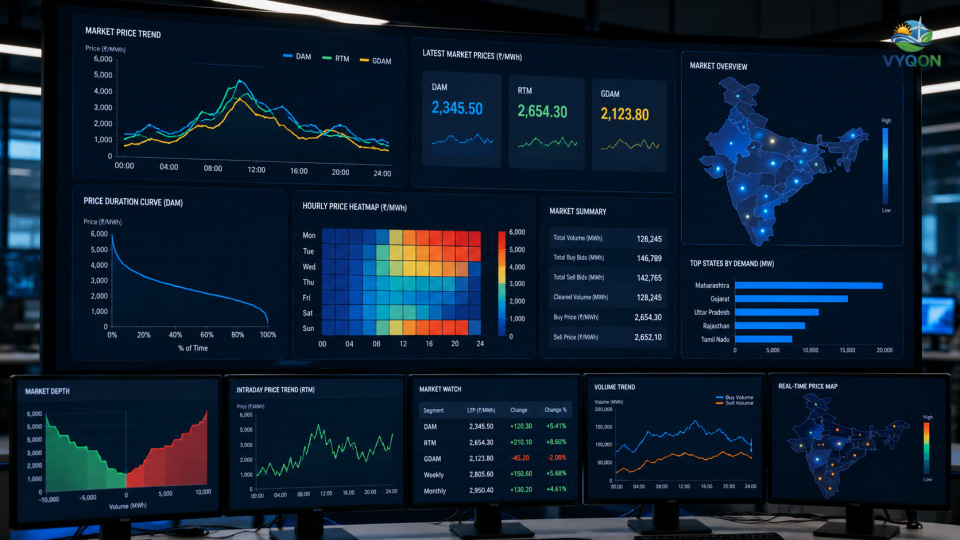
In July 2026, the Indian Energy Exchange (IEX) recorded a total electricity trading volume of 13,527 million units (MU), a 7.7% year-on-year (YoY) increase. This growth occurred against a backdrop of severe liquidity constraints in the Renewable Energy Certificate (REC) segment, where volumes plummeted 56.3% YoY. The month’s performance was defined by a significant surge in national power demand, driven by extreme weather conditions that forced a structural migration in trading behavior across the exchange’s diverse market segments.
National Energy Consumption and Market Clearing Prices
India’s energy consumption reached 170.70 billion units (BU) in July 2026, marking a 10.9% YoY growth. This spike was primarily catalyzed by an El Niño-driven heatwave and a 15% national rainfall deficit, which simultaneously drove up cooling demand and crippled hydropower output, which fell by 14% during the period. On July 16, 2026, the country recorded a peak demand of 270.20 GW—the second-highest peak ever recorded in Indian history.
The resulting supply-side pressure, highlighted by a 42.5% surge in buy bids within the Day-Ahead Market, led to a notable escalation in clearing prices:
- Day-Ahead Market (DAM) Prices: The average market clearing price rose to ₹4.99/unit, a 19.3% YoY increase.
- Real-Time Market (RTM) Prices: The average market clearing price reached ₹4.41/unit, up 15.1% YoY.
Segment-Wise Volume Analysis: Structural Shift to Real-Time Markets
The July data underscores a fundamental shift in utility procurement strategies, as market participants increasingly rely on last-minute adjustments to manage grid volatility and renewable intermittency.
Real-Time Electricity Market (RTM) The RTM continues its ascent as a critical grid-balancing tool, achieving a volume of 5,631 MU, a 10.2% YoY increase. RTM now accounts for approximately 42% of IEX’s total electricity volume (up from 35% in the previous year), reflecting a structural migration toward spot-market reliance as distributors navigate unpredictable demand spikes.
Day-Ahead Market (DAM) The DAM, including the High-Price Day-Ahead Market (HP-DAM), recorded 5,087 MU. This segment saw a 7.7% YoY decline from 5,510 MU, as high clearing prices and the shift toward RTM liquidity dampened traditional day-ahead procurement.
Term-Ahead Market (TAM) & Day-Ahead Contingency Comprising contingency, daily, weekly, and monthly contracts for up to three months, this segment witnessed a substantial 93.4% YoY surge, reaching 1,774 MU.
Green Market (G-DAM & G-TAM) The combined Green Market volume reached 1,035 MU, a marginal 0.9% YoY increase. Notably, the weighted average price in G-DAM declined by 4.2% to ₹3.75/unit. This creates an widening price gap between conventional power (₹4.99/unit) and green energy, potentially accelerating corporate renewable procurement in the coming quarters.
Renewable Energy Certificate (REC) Market Dynamics
The REC market faced a severe supply crunch in July, with traded volumes falling to 7.11 lakh certificates. This 56.3% YoY contraction was driven by a massive 77.8% drop in sell bids, which effectively pushed clearing prices higher across the month’s two sessions:
- July 8: Clearing price of ₹380/REC.
- July 29: Clearing price of ₹376/REC.
The next scheduled trading sessions for RECs are August 12 and August 26, 2026.
Regulatory and Corporate Context
The exchange faces a significant structural pivot following the July 27, 2026, hearing at the Supreme Court. The Court admitted IEX’s appeal against market coupling but explicitly refused to grant an interim stay. Consequently, the Central Electricity Regulatory Commission (CERC) is expected to implement market coupling rules within a 4-to-6-week window. This move aims to unify price discovery across exchanges, threatening IEX’s dominant 85% market share.
To mitigate this regulatory overhang, IEX is accelerating its diversification:
- Indian Gas Exchange (IGX): IEX filed the DRHP for an Offer for Sale (OFS) on July 14, 2026, to bring its stake down to the 25% regulatory ceiling.
- Coal Exchange: Following the notification of Coal Exchange Rules on June 4, a new mandate will require all coal trading, including Coal India’s e-auctions, to be routed through an exchange within six months of the first license going live. This is expected to displace incumbents like MSTC and mjunction.
Despite these challenges, IEX demonstrated financial resilience in Q1FY27, reporting a 12% YoY rise in consolidated net profit to ₹135 crore.
July 2026 Market Summary Table
| Market Segment | July 2026 Volume | YoY Percentage Change |
| Total Electricity Traded | 13,527 MU | +7.7% |
| Real-Time Market (RTM) | 5,631 MU | +10.2% |
| Day-Ahead Market (DAM) | 5,087 MU | -7.7% |
| Term-Ahead Market (TAM) | 1,774 MU | +93.4% |
| Green Market | 1,035 MU | +0.9% |
| REC Trading | 7.11 Lakh Units* | -56.3% |
*Note: REC volumes are expressed in lakh certificates; all other segments are in Million Units (MU).
Official Source Citations
The following official websites, data registries and regulatory bodies are referenced in the provided documentation as the primary sources for market performance, rules and energy statistics:
- Indian Energy Exchange (IEX) Official Portal: www.iexindia.com
- Indian Gas Exchange (IGX) Market Data: https://exchange.igxindia.com/web/market-data-daily
- Renewable Energy Certificate (REC) Registry of India: https://www.recregistryindia.nic.in/
- Ministry of Power (MOP) Official Press Releases: https://pib.gov.in/PressReleasePage.aspx?PRID=1759300
- Asian Development Bank Institute (ADBI) Official Publication: https://www.adb.org/publications/renewable-energy-certificates-trading-in-india-a-decade-in-review
Leave a Comment