
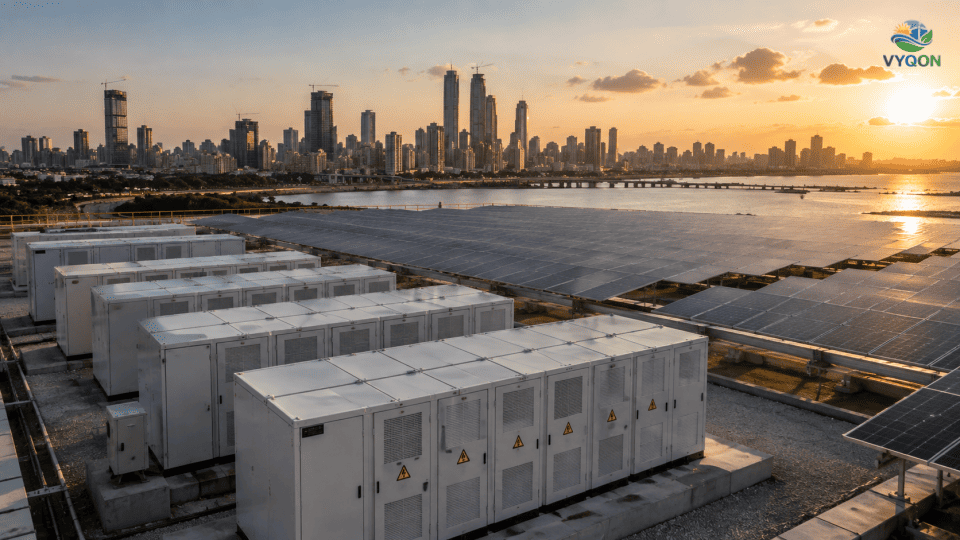
On August 06, 2026, the Maharashtra Electricity Regulatory Commission (MERC) approved a proposal by the Brihanmumbai Electric Supply and Transport (BEST) Undertaking for the long-term procurement of 220 MW of solar power integrated with a 110 MW/440 MWh Battery Energy Storage System (BESS). The 4-hour duration storage system is being procured through the Solar Energy Corporation of India (SECI) as part of a 2,000 MW/1,000 MW/4,000 MWh ESS tender under the ISTS-connected Tranche-XX scheme. The approval includes a 25-year Power Sale Agreement (PSA) at discovered tariffs of ₹2.86–2.87/kWh. The Commission also approved a trading margin of ₹0.07/kWh for SECI, noting that the Central Electricity Regulatory Commission (CERC) had already adopted the tariff under Section 63 of the Electricity Act, 2003.
Developer Allocations and Tariff Breakdown
The capacity was allocated to three developers through a competitive bidding process and electronic reverse auction conducted by SECI. The following allocations and tariffs were approved:
- LC Infra Projects Pvt. Ltd.: 50 MW allocation at a tariff of ₹2.86/kWh.
- GH2 Solar Limited: 50 MW allocation at a tariff of ₹2.87/kWh.
- Navayuga Green Energy Pvt. Ltd.: 120 MW allocation at a tariff of ₹2.87/kWh.
Power supply is scheduled to commence 24 months from the effective date of the Power Purchase Agreements (PPAs) executed between the developers and SECI.
Regulatory Alignment and Compliance Mandates
The procurement is designed to support BEST’s Renewable Purchase Obligation (RPO) and Energy Storage Obligation (ESO) while providing firm and dispatchable renewable energy (FDRE) capacity. Key regulatory factors include:
- Strategic Planning: The procurement aligns with BEST’s approved Resource Adequacy Plan, aimed at reducing dependence on short-term power markets and ensuring long-term tariff certainty.
- ESO Targets: Under the current framework, distribution licensees must increase their energy storage procurement from 1.5% in FY 2024–25 to 4% by FY 2029–30.
- Capacity Projections: This procurement assists BEST in meeting projected storage requirements, which are expected to rise from 60 MW in FY 2024–25 to 219 MW by FY 2029–30.
- Jurisdictional Role: MERC clarified that because the tariff was adopted by CERC under Section 63, its regulatory role was restricted to examining the prudence of the procurement for the utility.
Technical Infrastructure and Grid Integration
Although the procurement originated under an Inter-State Transmission System (ISTS) scheme, the projects allocated to BEST are physically connected to the Maharashtra State Transmission Utility (STU) network.
- Network Connection: Direct connection to the intra-state STU network eliminates ISTS transmission charges and losses.
- Operational Directives: The Maharashtra State Load Despatch Centre (MSLDC) expressed concerns regarding the absence of a dedicated operational framework for BESS. Consequently, MERC directed the STU and MSLDC to process connectivity and access applications under existing frameworks while a specific BESS regulatory framework is developed.
Financial Contingencies and Margin Conditions
The regulatory approval includes specific conditions regarding SECI’s trading margin and tax-related tariff adjustments:
- Trading Margin Conditionality: The approved ₹0.07/kWh margin is contingent upon SECI providing an escrow arrangement or an irrevocable, unconditional, and revolving letter of credit to the developers. If these financial instruments are not provided, the trading margin is restricted to ₹0.02/kWh.
- Reverse Change in Law Benefit: A reduction in GST on solar cells and modules from 12% to 5% has been identified as a potential reverse Change in Law benefit. This may result in a tariff reduction of approximately 10–12 paise per unit, subject to final reconciliation and regulatory verification.
Leave a Comment