
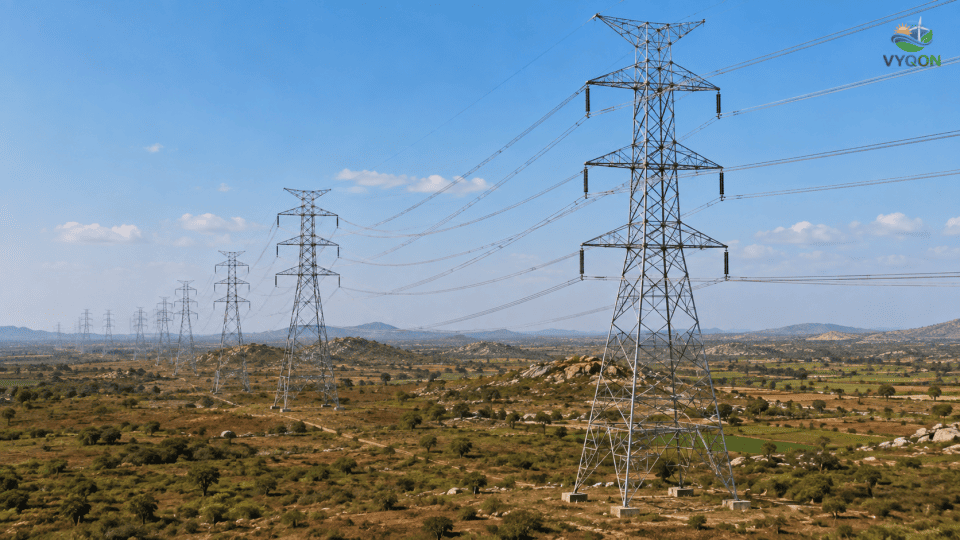
The Ministry of New and Renewable Energy (MNRE) is seeking Union Cabinet approval for the Green Energy Corridor (GEC) Phase III, a critical infrastructure initiative with an estimated investment outlay of approximately ₹50,000 crore. The mission is designed to evacuate 135 GW of renewable power to the national grid, addressing systemic bottlenecks that have hampered clean energy deployment. In a significant policy departure from state-utility-led iterations, Phase III will explicitly adopt the Public-Private Partnership (PPP) model to mobilize capital and accelerate execution timelines.
Technical Scope and Regional Targets
The proposed infrastructure represents a massive leap in scale compared to previous phases. While GEC Phase II involved approximately 10,750 circuit kilometers (ckm), Phase III and IV are projected to be eight to ten times larger, potentially exceeding 100,000 ckm of transmission lines to accommodate the 135-150 GW target.
The network strengthening will prioritize “renewable-energy-rich” states identified as primary generation hubs:
- Gujarat
- Rajasthan
- Karnataka
- Maharashtra
- Andhra Pradesh
The expansion centers on the Inter-State Transmission System (ISTS) as the backbone of India’s “One Nation, One Grid, One Frequency” architecture. To minimize energy losses over vast distances, technical specifications favor 765 kV high-voltage lines and Direct Current (DC) technology, which are essential for the efficient movement of bulk power across the unified national grid.
Execution Framework: The Shift to PPP and TBCB
Implementation for Phase III marks a decisive shift toward the PPP model, utilizing Tariff-Based Competitive Bidding (TBCB) to select private transmission service providers. This mechanism is designed to attract established infrastructure firms and large private transmission players, ensuring market competition drives down costs for the end consumer.
Central to this framework is the mitigation of “sequencing risk”—the historical misalignment where generation plants are completed before evacuation corridors are operational. To combat this, the PPP contracts incorporate stricter penalties and liabilities for private players regarding construction timelines and performance standards. By aligning the risk of “stranded assets” with the entities responsible for grid construction, the ministry aims to improve overall accountability in the infrastructure lifecycle.
Addressing Grid Constraints and Curtailment
The factual impetus for Phase III is a growing “connectivity” bottleneck that MNRE officials identify as the principal constraint on current deployment. Between April and June 2026 alone, grid constraints led to the curtailment of approximately 8,133 GWh of solar electricity.
This curtailment has severe financial implications for renewable energy developers, directly impacting cash flows and project returns as generated power remains trapped. Phase III is intended to resolve this inter-regional congestion, particularly the long-standing North-South transmission bottlenecks, allowing surplus power to reach high-demand centers without interruption.
Historical Context and Background
The GEC program is the foundational pillar for India’s target of 500 GW of non-fossil fuel capacity by 2030. While earlier phases established the framework, the upcoming phases transition the project into a truly nationwide endeavor.
GEC Phase Comparison
| Phase I & II | Phase III & IV |
| Phase I: Nearly complete (90-100% commissioned) across eight states (AP, GJ, HP, KA, MP, MH, RJ, TN). | Scale: Massive 135-150 GW target; project scale is 8-10x larger than previous phases combined. |
| Phase II: Targets 20 GW integration by FY27; footprint expanded to include Kerala and Uttar Pradesh. | Character: Nationwide Inter-State Transmission System (ISTS) covering “everything else” across India. |
Parliamentary Standing Committee observations have consistently underscored that grid expansion must precede or parallel capacity addition to ensure the credibility of the 2030 roadmap.
Financial Landscape and Investment Gaps
Achieving the necessary infrastructure scale requires addressing a widening financing gap. Research from Knight Frank India highlights several critical financial hurdles:
- Investment Disparity: India requires an estimated annual investment of 48–54 billion to meet its targets, significantly higher than the current levels of 13–18 billion.
- The Financing Gap: There is a specific $35 billion annual renewable financing gap. Compounding this is the fact that financing in India is 80% more expensive than in mature international markets.
- Capital Recycling and InvITs: To bridge these gaps, the government is promoting alternative mechanisms like Infrastructure Investment Trusts (InvITs). Currently, less than 2% of operational renewable capacity is monetized through InvITs, representing a massive untapped avenue for developers to recycle capital from operational assets into new transmission and generation projects.
Official Source Citations
- Press Information Bureau (PIB), Government of India. “Renewable Energy Integration.” Published March 09, 2026. https://www.pib.gov.in/PressReleaseDetail.aspx?PRID=2236994
Leave a Comment