
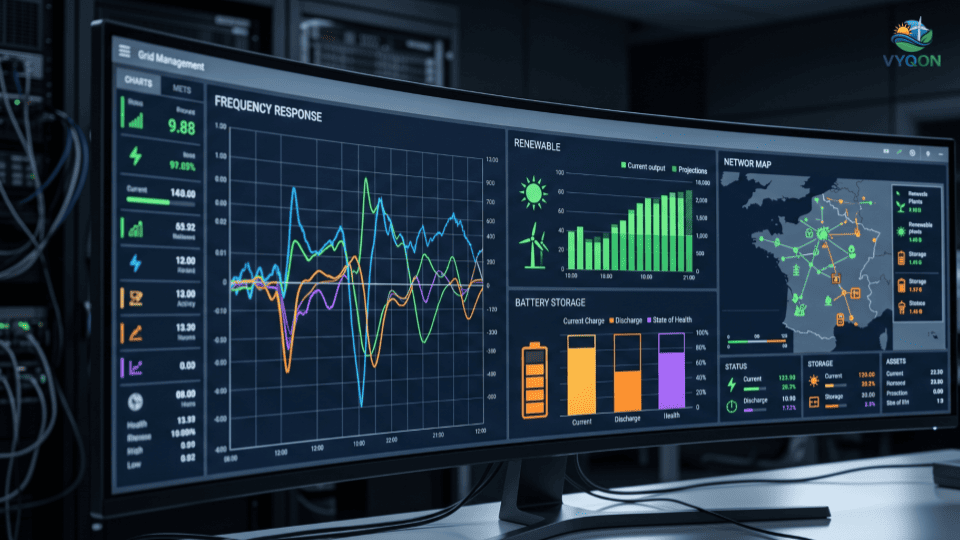
The Bihar Electricity Regulatory Commission (BERC) has released the Draft Bihar Electricity Grid Code, 2026. These regulations will supersede the Bihar Electricity Grid Code, 2010. The draft aims to align state-level operations with the Indian Electricity Grid Code (IEGC) 2023 and address grid conditions that have evolved since the previous code was notified sixteen years ago.
Primary Frequency Response Mandates for Renewables and Storage
The draft code introduces operational requirements for Wind, Solar, and Battery Energy Storage Systems (BESS) to provide primary response when grid frequency falls. The specific technical parameters include:
- Applicability: Requirements apply to wind, solar, and BESS projects with capacities above 10 MW connected at 33 kV or higher.
- Operating Level Capability: Mandatory capability to increase output to at least 105% of the operating level.
- Maximum Continuous Rating (MCR): Support requirements up to 105% or 110% of MCR during frequency drops to maintain grid stability.
Institutional Governance and Oversight Panels
The draft code establishes a framework for institutional governance involving the State Load Despatch Centre (SLDC), Area Load Despatch Centres (ALDCs), and the following specialized oversight bodies:
- Grid Code Review Panel: Mandated for ongoing regulatory oversight and the processing of future amendments.
- Operation Coordination Committee (OCC): Established to manage operational synchronization among grid participants.
- Protection Coordination Committee (PCC): Responsible for system safety, including the execution of protection audits.
Technical Operational Rules: Scheduling, Testing, and Disconnection
Technical rules governing grid participants are detailed under the following categories:
Qualified Coordinating Agencies (QCAs) The code defines QCAs as agencies responsible for coordinating schedules and commercial settlements for wind and solar generators at pooling stations. A key commercial function of the QCA is the de-pooling of payments received from the State Deviation Pool Account for settlement with individual generators.
Trial-Run Testing The draft sets out the process for the commissioning and declaration of commercial operation. This includes mandatory trial-run testing for Energy Storage Systems (ESS) and renewable energy projects to verify technical standards prior to commercial service.
Automatic Disconnection The code stipulates rules for automatic disconnection during under-frequency events. This mechanism is established to maintain grid discipline during periods of critical system stress.
Deviation Settlement and Commercial Mechanism Alignment
The Draft Grid Code provides the foundational definitions for “State Entities,” “Time Blocks,” and “Scheduled Generation” required for the operation of the Bihar Electricity Regulatory Commission (Deviation Settlement Mechanism and Related Matters) Regulations, 2025.
The commercial objective of this alignment is to ensure that grid users adhere to their schedules of drawal and injection through a defined “Deviation Rate” or “Deviation Charge.” The SLDC is responsible for managing these deviations, calculating applicable charges, and maintaining the State Deviation Pool Account.
Public Consultation and Timeline for Implementation
The BERC has set the following schedule for stakeholder engagement and the finalization of the regulations:
- Deadline for written comments and objections: September 4, 2026.
- Public Hearing date: September 10, 2026, at 11:30 A.M. in the Commission’s court room in Patna.
Additionally, the Commission has scheduled a public hearing for the Resource Adequacy Framework (1st Amendment) on August 27, 2026. This amendment specifically proposes to modify Clause 9 of Chapter 4 regarding generation resource assessment and procurement planning.
Official Sources
Leave a Comment