
Strengthening Rajasthan’s Power Ecosystem
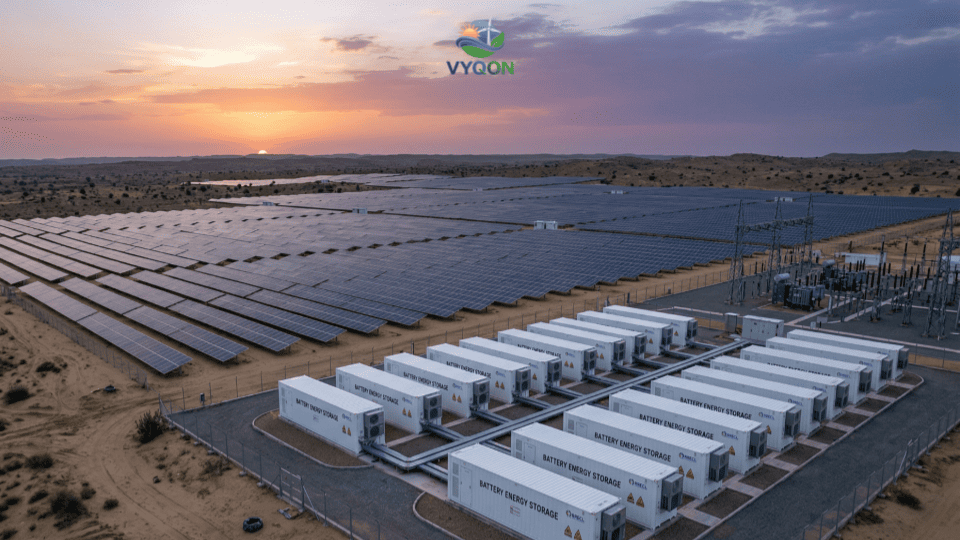
The Rajasthan Electricity Regulatory Commission (RERC) has formally notified the “RERC (Battery Energy Storage Systems) Regulations, 2026,” codifying a sophisticated regulatory architecture designed to de-risk private investment and stabilize the state’s high-RE grid. Replacing the 2025 draft, this final framework establishes a definitive roadmap for deployment across the generation, transmission, and distribution segments. By providing institutional clarity, the RERC aims to facilitate the seamless integration of Rajasthan’s massive solar and wind pipeline, transitioning the state toward a more flexible and modern power ecosystem.
Core Framework Pillars: Deployment, Aggregation, and GEOA Mandates
The 2026 framework establishes a multi-modal deployment strategy to maximize asset utilization. The regulations identify four primary pathways for integration:
- Standalone BESS: Grid-connected assets providing independent storage services.
- Co-located BESS: Systems paired with generation assets to firm up renewable output.
- Behind-the-Meter (BTM) BESS: Consumer-level installations for load management and demand response.
- Aggregator Model: A critical policy lever allowing third-party entities to pool small-scale distributed energy resources (DERs) to participate in wholesale energy markets.
The regulations expand eligibility to include utilities, independent power producers, and “prosumers.” Crucially, the framework integrates with the Green Energy Open Access (GEOA) rules, which now mandate that projects exceeding 5 MW must establish a BESS with a minimum 2-hour duration equivalent to 5% of the plant capacity. To incentivise early adoption, the RERC has provided 75% to 100% wheeling and transmission charge exemptions for the first 2,000 MW of BESS capacity or projects established through 2030.
Regulatory Note: To maintain its status as an independent, neutral grid operator, the State Load Despatch Centre (SLDC) is strictly prohibited from owning battery storage assets. The SLDC’s role is confined to its capacity as the Nodal Agency for registration and coordination.
Procurement, Tariff Mechanisms, and Financial Viability
The RERC mandates that all capacity procurement by distribution licensees must occur through transparent, Tariff-Based Competitive Bidding. To ensure financial bankability, bid documents must explicitly address responsibility for charging energy, round-trip efficiency losses, and energy settlement mechanisms.
The framework is bolstered by the Government of India’s Viability Gap Funding (VGF) scheme, offering financial support of up to ₹18 lakh per MWh. Industry stakeholders must note the critical administrative deadline: Battery Energy Storage Purchase Agreements (BESPA) must be executed by March 8, 2026, to remain eligible for VGF support.
Tariff Benchmarking: Rajasthan’s Competitive Advantage The recent RVUNL tender in Bikaner demonstrated significant cost-efficiency, particularly when normalized for storage duration.
| State/Tender Agency | Developer (Key Winner) | Duration | Discovered Tariff (per MW/month) |
| Rajasthan (RVUNL Bikaner) | Patanjali Ayurved (250 MW share) | 4 Hours | ~₹2.85 lakh |
| Uttar Pradesh (SJVN) | Various | 2 Hours | ~₹3.59 lakh |
| Bihar (BSPGCL) | Various | 2 Hours | ~₹4.40 lakh |
| Kerala (SECI/NHPC) | Various | 2 Hours | ~₹4.41 lakh |
Note: Rajasthan’s tariff is exceptionally competitive given its 4-hour duration compared to the 2-hour systems standard in other states.
Technical Mandates and Operational Standards
To ensure grid-scale reliability, the RERC has instituted rigorous technical thresholds:
- Minimum Capacity: 1 MW for systems connected at 11 kV or higher.
- Energy Rating: Minimum of two-hour storage duration (except for systems primarily dedicated to frequency regulation).
- Administrative Efficiency: The SLDC is mandated to process BESS registration applications within a 30-day timeline, supported by a formal grievance mechanism for delays.
- Exemptions: BTM and distribution transformer-level systems are exempt from these capacity thresholds to facilitate decentralized adoption.
Market Impact: Revenue Stacking and Merchant Milestones
The 2026 regulations authorize “revenue stacking,” allowing operators to maximize internal rates of return (IRR) by providing multiple services, including:
- Energy Arbitrage and Frequency Regulation.
- Voltage Support and Spinning Reserves.
The strategic viability of this model is evidenced by the commissioning of India’s first merchant BESS by Juniper Green Energy in Bikaner (100 MWh) on January 23, 2026. This project serves as a proof-of-concept for merchant revenue streams in peak arbitrage and ancillary markets. Additionally, the regulations clarify that stored renewable energy supplied back to the grid retains its “renewable” status, facilitating compliance with the new Renewable Consumption Obligation (RCO) framework.
Environmental Compliance and Safety
Sustainability and safety remain paramount. All projects must align with the Battery Waste Management Rules, 2022, strictly adhering to the Extended Producer Responsibility (EPR) framework for end-of-life management. Furthermore, the RERC mandates compliance with Central Electricity Authority (CEA) standards regarding technical safety and cybersecurity to protect against emerging grid vulnerabilities.
Strategic Technology Scoping: PSP Exclusion and Future-Proofing
While the regulations are currently specific to BESS, the Commission has opted to exclude Pumped Hydro Storage (PSP) at this stage. The rationale is that PSPs are already mature technologies governed by existing renewable energy tariff regulations. However, the RERC has included an extension provision, allowing this framework to govern other emerging storage technologies in the future until dedicated regulations are issued, ensuring no regulatory vacuum exists for long-duration storage.
Conclusion: Integration with Resource Adequacy
The notification of the BESS Regulations 2026 is a cornerstone of Rajasthan’s broader Resource Adequacy (RA) strategy. Under the concurrent RA regulations, the State Transmission Utility (STU) and DISCOMs are now required to maintain 10-year rolling plans and establish dedicated planning cells to ensure cost-optimal procurement. These regulations align Rajasthan with national Energy Storage Obligation (ESO) targets, which scale from 1.5% in 2024-25 to 4% by the 2029-30 fiscal year, providing the long-term certainty required for the private sector to lead the state’s energy transition.
Leave a Comment