
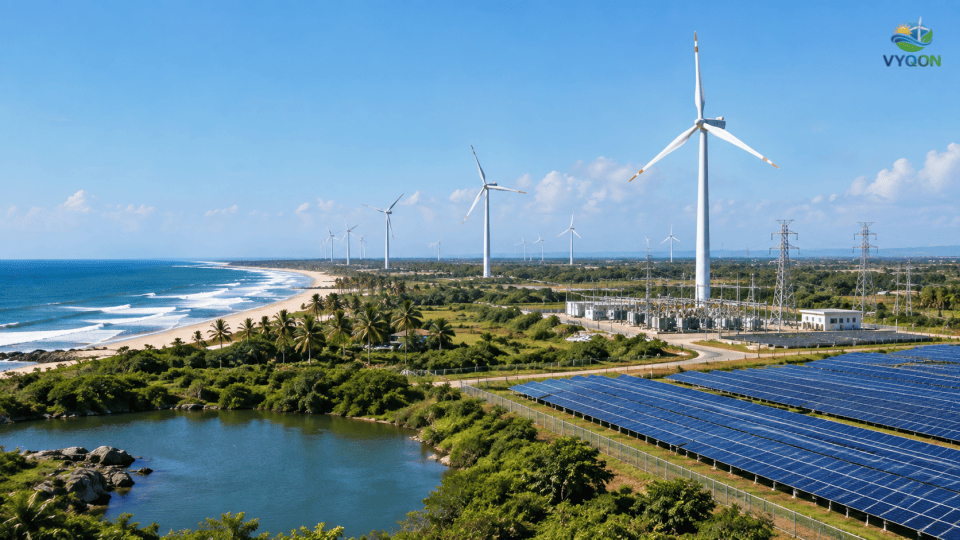
Tamil Nadu has set a new benchmark for Indian states by codifying a 50% renewable energy mandate into its 2031 planning horizon. The newly unveiled Power Roadmap seeks to align the state’s total installed capacity of 46,846 MW with a rapidly expanding green energy base that has already reached 28,348 MW. This strategic framework establishes the infrastructure requirements and storage targets necessary to transform the state’s high renewable potential into a reliable, dispatchable power supply.
Breakdown of the 2031 Roadmap Targets
The roadmap provides a structured path for decarbonizing the state’s grid while meeting rising industrial demand:
- 50% Renewable Energy Mix: A firm commitment to sourcing half of the state’s total energy requirements from renewable sources by 2031.
- Timeline to 2031: A phased commissioning schedule designed to integrate new solar, wind, and storage assets over the next six years.
- Infrastructure Scaling: Systematic upgrades to the state’s transmission and distribution networks to accommodate higher levels of variable injection.
Current Energy Profile and Capacity Statistics
Tamil Nadu remains a leader in India’s energy transition, leveraging a diverse portfolio of wind and hydro assets alongside a growing solar sector. While the state’s renewable footprint has now climbed to over 28.3 GW, the following table reflects the verified baseline as of mid-2025.
Tamil Nadu Installed Renewable Capacity (as of June 30, 2025)
| Category | Capacity (MW) |
| Wind Power | 11,830.37 |
| Solar Power | 10,570.88 |
| Large Hydro Power | 2,178.20 |
| Bio Power | 1,046.62 |
| Small Hydro Power | 123.05 |
| Total Installed RE | 25,749.12 |
The roadmap’s ambitious trajectory is set against a backdrop of significant national growth. Across India, capacity additions reached 3,068 MW in October 2025 alone, comprising 2,592 MW of solar and 476 MW of wind, signaling a favorable macro environment for Tamil Nadu’s procurement goals.
Grid Stabilization: Battery Energy Storage Systems (BESS)
To mitigate the intermittency of its vast wind and solar assets, the 2031 roadmap prioritizes standalone battery storage. The Tamil Nadu Green Energy Corporation (TNGECL) has launched a major tender for 1.5 GWh of BESS across seven critical substations.
These projects utilize a Build-Own-Operate (BOO) model and are eligible for viability gap funding through the Power System Development Fund. From an analytical perspective, the technical specifications reflect an unusually active duty cycle: each unit is designed for four hours of rated storage and approximately 1.5 cycles per day. This high level of activity is essential for managing the state’s intense daily swings in renewable output. Looking beyond this initial phase, the state has already outlined secondary plans for an additional 2.5 GWh of standalone battery storage.
Transmission Infrastructure and GEC Phase-II
Infrastructure remains the primary bottleneck for large-scale renewable integration. Under the Green Energy Corridor (GEC) Phase-II, several projects are currently being monitored to ensure Tamil Nadu remains well-integrated with the National Grid through its existing 765kV/400kV lines and +800kV HVDC systems.
- Evacuation Target: The current phase is designed to support the evacuation of 4,000 MW of renewable energy.
- Infrastructure Components: The plan includes 624 circuit kilometers (ckm) of transmission lines and a substation capacity addition of 2,200 MVA.
- Financials: The total project cost is estimated at ₹719.76 crore, supported by 33% Central Financial Assistance (CFA).
- Implementing Agency: Tamil Nadu Transmission Corporation Limited (TANTRANSCO) is executing the project through nine distinct work packages.
Specialized Energy Segments: Offshore Wind and Rooftop Solar
The 2031 roadmap identifies offshore wind and distributed solar as the next frontiers for capacity expansion.
Offshore Wind Development In accordance with the Ministry of New and Renewable Energy (MNRE) strategy to develop 37 GW of offshore wind capacity across Tamil Nadu and Gujarat by 2030, the state is advancing early-stage development. This includes a tender for 4 GW of capacity in Tamil Nadu’s seabed areas. This effort is supported by a guiding roadmap developed with ICLEI South Asia to establish the necessary socio-economic and technical ecosystems for offshore energy.
Rooftop Solar and Distributed Energy The state is intensifying support for rooftop solar to reduce the load on the primary transmission grid. While other regional benchmarks, such as Andhra Pradesh’s 1,200 MW rooftop EPC tender, illustrate the scale of current market activity, Tamil Nadu is focusing on localized EPC tenders to boost rooftop adoption among commercial and industrial consumers.
Timeline and Procedural Steps
The state is currently navigating an intensive bidding cycle to realize its short-term milestones. Key submission deadlines include:
- December 22, 2025: Bid submission for the 375 MW/1,500 MWh standalone BESS tender.
- December 26, 2025: Bid submission for the 15 MW/45 MWh TNGECL BESS tender.
The roadmap stipulates an 18-month commissioning timeline for these storage assets from the date of the award, ensuring that the first wave of stabilization infrastructure will be operational by mid-2027.
Official Sources & References
- Ministry of New and Renewable Energy (MNRE) Document: MNRE Wind Energy Overview & Offshore Wind Potential Authority: Ministry of New and Renewable Energy, Government of India
- Ministry of Statistics and Programme Implementation (MOSPI) Document: Energy Statistics India Report Authority: National Statistical Office, MOSPI, Government of India
- National Institute of Solar Energy (NISE) / Press Information Bureau (PIB) Document: State-wise Solar Energy Potential Assessment Authority: Press Information Bureau / Ministry of New and Renewable Energy, Government of India
- Press Information Bureau (PIB), Government of India Document: India’s Renewable Energy Capacity Milestones & State Progress Authority: Press Information Bureau, Government of India
- Government of Tamil Nadu Document: Department of Environment & Climate Change State Report Authority: Government of Tamil Nadu
- ICLEI South Asia & MNRE Document: Development of Roadmap for Offshore Wind in Tamil Nadu Authority: ICLEI South Asia / Ministry of New and Renewable Energy (MNRE), Govt of India
Leave a Comment